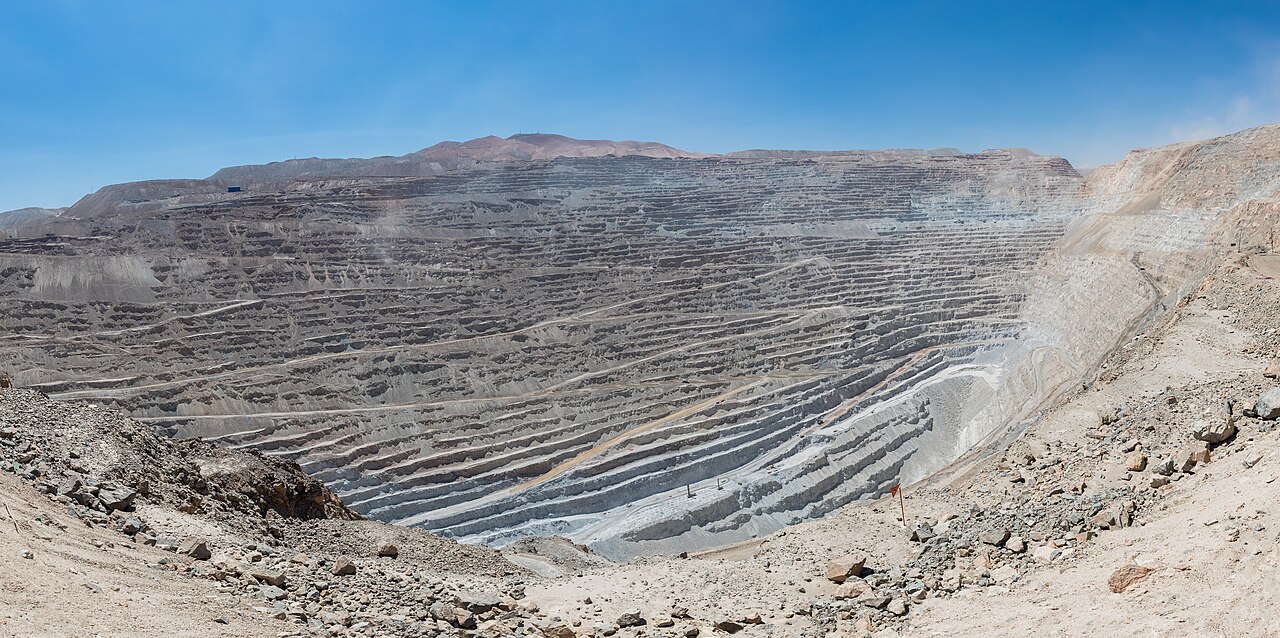
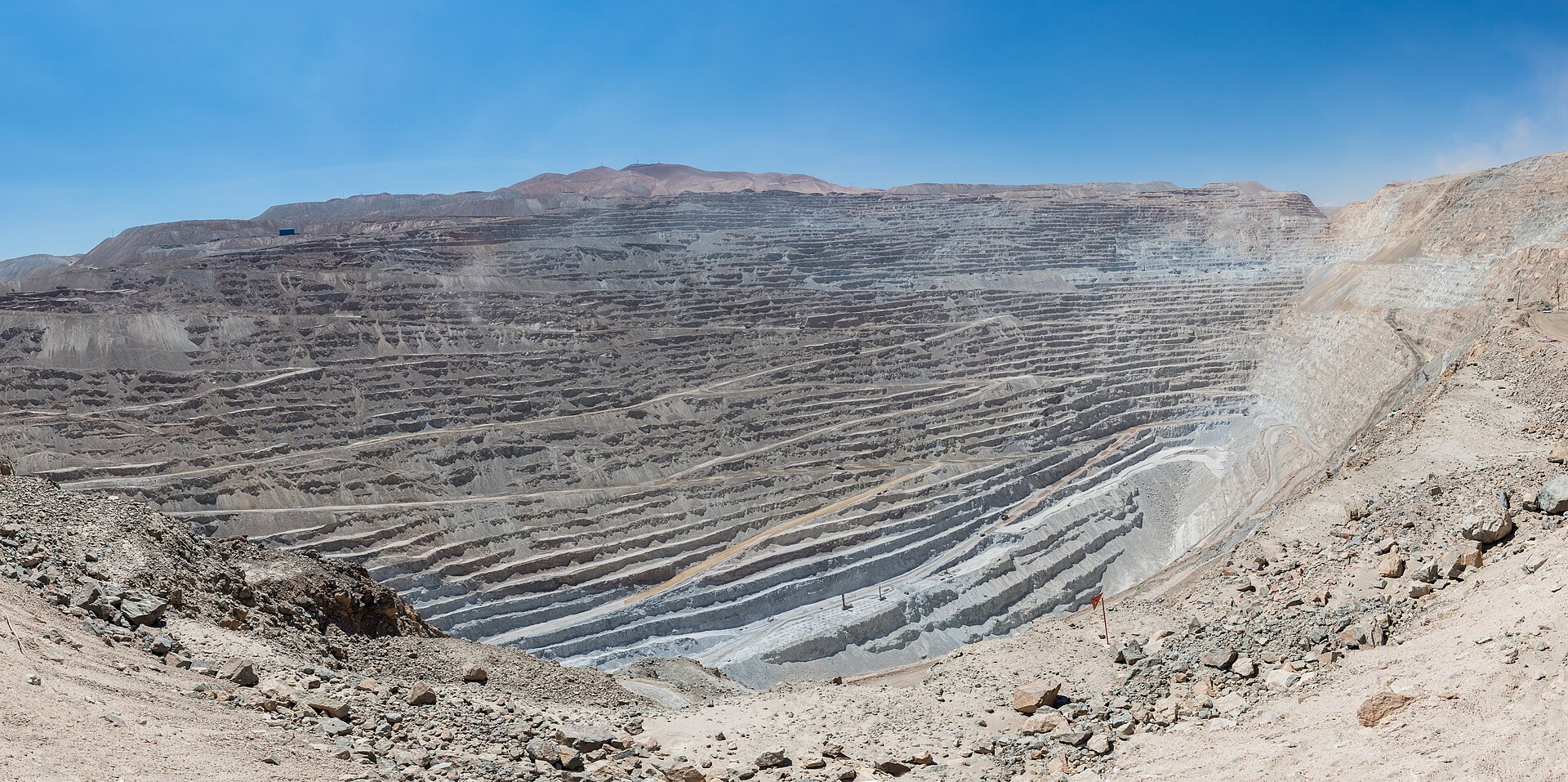
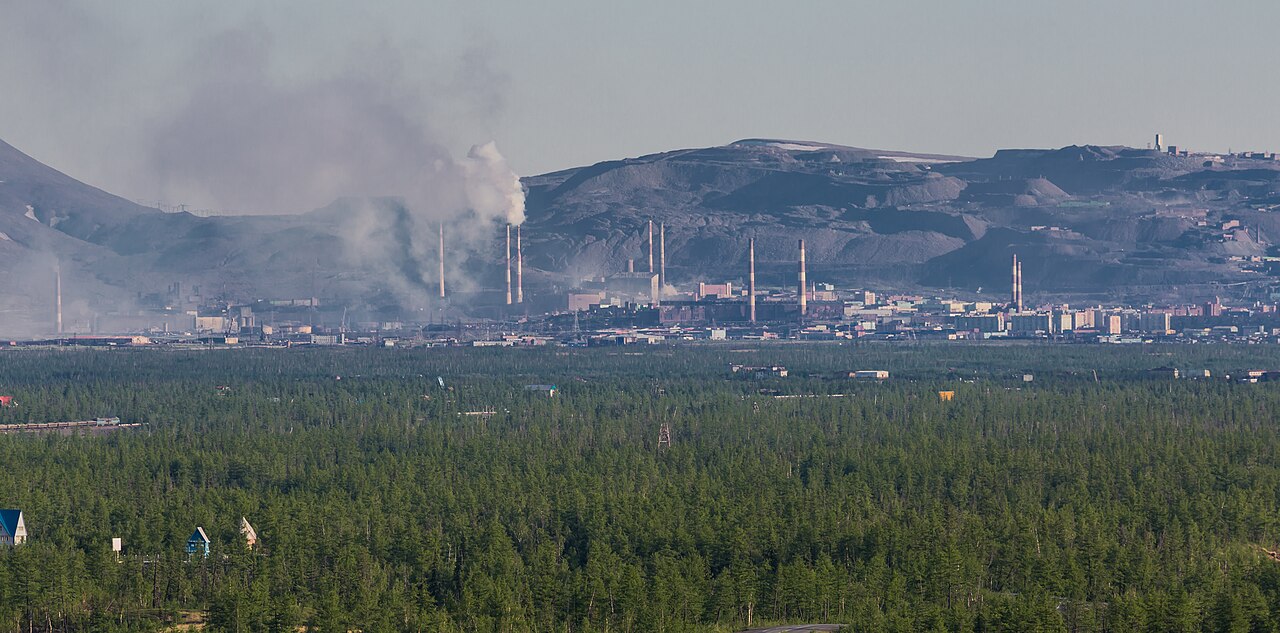
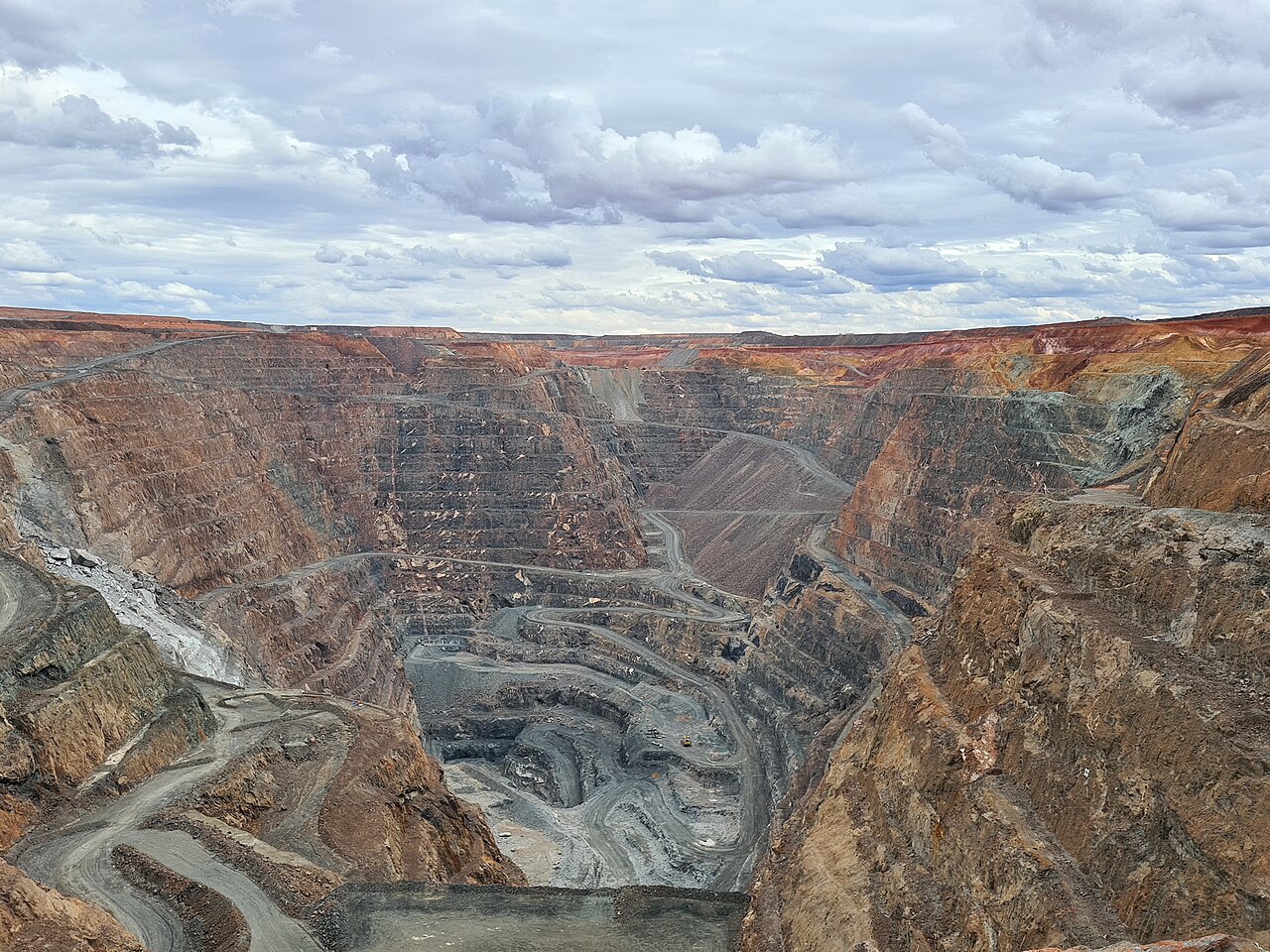
×Chuquicamata, Chile, 2016. Photograph by Diego Delso, CC BY-SA 4.0.
The briefing
Energy, minerals, and the narrow places between them are one subject. A full well or a busy pit can still leave the world short if a strait, a canal, or a chemical plant stops.
Figures here are rounded and dated: the EIA for Hormuz in 2023, the USGS for mine totals, the IEA for oil and coal. This is not a broker and not a suggestion to buy or sell.
About a fifth of petroleum liquids used Hormuz in the EIA’s 2023 account.
About seven in ten mined cobalt tonnes come from the Congo.
Indonesia was about half of nickel mine output in the USGS total for 2023.
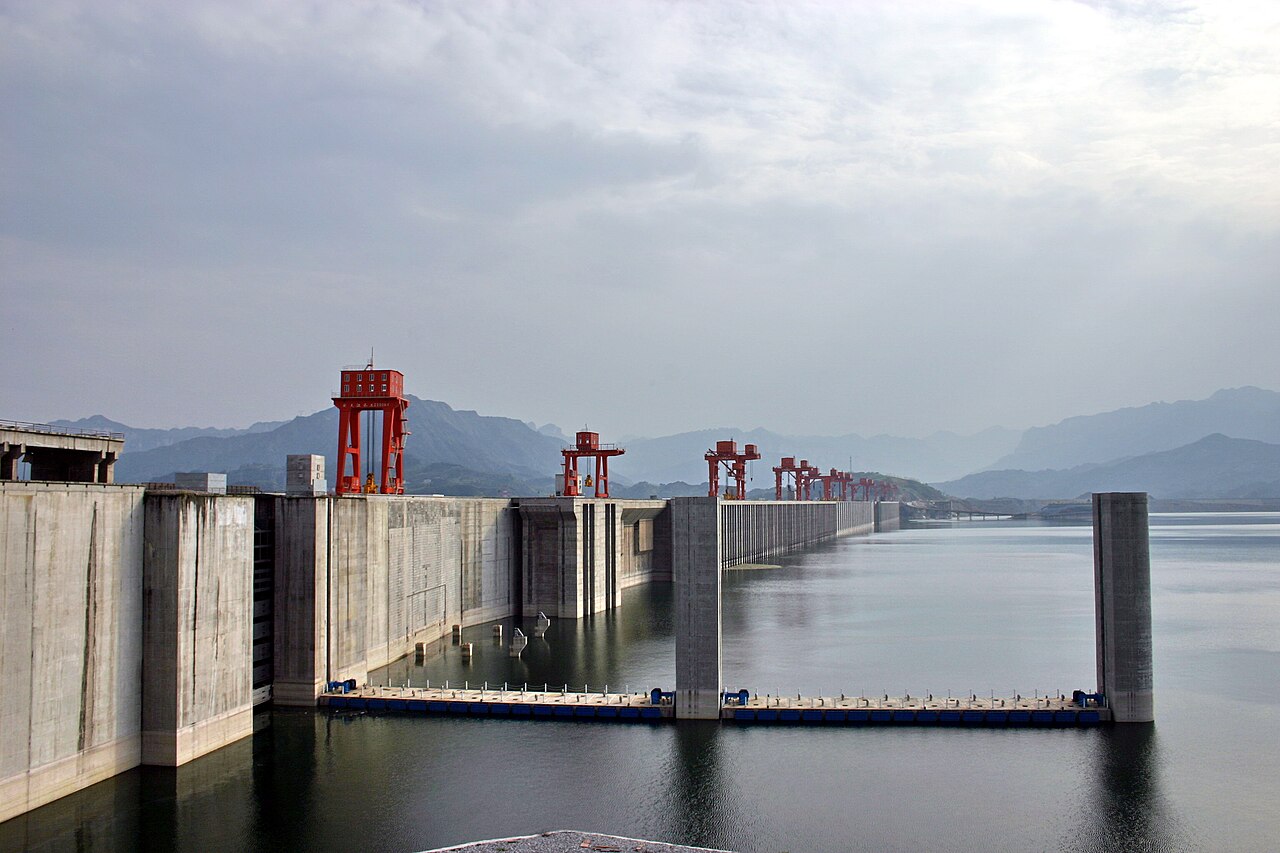
Three Gorges is 22,500 megawatts of nameplate, not a promise about the rain.
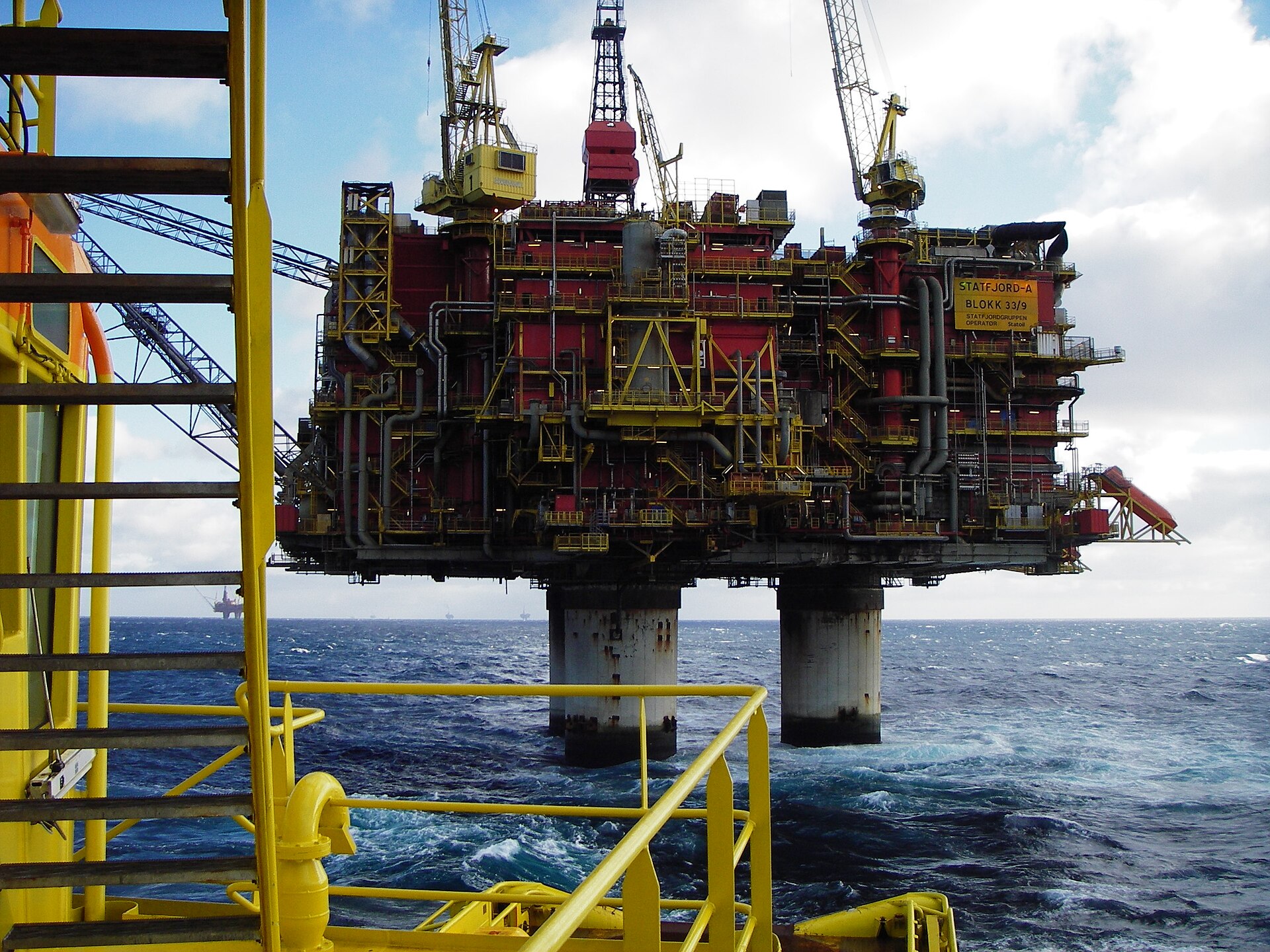
×Statfjord A. Photograph by Marcusroos, CC BY-SA 3.0.
Eight ways the world makes power
Oil, gas, coal, nuclear, water, wind, sun, and geothermal heat are not a ranking. Some can be stored. Some must be burned as they arrive. Some hide a mine inside the machine.
A barrel at the well is not diesel. Methane in a pipe is not liquefied gas. Coal for a boiler is not coal for a blast furnace.
Permian tight oil is one well at a time.
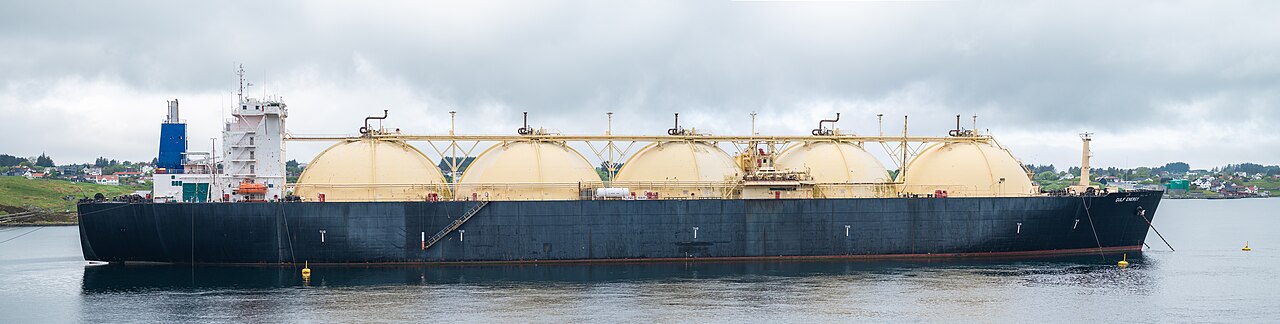
LNG is methane at about −162°C, on a ship that cannot carry crude.
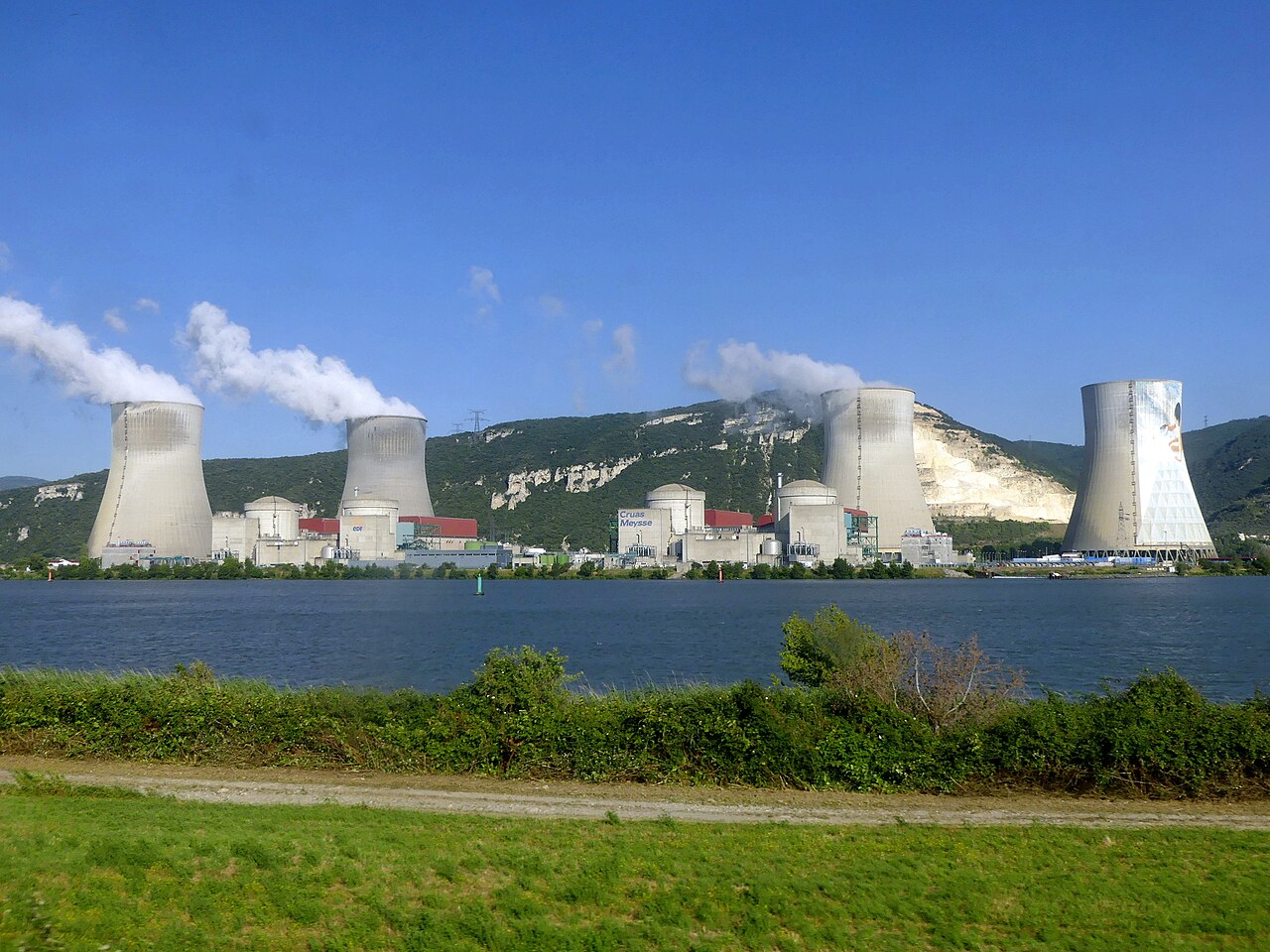
Nuclear is about a tenth of world electricity, and about two-thirds of France’s.
Wind and solar arrive when the weather says so. The machines are made of other mines.
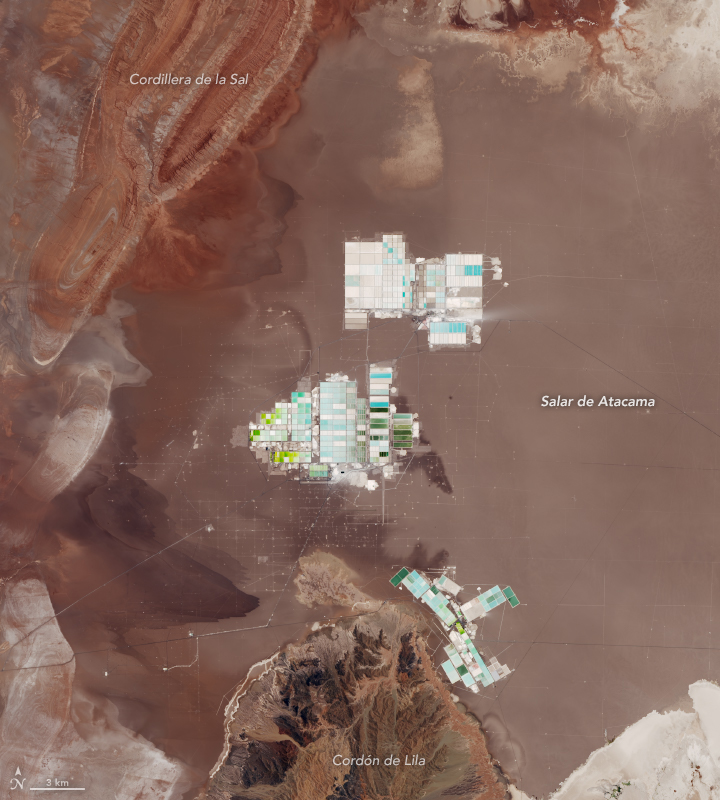
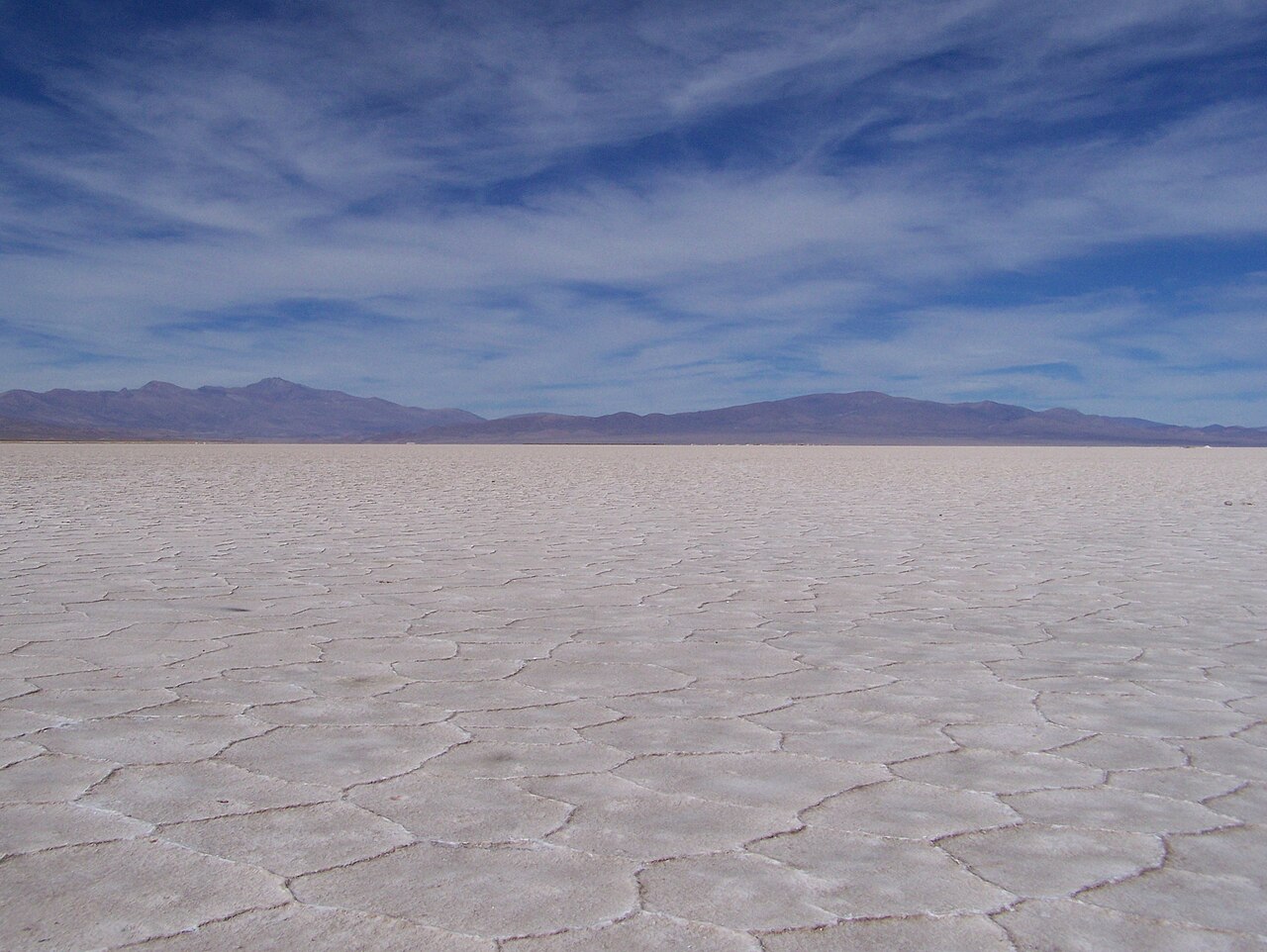
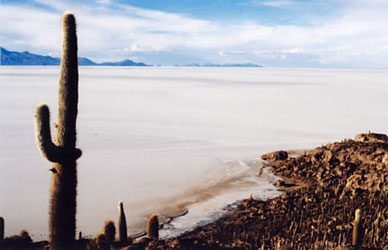
×Salar de Atacama, Landsat 8, 2018. NASA, public domain.
Materials with a bottleneck
The country that digs is often not the country that finishes. Copper, lithium, nickel, cobalt, graphite, and rare earths each have a second map: the smelter, the chemical plant, or the separation works.
A resource is not a reserve, and a white salt flat is not a supply. Uyuni is the example to keep beside that sentence.
Chile, Peru, and the Congo mine copper. China smelts a larger share than it mines.
Australia leads lithium mine output. Battery chemicals are a third map.
Cobalt refining sits far from the Congolese pits.
An electric car uses on the order of eighty kilograms of copper, against a little over twenty in a petrol car.
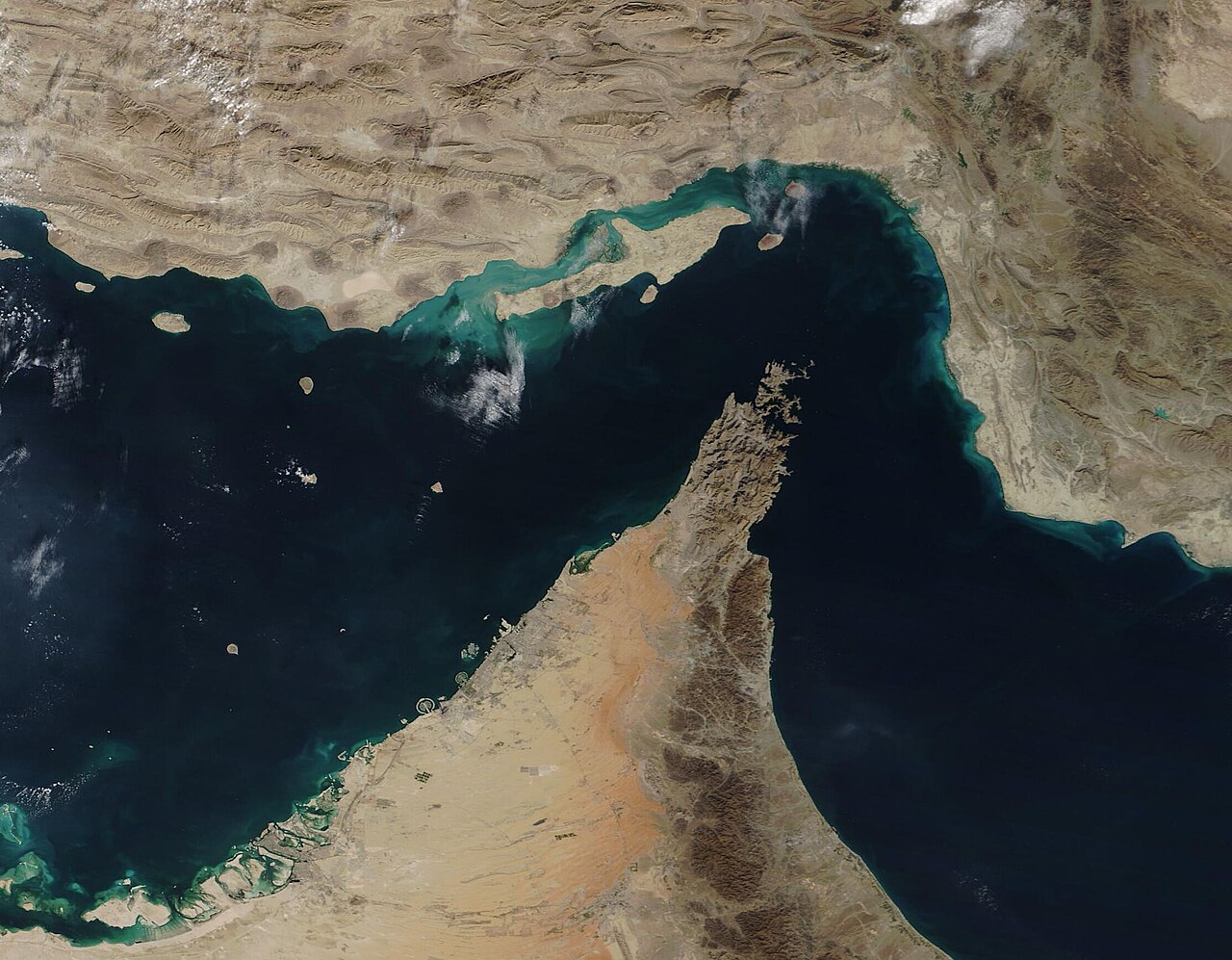
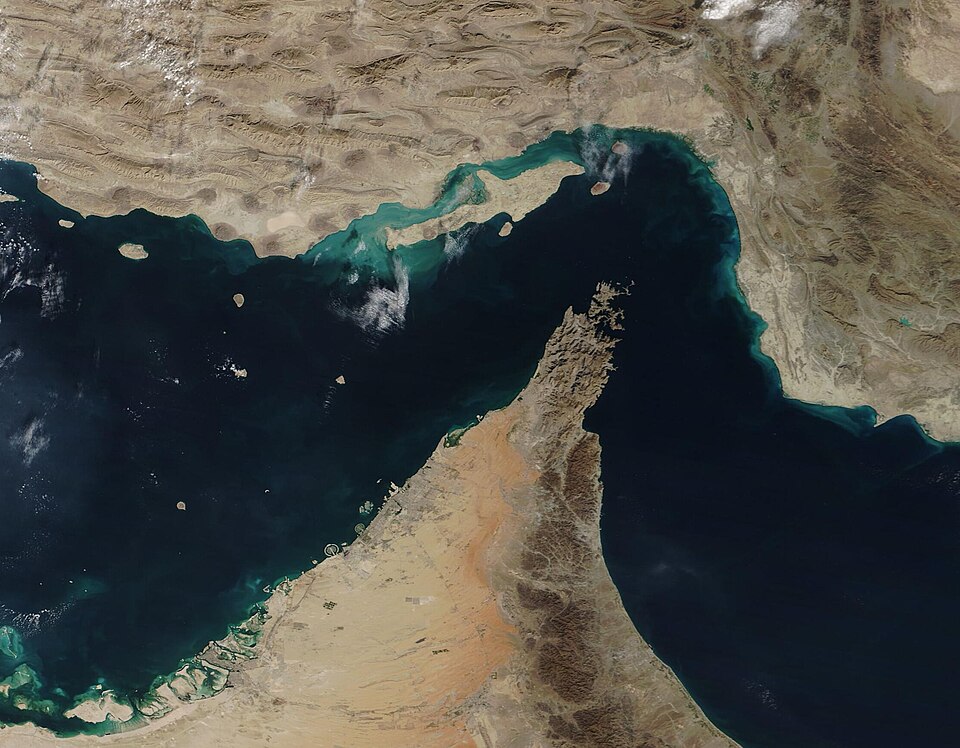
×Strait of Hormuz, MODIS, 4 December 2020. NASA, public domain.
Doors, not wells
Hormuz, Malacca, Bab el-Mandeb, Suez, Panama, the Turkish Straits, and the Cape do not produce energy. They decide whether energy already produced can arrive, and what the detour costs in days.
Spare capacity that cannot be shipped is only a fuller tank. Pipelines that avoid Hormuz exist. They are not big enough to replace the strait.
About 20.5 million barrels a day of oil and products used Hormuz in 2023.
Malacca is where Gulf oil becomes an Asian fact.
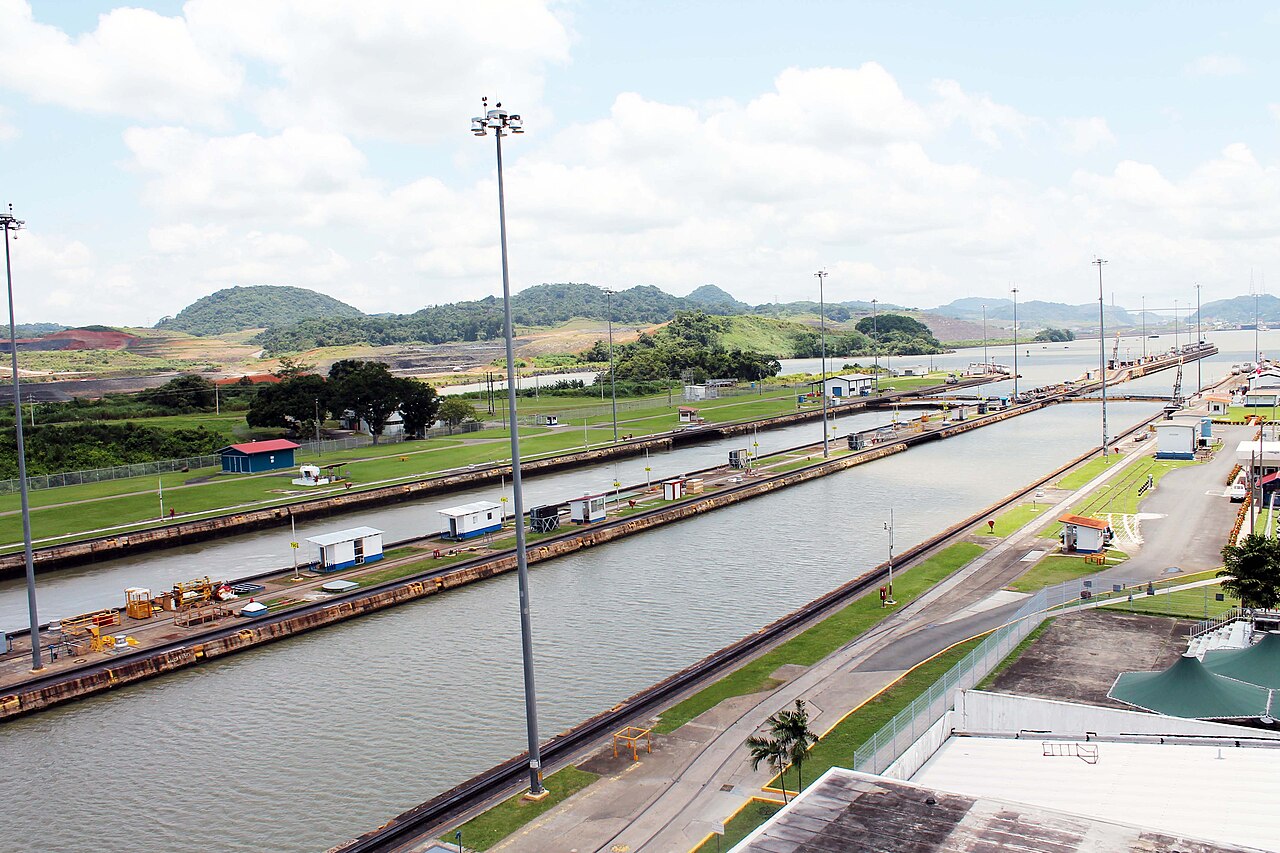
Panama’s limit is a lake filled by rain.
Capesize iron-ore ships were already going around the Cape.
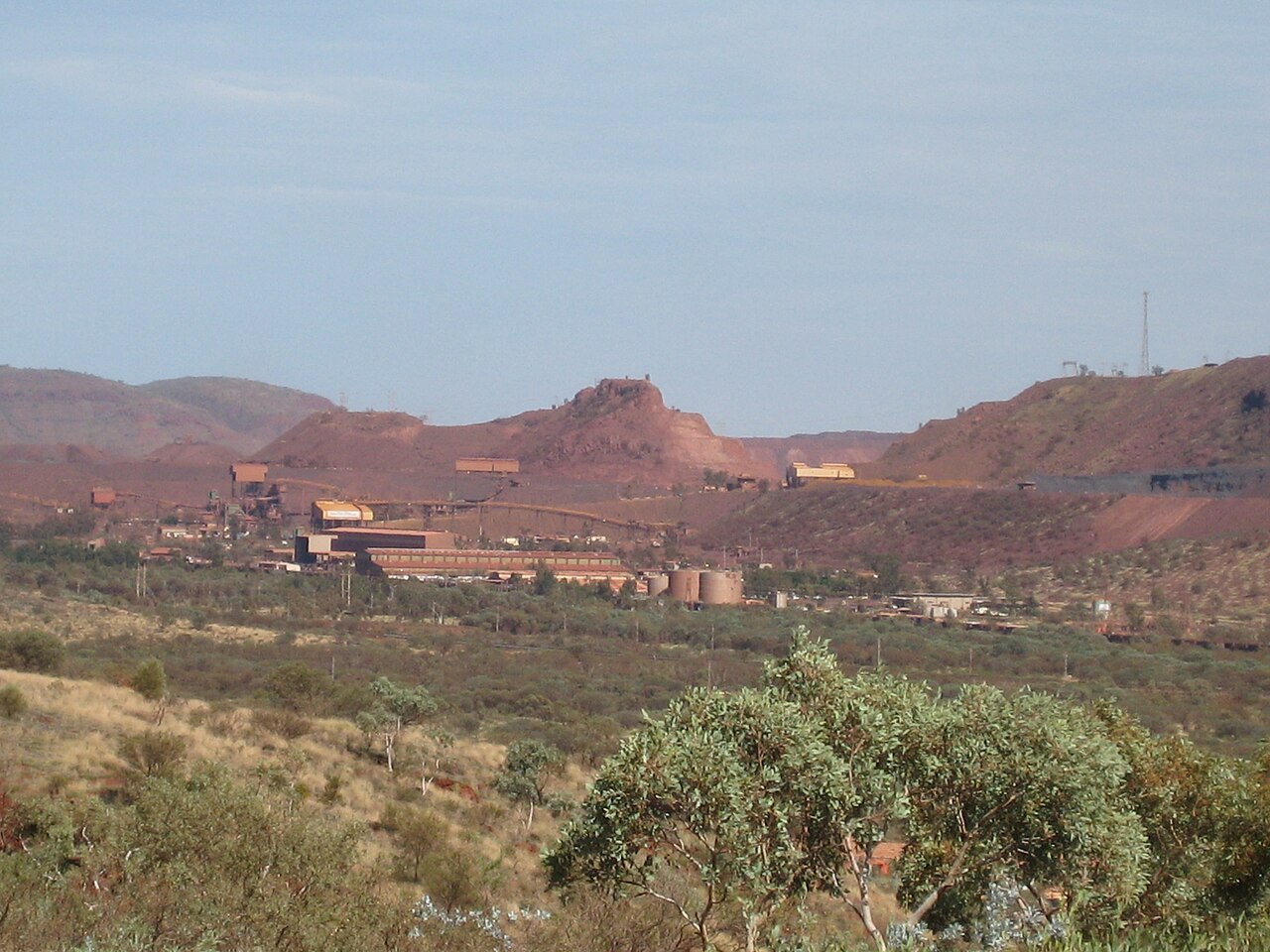
×Mount Whaleback, Newman. Photograph by Calistemon, CC BY-SA 3.0.
Places worth knowing by name
Each plate is a system: rock, railway, port, and buyer. The Pilbara, the Permian, the Gulf, the lithium triangle, and the copper pits are not country profiles.
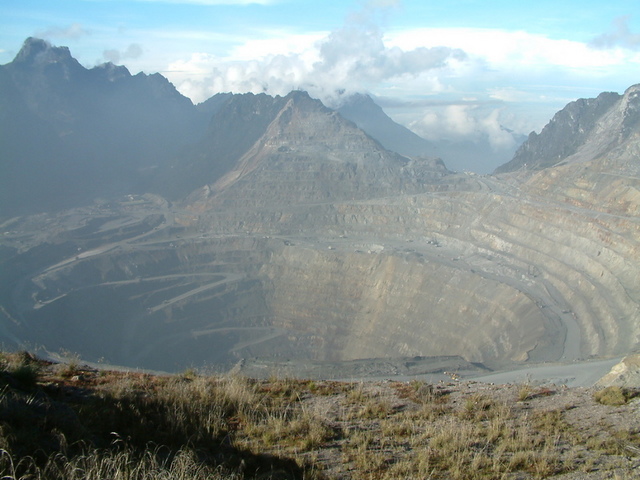
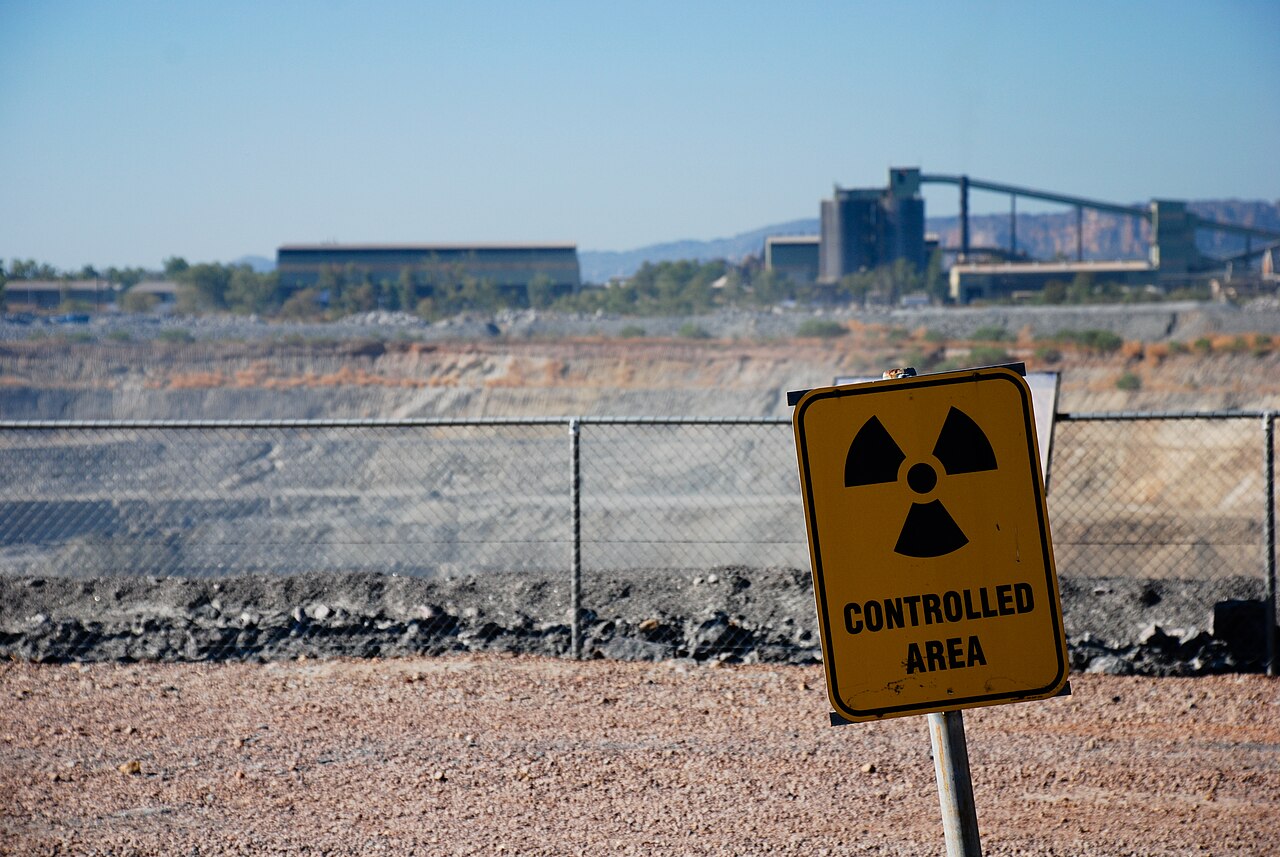
A photograph stays the place it is. Grasberg is copper and gold in Papua, not Sulawesi nickel. Ranger stopped mining in 2021. Norilsk is the Arctic, not Indonesia.
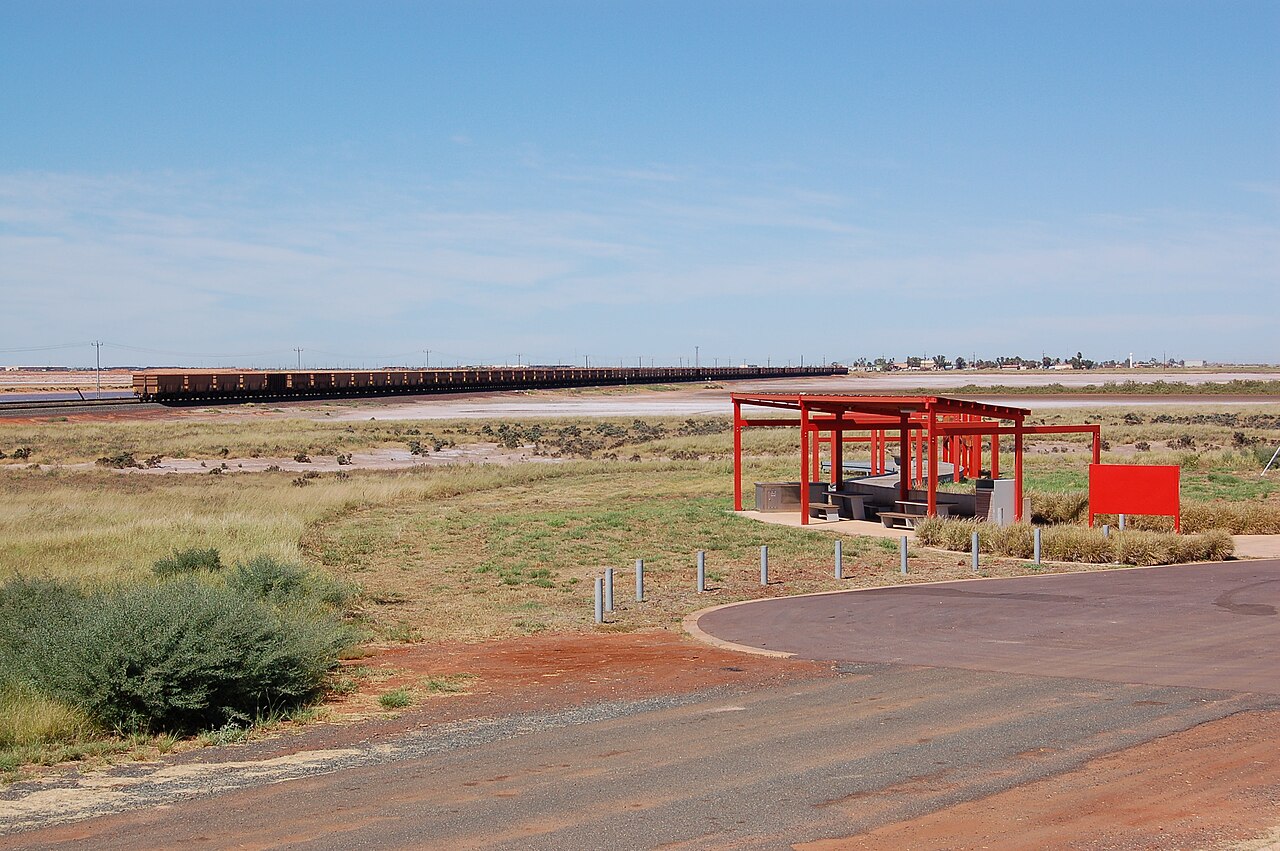
Port Hedland moves iron ore in trains measured in kilometres.
The Atacama ponds are brine, not a battery salt.
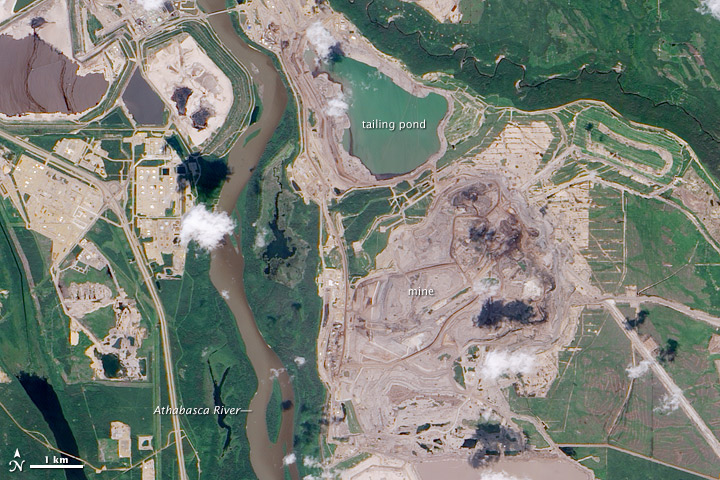
The Athabasca oil sands are a factory laid over a forest.
Salinas Grandes is the postcard. Other salars are the projects.
×Copper cathode. Photograph by Xstrata Technology, CC BY-SA 3.0.
Follow one cathode
A large copper pit often runs at under one percent metal. Most of the rock stays in a tailings dam. What ships is a concentrate. What a factory wants is a cathode, after a smelter.
Lithium forks at the first step: hard-rock spodumene in Australia, brine in the Andes, then a chemical plant that is often somewhere else.
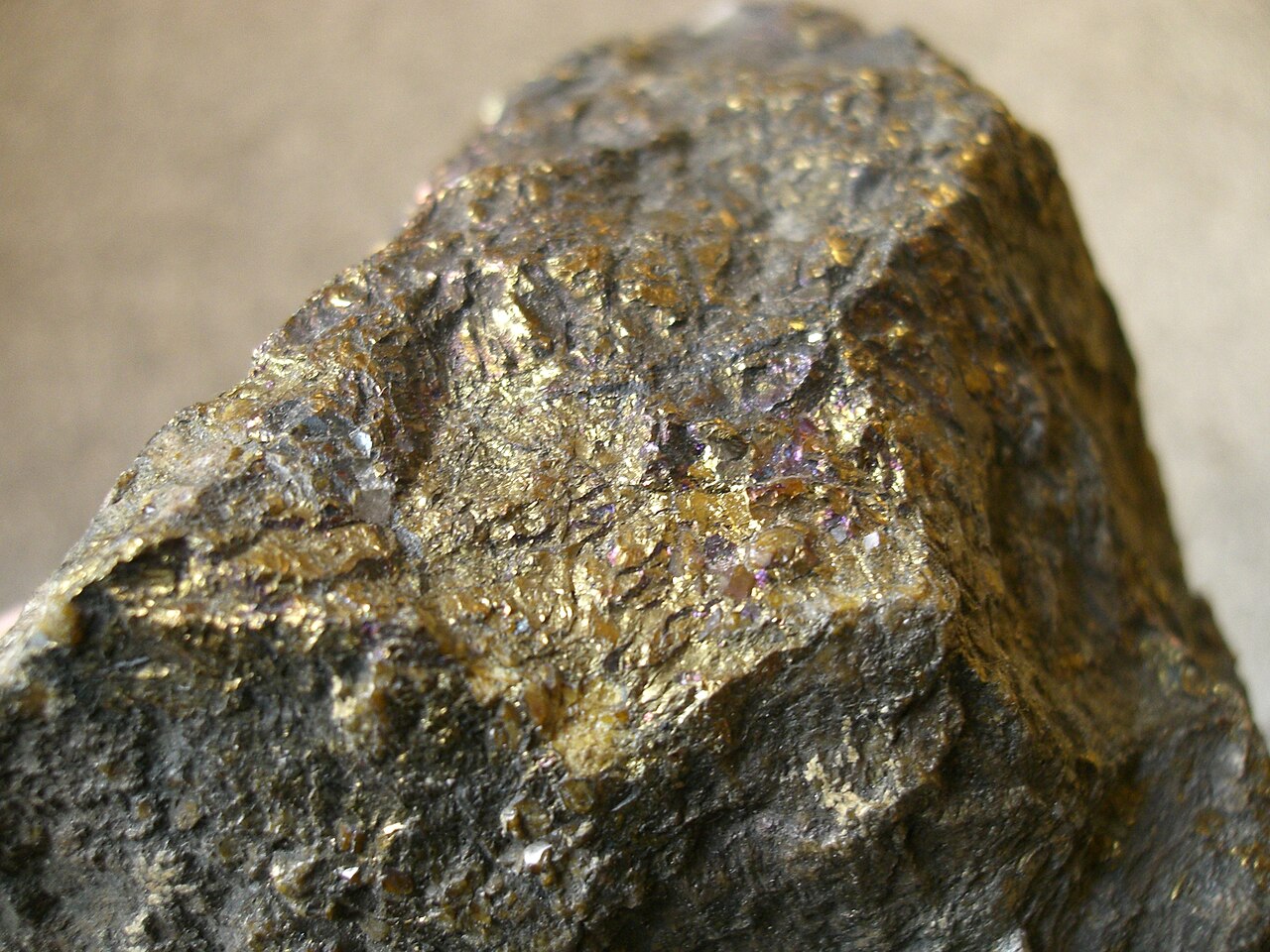
Chalcopyrite in a specimen is not a tonne in the trade.
Spodumene is not battery hydroxide.
A transformer queue can outlast a mine announcement.
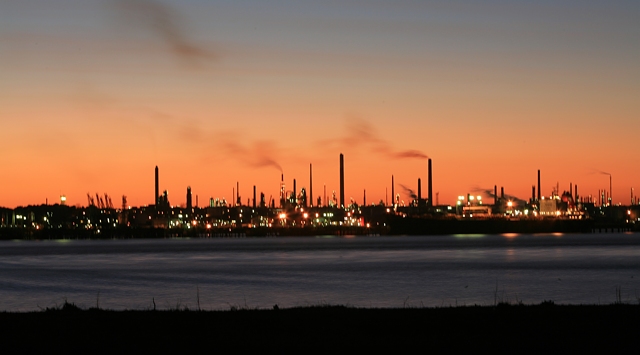
×Fawley, Southampton Water. Photograph by Peter Facey, CC BY-SA 2.0.
Field notes for a longer sitting
Three notes slow the reader down. A reserve is not a plan. The plant you cannot see is often the chokepoint. Electricity is a mineral story before it is a climate story.
Geology publishes a resource. A company publishes a reserve only after price, permits, water, and a way to move the rock are real.
Uyuni is a famous resource and, so far, a small industry.
A refinery has a diet. The wrong crude is not a substitute.
New power lines spend copper, aluminium, and electrical steel first.
A date belongs on every photograph and every tonne.
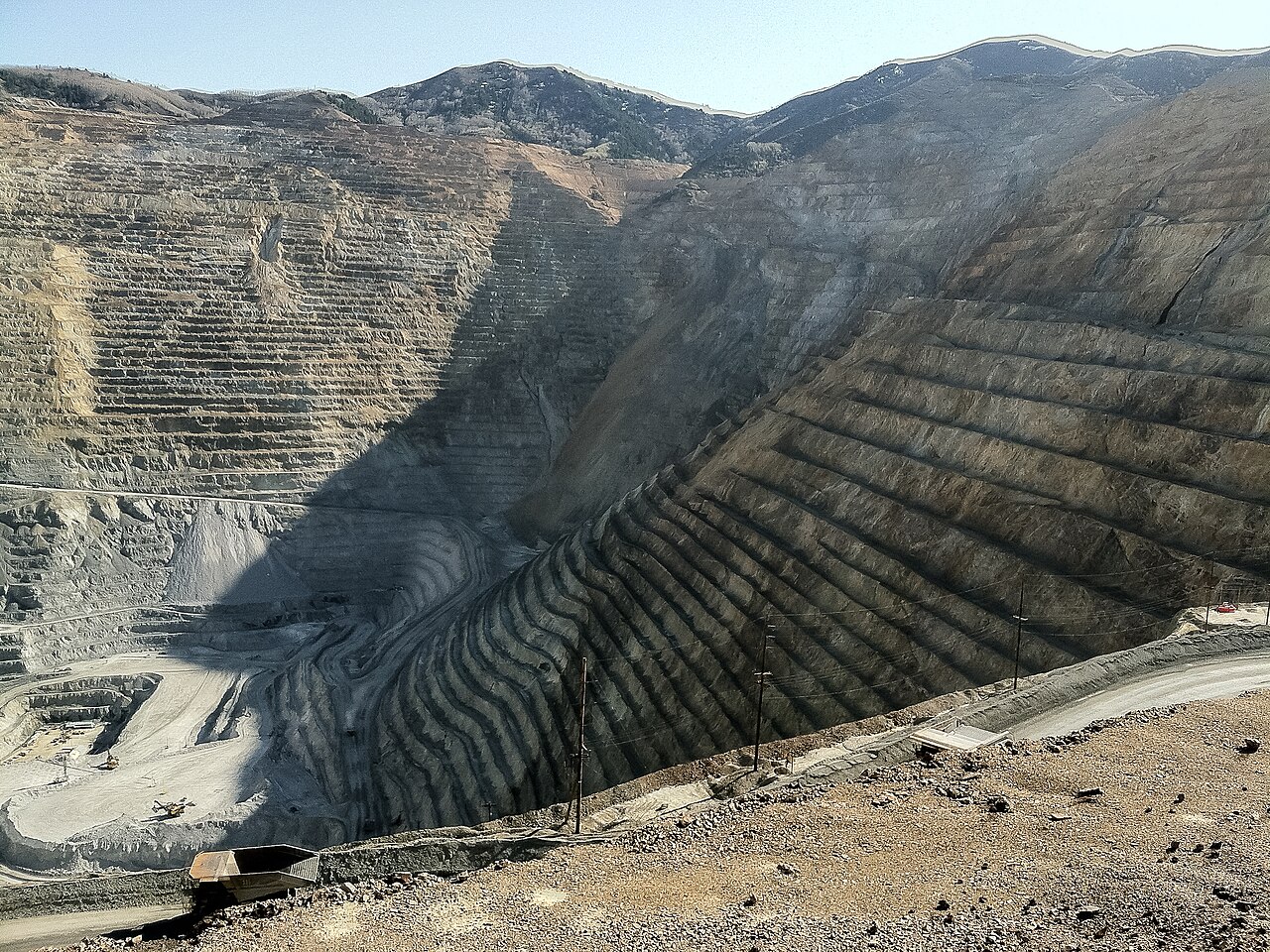
×Bingham Canyon, Utah, 2012. Photograph by David Ratledge, CC BY 4.0.
How a number is allowed onto the page
Strata is a public reading desk. It is not a company, a fund, or a ministry. It does not tell you what to buy, and it does not invent a statistic to fill a gap.
Every picture is a real photograph or a real satellite image. The caption names the maker and the license. If a mine has stopped, the caption says so.
Sources used most often: EIA, IEA, USGS, World Nuclear Association.
Rounded numbers are a choice. A false precise number is worse.
The glossary keeps reserve, concentrate, LNG, and nameplate apart.
The photograph register lists every picture on the site.
Chuquicamata copper mine, above Calama, Chile, 2016. Photograph by Diego Delso, CC BY-SA 4.0. About 22.3°S, 68.9°W.
Issue 01 · a desk for the whole system
The ore is only the start of the map.
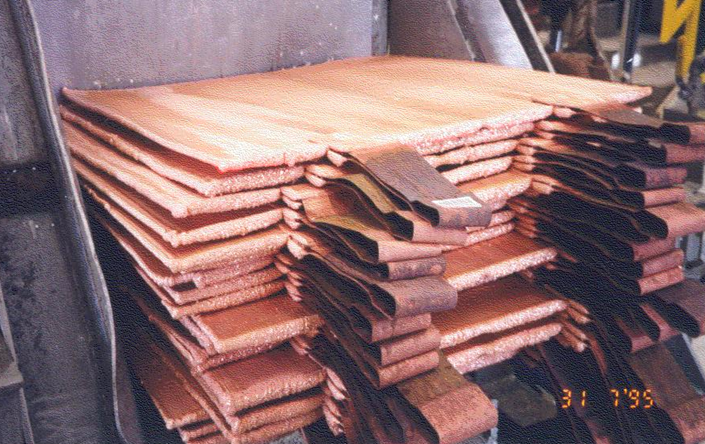
Copper cathode, the sheet that leaves the smelter. Photograph by Xstrata Technology, CC BY-SA 3.0. The pit in the background is Chuquicamata. This picture is the metal after it.
Energy, minerals, and the narrow places between them are one subject. A well can be full, a pit can be busy, and the world can still run short if a strait, a canal, or a chemical plant stops.
Stay with it
A seven-minute route
Read these five stops in order. They are written to be finished in one sitting, and each page continues well past the stop if you want the longer version.
A barrel of oil is counted at the well. A tonne of copper is counted at the mine. The fact that decides a bad month usually sits between those two numbers: the pipe, the strait, the lock, the refinery, the chemical plant that turns a concentrate into something a factory can actually use.
In its account of 2023, the U.S. Energy Information Administration estimated that about 20.5 million barrels a day of oil and petroleum products moved through the Strait of Hormuz. That was roughly a fifth of world petroleum liquids consumption. The strait produces nothing. It is a doorway. Saudi Arabia, Iraq, Kuwait, and the United Arab Emirates can have full tanks onshore and still be unable to reach the buyers waiting on the other side. A large share of Qatar’s liquefied natural gas uses the same door.
The strategic map is often one step downstream of the geology.
Minerals repeat the pattern, one step further from the rock. The Democratic Republic of the Congo accounts for about seven in ten tonnes of mined cobalt in recent totals from the U.S. Geological Survey. Most of that cobalt is not turned into chemical product in the Congo. It leaves as an intermediate and is refined elsewhere, above all in China. Australia mines more lithium than any other country, much of it hard-rock spodumene from Western Australia. A great deal of the conversion into battery-grade carbonate and hydroxide happens in Chinese plants. Chile’s Atacama and the salt flats of Argentina are extraordinary places. They are not, by themselves, a battery industry.
This desk reads energy, minerals, and routes as one system. A wind turbine is a steel, copper, and rare-earth object before it is a climate policy. A transmission line is a copper and aluminium object before it is a grid plan. An electric car is a lithium, nickel, graphite, copper, and manganese object before it is a consumer product. The countries that dig, the countries that refine, and the narrow waters in between are the subject of the pages that follow.
The reading is for a general audience that wants the names of places, the order of magnitude, and the constraint that would matter if something stopped. Strata is not a broker, a ministry, or a letter about what to buy. Figures are tied to the public source that publishes them — the EIA, the International Energy Agency, the USGS Mineral Commodity Summaries, the World Nuclear Association, and national geological surveys — and they are dated, because this map moves. Rounded numbers are a choice. A false precise number would be a worse one.
~1/5Share of world petroleum liquids that passed the Strait of Hormuz in the EIA’s 2023 account.Click to open · EIA, flows in 2023
About 20.5 million barrels a day of oil and products used the strait in that account. The water produces nothing. Saudi Arabia, Iraq, Kuwait, and the United Arab Emirates can be full onshore and still unable to reach a buyer. A large share of Qatar’s liquefied natural gas uses the same door.
Pipelines that avoid Hormuz exist. They are not big enough to replace the strait. Spare barrels that cannot be loaded are only a fuller tank.
~7/10Share of mined cobalt coming from the Democratic Republic of the Congo.Click to open · USGS, recent mine totals
Most of that cobalt is dug beside copper on the Copperbelt. It usually leaves as an intermediate, not as a battery chemical. The refining step sits far from the pit, above all in China.
A mine total is not a cathode. The second map, the plant, is the one that fails quietly.
~1/2Share of world nickel mine output from Indonesia in the USGS total for 2023.Click to open · USGS Mineral Commodity Summaries
Indonesia’s rules on ore exports pulled smelting and chemical plants onto the islands. About half of world mine output in that 2023 total is not the same thing as a battery-grade chemical. Nickel pig iron for stainless steel and nickel sulphate for a cathode are different products.
Norilsk, in the Arctic, is a different nickel, copper, and palladium system. It is not an Indonesian mine, and no photograph of it should be labeled as one.
22.5 GWNameplate capacity of the Three Gorges Dam, the largest power station yet built.Click to open · installed capacity, not a year’s weather
22,500 megawatts is the size of the machines, not a promise about the rain. Itaipu, shared by Brazil and Paraguay, is 14,000 megawatts of nameplate. Hydropower is on the order of fifteen percent of world electricity. A dry year shows up as idle smelters, because aluminium was built beside cheap water on purpose.
You cannot put the watershed on a ship. The dam in the photograph is Sandouping, April 2007.
Click a photograph. The note opens on this page: what can be stored, what must be burned as it arrives, and which machine hides a mine. The full chapter is a second click.
01 · Liquids · clickOil, and the spare barrel
A barrel at the well is not diesel.
World oil demand in the mid-2020s sits a little above 100 million barrels a day, in the International Energy Agency’s market reports. That number is already gasoline, diesel, jet fuel, and chemical feedstock. It still has to be refined. Light oil from the Permian and heavy bitumen from Alberta do not swap places in a refinery in a week.
The United States has been the largest producer in recent years, one tight-oil well at a time. Saudi Arabia still matters most in a crisis, because it holds most of the spare capacity: oil that can be raised quickly, not oil that needs a new project. Spare oil that cannot pass Hormuz is only a fuller tank.
About 20.5 million barrels a day used Hormuz in the EIA’s 2023 account, roughly a fifth of petroleum liquids.
Statfjord A is a North Sea platform. Norway’s larger export to Europe is pipeline gas, not this one concrete leg.
Pipeline gas is a continuous flow tied to one map. Liquefied natural gas is methane cooled to about −162°C and put on a ship that cannot carry crude. The equipment does not swap. The United States was the largest LNG exporter in 2023. Qatar’s North Field and the plants of northwest Australia are the other gates people name.
A liquefaction train takes years. A floating import terminal can be hired faster than it can be built. The strategic object is the plant that makes the liquid, not the methane still in the ground. The ship in the photograph is Gulf Energy, Norway, 2023. Norway’s main gas export is still by pipeline.
Europe learned the split in 2022, when Russian pipeline gas fell and cargoes plus Norwegian pipes filled part of the gap.
03 · Coal · clickStill a third of the world’s electricity
Two coals, two jobs.
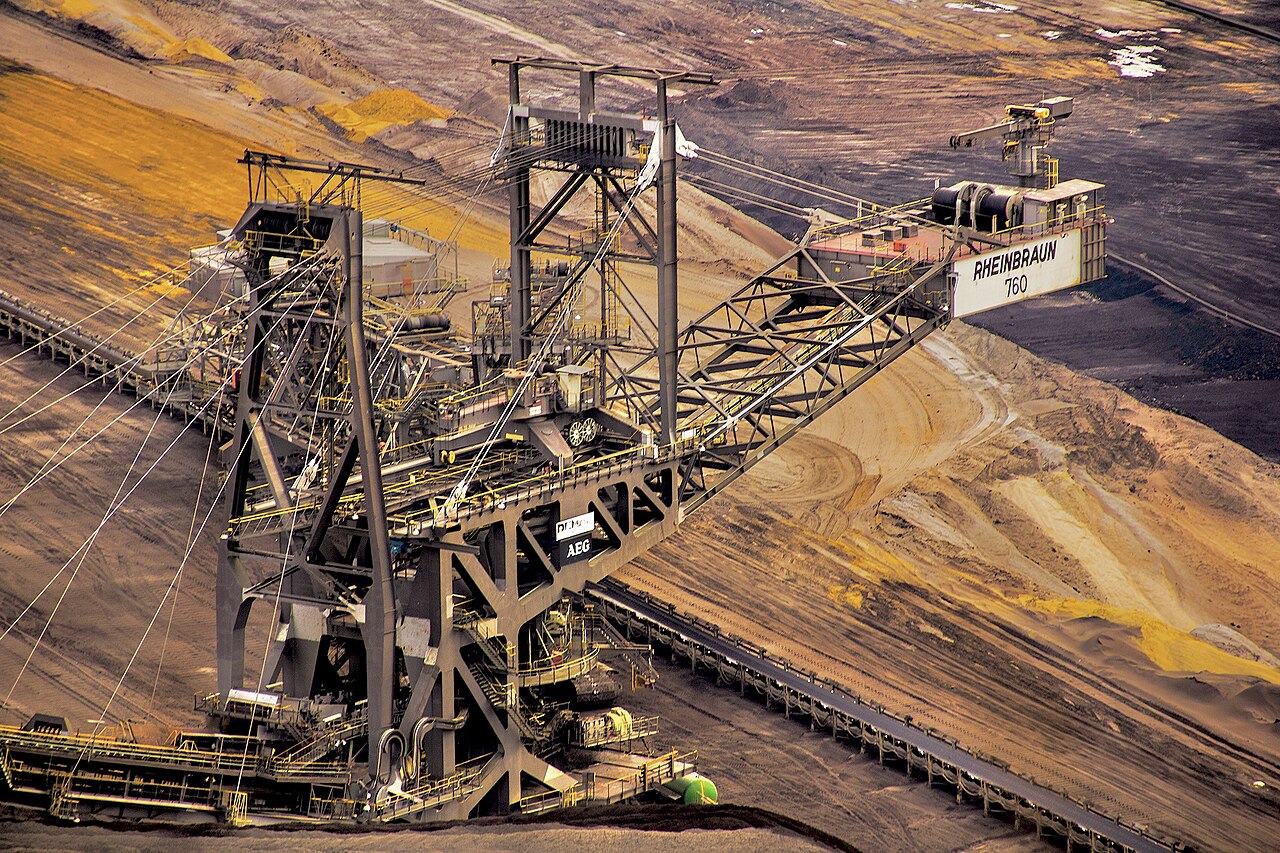
Thermal coal still makes about a third of world electricity. Metallurgical coal is the carbon inside most blast furnaces. Closing a power station does not retire the second. China burns more than half of the world’s coal. Indonesia and Australia dominate much of the seaborne thermal trade.
Garzweiler, in the photograph, is German lignite: too low in energy to ship across an ocean, strategic only to the station next door. It is not a picture of Australian export coal.
A steel system built on blast furnaces does not treat met coal as a power-station question.
04 · Nuclear · clickHeat from a small mass of metal
The cooling tower is the last building.
Nuclear supplies around a tenth of world electricity, and about two-thirds of France’s. Cruas is one station in that French fleet, beside a river that has to take the heat. It is not a picture of every reactor, and it is not Olkiluoto 3.
Kazakhstan leads uranium mine output, mostly by dissolving the ore underground. Canada’s Athabasca ores are far richer per tonne. Yellowcake, the yellow powder, is an intermediate. It is not fuel, and it is not a weapon. Enrichment is a much shorter list of countries than the mines.
Ranger, in Australia, stopped mining in 2021. A photograph of it is not current supply.
A reactor burns on a campaign, not a daily delivery.
Three Gorges is 22,500 megawatts of nameplate at Sandouping. The photograph people use is often Dan Kamminga’s, April 2007. Nameplate is the size of the machines. A dry year is a different number. Itaipu is 14,000 megawatts, shared by Brazil and Paraguay.
Hydropower is on the order of fifteen percent of world electricity. Aluminium smelters sit beside cheap hydro on purpose, so a dry year in Sichuan, Brazil, or on the Zambezi shows up as idle pots. The river stays where it is.
A dam is not a battery you can move to another continent.
The locks beside Three Gorges are a transport fact as well as a power fact.
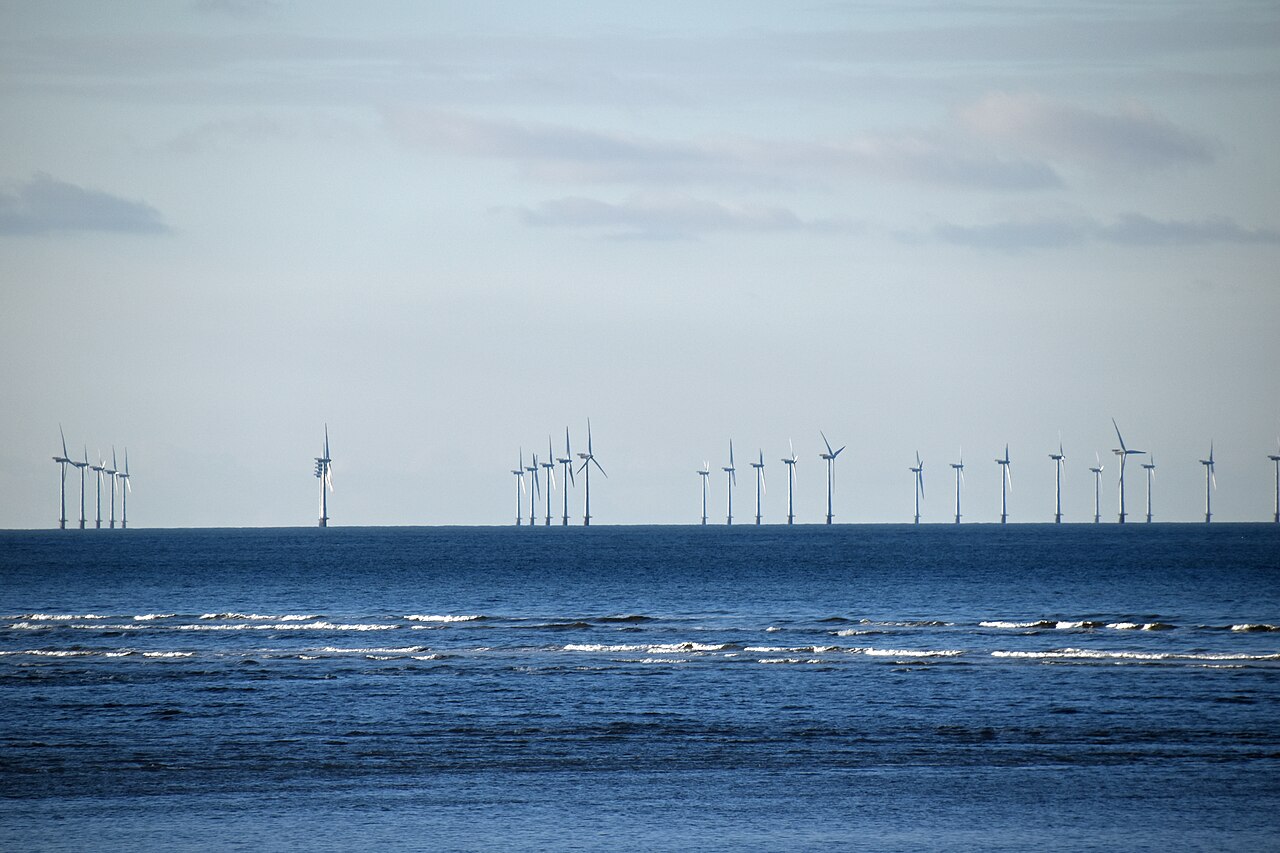
Horns Rev 1 was 160 megawatts, commissioned in 2002. Farms now planned for the North Sea are counted in gigawatts. The wind itself is not a stock. A calm week is not solved by a fuller warehouse of wind.
The machine is a mine before it is a climate policy: steel, concrete, copper, and often a rare-earth magnet. Cables, installation ships, and the line to the city are the pieces that run out first.
Storage, hydro that can wait, and a wide grid decide whether a gust becomes useful power.
The photograph is the early Danish farm, not a gigawatt project.
07 · Sun · clickMirrors, and the larger story in glass
The famous picture is the smaller technology.
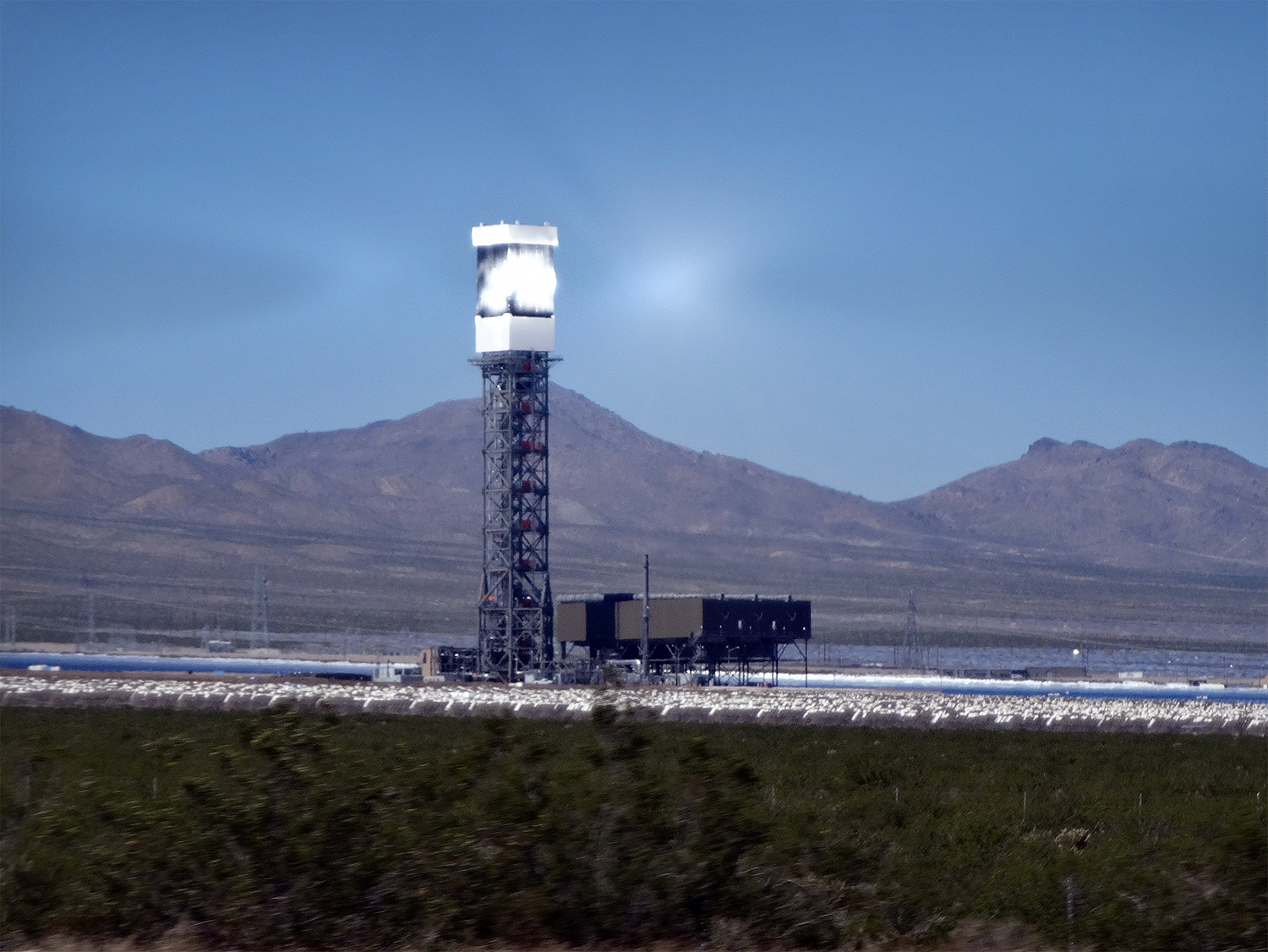
Ivanpah is a concentrating tower: mirrors heating a receiver. Almost all new solar capacity is photovoltaic glass, not towers. Polysilicon, wafers, cells, and modules are heavily concentrated in Chinese plants. The power arrives at noon and leaves at dusk.
The evening ramp is a mineral story: batteries, wires, and plants that can change output. A field of panels is not a power system until the substation exists.
Do not describe Ivanpah as the way most new solar is built.
The factories, not the sunlight, are the concentrated step.
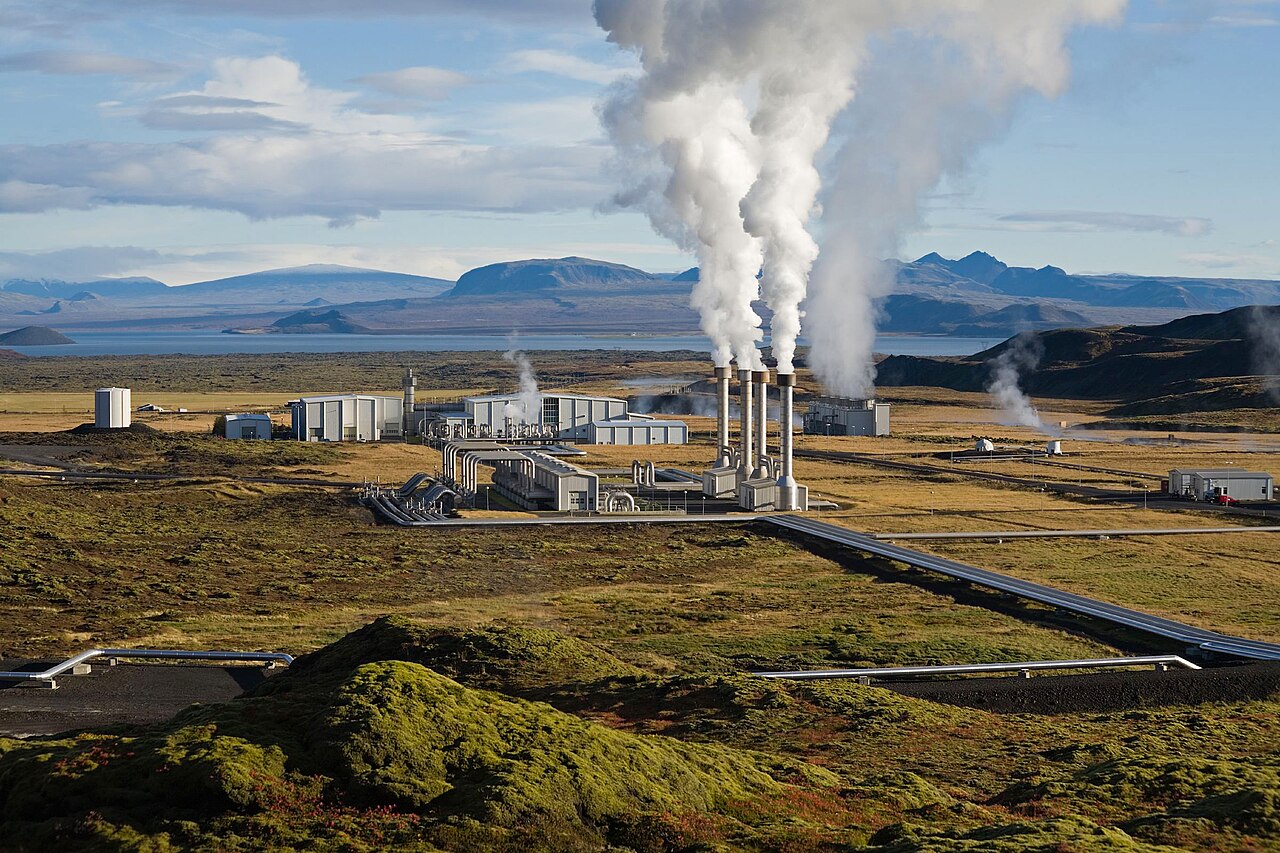
Nesjavellir serves electricity and heat in Iceland, where almost all power is hydro and geothermal. Hellisheiði is the other plant people pair with it. Kenya’s Olkaria is the other national-scale field worth knowing by name.
The heat does not travel. Geothermal never becomes someone else’s strait. It only fails locally: the well, the pipe, the plant beside the steam.
A postcard of Iceland is not a plan for a country without the reservoir.
District heat and electricity are both on the pipes. They are not the same product.
Click a row. The note opens underneath it, on this page. The filter still sorts the list. The longer entry is a second click.
CopperWire · motors · gridChile, Peru, and the Congo mine it. China smelts a larger share than it mines. An electric car uses several times more copper than a petrol car.Click to open
A large copper pit often runs at under one percent metal. Most of the rock stays in a tailings dam. What ships is a concentrate. What a factory wants is a cathode, after a smelter. An electric car uses on the order of eighty kilograms of copper, against a little over twenty in a petrol car.
Chuquicamata, Bingham Canyon, and the Copperbelt are one trade seen from three rims. The photograph of a cathode is refined metal, not ore.
LithiumBrine · spodumeneAustralia leads mine output. The Andes hold the famous brines. Battery chemicals are a third map, drawn mostly through Chinese conversion plants.Click to open
Hard-rock spodumene in Western Australia and brine in the Andes are not the same first step. Neither is battery hydroxide. The chemical plant is often in a third country. The Atacama ponds in the satellite picture are evaporation, not a battery salt.
Salar de Uyuni is a famous resource and, so far, a small industry. Salinas Grandes is the postcard. Other salars are the projects. A white flat is not a supply.
NickelStainless · batteriesIndonesia’s ore-export rules pulled the midstream onto the islands. About half of world mine output in the 2023 USGS total.Click to open
About half of world nickel mine output in the USGS total for 2023 came from Indonesia. Nickel pig iron for a stainless mill is not nickel sulphate for a battery cathode. The ore moved. The specification is a plant.
Grasberg, in Papua, is copper and gold. It is not Sulawesi nickel. Norilsk is Arctic nickel, copper, and palladium. It is not Indonesia. This page does not use a Morowali field photograph, because one honest picture of that complex was not in the set.
CobaltCathodesAbout seven in ten mined tonnes come from the Congolese Copperbelt, usually beside copper. Refining is concentrated far from the pit.Click to open
About seven in ten mined cobalt tonnes come from the Congo, usually as a companion to copper. The refining map is not the mine map. A tonne at the pit is not a cathode chemical.
The constraint people lose is the plant, not the width of the orebody on a geological map.
GraphiteAnodesEvery conventional lithium-ion anode is a carbon story. Natural graphite mining and the spherical coating step are both heavily concentrated.Click to open
A conventional lithium-ion anode is graphite. Natural flake and synthetic graphite are different routes into a similar job. The coating step that makes spherical particles for a cell is as concentrated as the mining, and it is not the same building as the pit.
A specimen of graphite in a museum drawer is not a tonne in the anode trade.
Rare earthsMagnetsNeodymium and praseodymium make the strong magnets in many motors and turbines. Separation, not the orebody, is the scarce step.Click to open
Neodymium and praseodymium are the names that matter for many motors and for a share of wind turbines. The ore is not rare in the casual sense. The separation works, which pull one element out of a mix of similar ones, are the scarce step.
A magnet is not a mine. A mine announcement without a separation plant is a rock.
Iron oreSteelThe Pilbara and Brazil’s Carajás feed seaborne trade. China buys most of it. Without the ore, there is no tower, rail, or turbine mast.Click to open
Mount Whaleback, the Port Hedland trains, and capesize ships are one system. Port Hedland can move on the order of half a billion tonnes in a busy year. Those ships do not fit through Suez or Panama. China buys most of the seaborne ore and smelts more steel than the rest of the world combined.
The crust is full of iron. The railway, the tidal port, and the blast furnace are the single points. Metallurgical coal, not thermal coal, is the partner in most of those furnaces.
UraniumNuclear fuelKazakhstan leads mine output by in-situ leaching. Canada’s Athabasca ores are far richer per tonne. The fuel cycle has many gates after the mine.Click to open
Kazakhstan often accounts for above two-fifths of uranium mine output, mostly by in-situ leaching. Canada’s Athabasca grades are far richer per tonne. After the mine come milling, conversion, enrichment, and fabrication. Yellowcake is the intermediate people photograph. It is not a fuel assembly.
Ranger stopped mining in 2021. The picture is a lesson in dates, not a picture of a running mine.
PotashFertilizerSaskatchewan, Russia, and Belarus dominate a mineral that never enters a battery and still sits inside food security.Click to open
Potash is a fertilizer mineral. It does not go into a battery, and it still decides whether a harvest has the potassium it needs. Saskatchewan, Russia, and Belarus dominate the trade. There is no honest potash-mine photograph in this desk’s set, so this row stays with words rather than a mislabeled palace or a different pit.
Guinea is the leading bauxite exporter, and Australia is a major one too. That is a different mineral: aluminium, which also hides an electricity bill inside the smelter. China smelts more aluminium than the rest of the world combined.
Click a passage. The note opens on this page. These doors do not create energy. They decide whether energy already produced can arrive.
Satellite photograph · clickHormuzAbout 20.5 million barrels a day of oil and products in the EIA’s 2023 account, plus a large share of Qatar’s LNG.
Hormuz produces nothing. In the EIA’s 2023 account it carried about 20.5 million barrels a day of oil and products, roughly a fifth of world petroleum liquids, and a large share of Qatar’s LNG. Pipelines that avoid the strait exist. They are not sized to replace it.
The image is MODIS, 4 December 2020, NASA, public domain. It is a satellite photograph, not a ship.
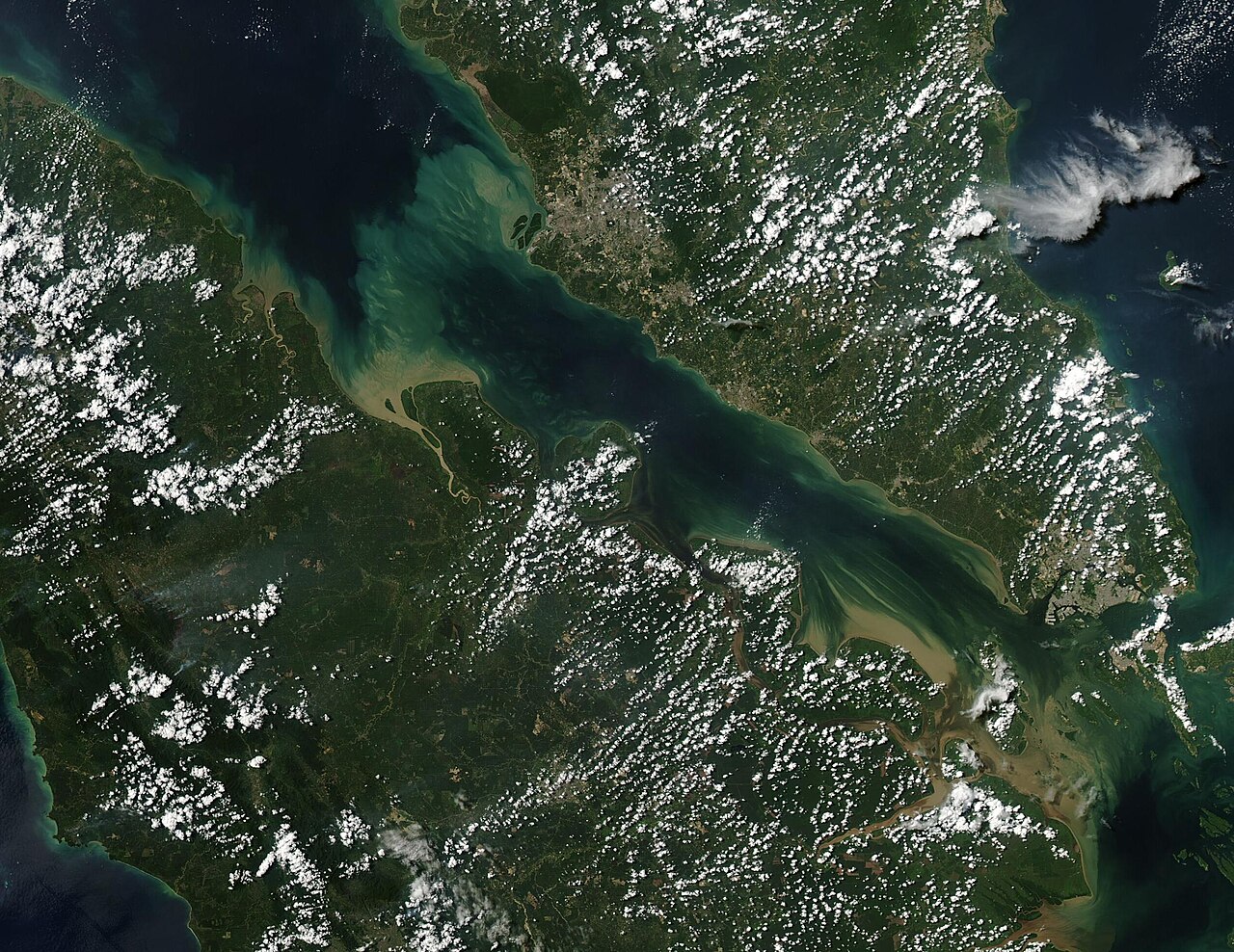
Satellite photograph · clickMalaccaThe second great oil chokepoint, and the main sea road from the Gulf and Africa toward East Asia.
Malacca is where Gulf oil becomes an Asian fact. It is the second great oil door, between the Indian Ocean and the Pacific. A ship that cannot use it takes days, not a slogan.
The image is MODIS, NASA, public domain. The date on the file is 25 August 2025.
From the channel, 2003 · clickBab el-MandebThe short door into the Red Sea. When it becomes hostile, ships take the long road around Africa.
Bab el-Mandeb is the short door from the Gulf of Aden into the Red Sea, and therefore toward Suez. The photograph is from mid-channel in 2003, Richard Weil, CC0. When the door is hostile, the alternative is the Cape, measured in extra days and extra fuel.
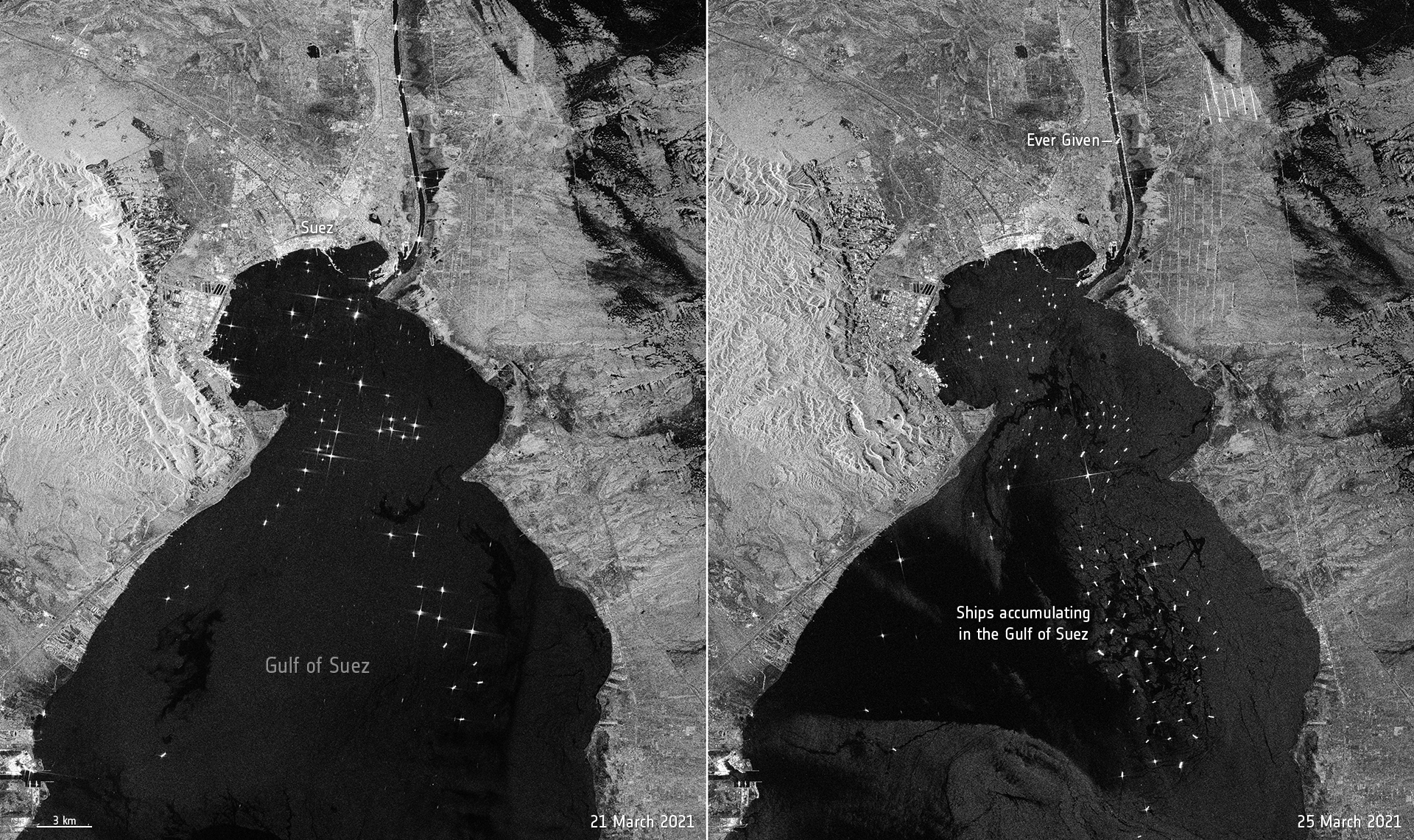
Suez itself is a canal, not a strait. The picture people remember from 2021 is a ship stuck. A canal is a ditch with rules, a draft limit, and a queue.
Click a note. It opens here, before the longer essay. A reserve is not a plan. The plant you cannot see is often the chokepoint. Electricity spends metal before it spends a policy.
Note · clickA reserve is not a planGeology publishes a resource. A company publishes a reserve only after price, permits, water, and a railway are real.
A resource is a model of the rock. A reserve is the part a signed study says can be mined at a stated price, with permits, water, and a way to move it. A producing tonne is the only one that heats a furnace. Uyuni is the example to keep beside that sentence: famous as a resource, small as an industry.
Mount Whaleback is an iron-ore pit at Newman, photographed by Calistemon, CC BY-SA 3.0. The pit is real. A reserve figure without a railway is still a model.
Note · clickThe plant you cannot see on a chart of straitsCrude oil is not diesel. Spodumene is not battery hydroxide. The quiet chokepoint is the conversion step.
Fawley, on Southampton Water, is one refinery among hundreds. Peter Facey photographed it, CC BY-SA 2.0. The stacks are the point: a plant tuned to a diet of crudes. The wrong barrel is not a substitute for a week.
The same shape shows up in minerals. Spodumene is not battery hydroxide. A rare-earth concentrate is not a magnet. The month goes wrong in the building the chart of straits leaves out.
Note · clickElectricity is a mineral storyNew power lines, motors, and turbines spend copper, aluminium, and electrical steel before they spend a policy.
A new line spends copper, aluminium, and electrical steel before it spends a slogan. Transformers are ordered years ahead because the factories that wind them have queues. A solar farm can have every module on site and still wait on the substation.
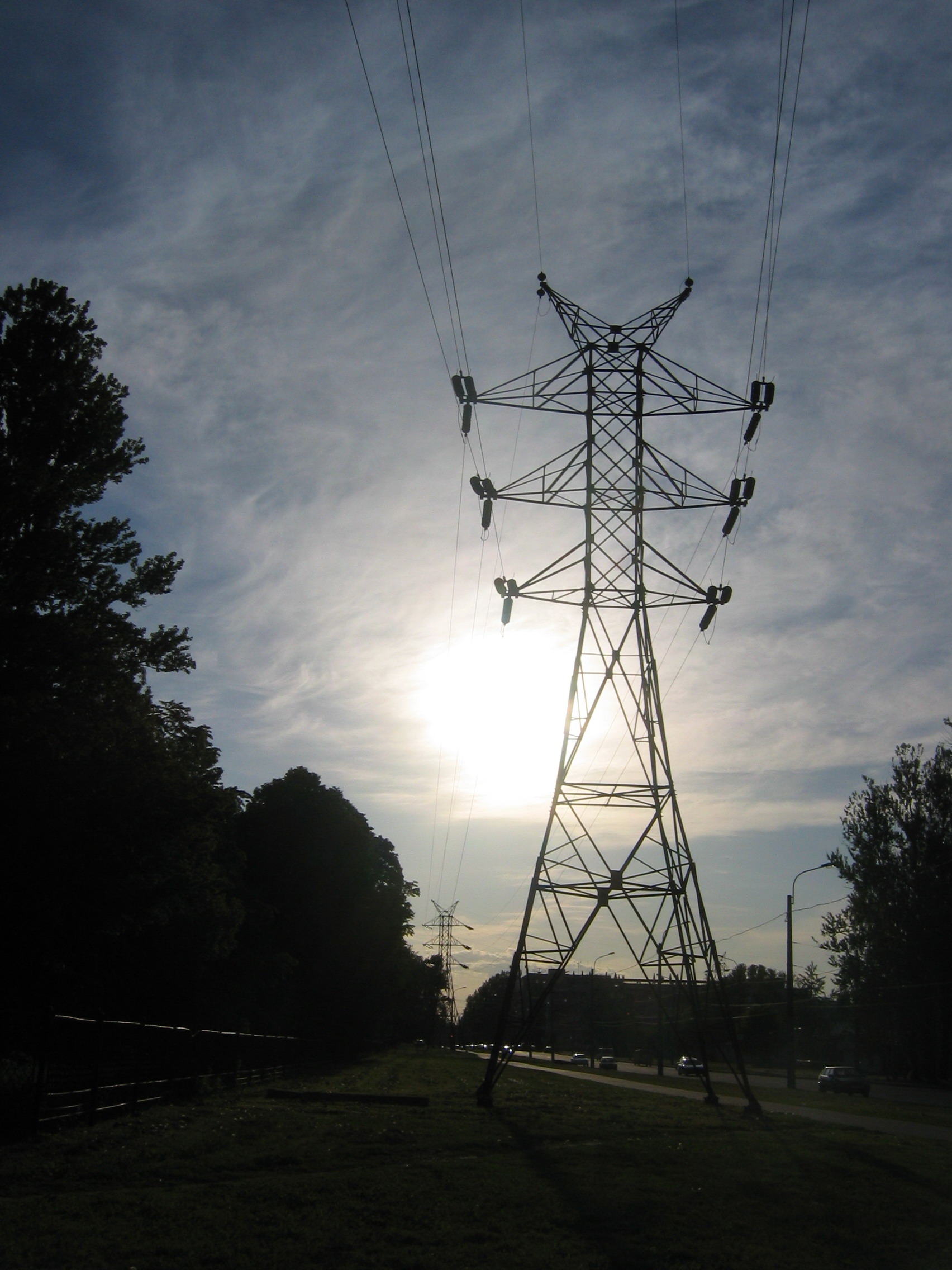
The pylon in the photograph is a public-domain picture of the wire, not of a particular country’s grid. An electric car uses on the order of eighty kilograms of copper, against a little over twenty in a petrol car. Scrap from old buildings is real. It is not sized for both jobs at once.
Every button below opens a note. The note uses a list, a table, or a sequence, so the format changes with the subject.
Oil is a diet, not a single liquid.
Permian Basin, near Monahans, Texas. Photograph by Quintin Soloviev, CC BY 4.0.
A barrel at the well is not diesel, jet fuel, or the naphtha a chemical plant cracks. A refinery is tuned to a slate of crudes. Light Permian oil and heavy Alberta bitumen cannot swap places in a week.
What has to be true
The well is flowing, or spare capacity can be opened.
A pipeline or a loading terminal can take that grade.
A ship can clear the strait the terminal faces.
A refinery in reach is built for that diet.
Place
Job
Permian Basin
Flexible tight oil, well by well
Saudi Arabia
Most of the world’s spare barrels
Hormuz
The door those barrels must use
Fawley and its cousins
Where crude becomes a product
Close the door and the field is still full. The buyer is still empty.
LNG tanker Gulf Energy, Norway, 2023. Photograph by Gordon Leggett, CC BY-SA 4.0.
Pipeline gas is a continuous flow tied to one map. Liquefied natural gas is methane cooled to about −162°C and put on a specialized ship. The two trades do not share equipment.
Pipelines. Norway’s system into Britain and the European mainland. A field, a plant at the coast, a landfall.
LNG export. The United States Gulf from 2023, Qatar’s North Field, and the plants of northwest Australia.
The slow piece. A liquefaction train takes years. A floating import terminal can be hired faster than it can be built.
The strategic object is the plant that makes the liquid, not the methane still in the ground.
Garzweiler lignite mine, Germany. Photograph by Maya, CC BY-SA 3.0. A local pit, not seaborne coal.
Thermal coal
Metallurgical coal
Used for
Steam and electricity
Coke inside a blast furnace
Share of power
Still about a third of world electricity
Not a power-station question
Who ships it
Indonesia and Australia, among others
Australia, the United States, Canada, Russia
What closing it does
A grid finds another fuel, at a price
A steel system built on furnaces does not
Lignite, as at Garzweiler in Germany, is a third case: too low in energy to ship across an ocean, strategic only to the power station next door. China burns more than half of the world’s coal.
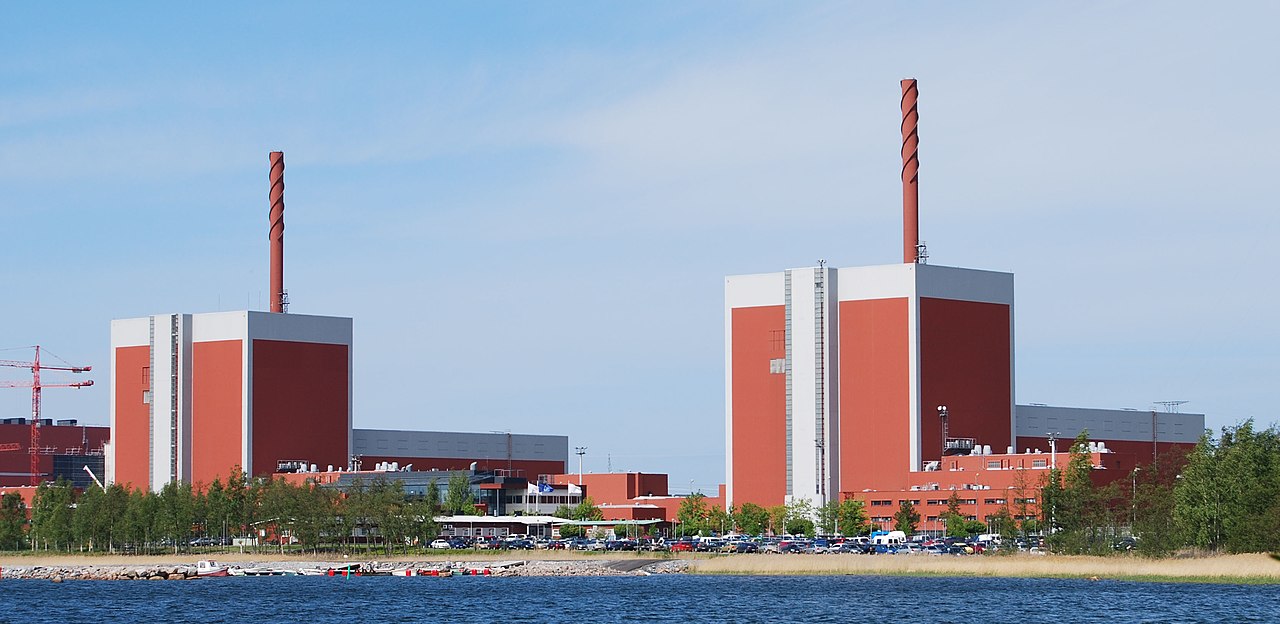
Olkiluoto 1 and 2, Finland. Public domain. Not a picture of the later unit 3.
Mine uranium. Kazakhstan leads, mostly by dissolving the ore underground.
Mill it to yellowcake. That yellow powder is not fuel.
Convert it to a gas, then enrich the fissile share. This club is small.
Fabricate pellets and load them. A reactor burns on a campaign, not a daily delivery.
Nuclear supplies around a tenth of world electricity, and about two-thirds of France’s. The photograph people know is the cooling tower. The constraint a utility loses sleep over is enrichment.
Copper cathode. Photograph by Xstrata Technology, CC BY-SA 3.0. Refined metal, not ore.
Chile has been the largest mine producer for a generation. Escondida is the largest pit by output. The Congo has risen fast on high-grade ore. China smelts more than it mines. An electric car uses several times more copper than a petrol car, on the order of eighty kilograms against a little over twenty, once the motor and the charger are counted.
The ore is generous. The smelter queue and the transformer queue are not.
Wire, motors, and substations
Wind-farm cables and inverters
The busbars inside a battery plant
Scrap from old cities, real but not enough for a new grid
Iron ore is a railway that happens to be full of rock.
Iron-ore train, Port Hedland, 2012. Photograph by Bahnfrend, CC BY-SA 3.0.
Australia’s Pilbara and Brazil’s Carajás feed the seaborne trade. China buys most of it. Port Hedland can move on the order of half a billion tonnes in a busy year. The ships are capesize. They do not fit through Suez or Panama.
A pit such as Mount Whaleback.
A private heavy-haul railway, trains kilometres long.
A tidal port and a capesize hull.
A blast furnace, which also needs metallurgical coal, or a newer iron-making route.
The crust is full of iron. The system that moves it is full of single points: one railway, one port, one buyer.
Click a layer. The note under it is the way that layer fails, and the page where the longer version lives.
These are flows, not stocks. They arrive when the weather says so. A turbine or a panel does not store a windy week. Storage, hydro that can wait, and a wide grid decide whether the flow becomes useful power.
The machine is also a mine. Steel, copper, and often a rare-earth magnet are inside it before any climate policy is. Horns Rev 1, the early Danish offshore farm, was 160 megawatts. Farms now planned for the North Sea are counted in gigawatts, and each machine still has to be wound, cabled, and founded.
What arrives free. The wind and the noon sun.
What does not. The mast, the magnet, the export cable, and a grid that can take a gusty afternoon.
What fails first. A calm week, or a substation that was ordered too late.
Transformers, substations, and high-voltage lines are copper, aluminium, and electrical steel. They are ordered years ahead because the factories that wind them have queues. A solar farm can have every module on site and still wait on the substation.
An electric car uses on the order of eighty kilograms of copper once the motor and the charger are counted, against a little over twenty in a petrol car. A new city grid spends the metal again, in cables the public never sees. Scrap from old buildings is real. It is not sized for both jobs at once.
Refineries, LNG trains, smelters, and chemical conversion are where a raw material becomes a specification. Spodumene is not battery hydroxide. Crude is not diesel. A concentrate of rare earths is not a magnet.
These buildings are slow. A liquefaction train takes years. A refinery is tuned to a diet of crudes and cannot swap a light Permian barrel for heavy Alberta bitumen in a week. The photograph people remember is the pit. The month goes wrong in the plant.
Hormuz, Malacca, Bab el-Mandeb, Suez, Panama, the Turkish Straits, and the Cape. None of them produces energy. Each one decides whether energy already produced can arrive, and what the detour costs in days.
In the EIA’s account of 2023, about 20.5 million barrels a day of oil and products used Hormuz, roughly a fifth of world petroleum liquids. A large share of Qatar’s liquefied natural gas uses the same water. Pipelines that avoid the strait exist. They are not big enough to replace it.
Concentrators, leach pads, and flotation circuits. A large copper pit often runs at under one percent metal. Most of what comes out of the ground stays in a tailings dam. The thing that ships is a concentrate, not a cathode.
Nickel laterite adds a harder plant, the high-pressure acid leach, before the metal is fit for a battery. The mill is why a country can ban ore exports and still not have a finished product. The rock moved. The specification did not.
This is the only layer geology gave anyone. A resource is a model of that rock. A reserve is the part a signed study says can be mined at a stated price. A producing tonne is the only one that heats a furnace.
Bolivia’s Salar de Uyuni is a famous lithium resource and, so far, a small industry. Ranger, in Australia, is a uranium photograph of a mine that has stopped. Dates belong next to every orebody, because a white salt flat and a closed pit are not supply.
Six more notes. Each button opens a longer card: who can raise output, who refines, and which constraints are water, scrap, food, or time.
Spare capacity is still a barrel that has to move.
Statfjord A, North Sea. Photograph by Marcusroos, CC BY-SA 3.0. A platform is not spare capacity.
Most of the world’s ability to raise oil output quickly sits in Saudi Arabia. Spare capacity means oil that can be produced above what is already flowing. It is not a tanker at sea, and it is not a promise that every grade of crude can appear in every port.
World demand in the mid-2020s sits a little above 100 million barrels a day in the International Energy Agency’s market reports. The United States leads recent production from the Permian, one well at a time. That oil is flexible. It is not the same object as a Gulf barrel that must clear Hormuz, or as the heavy bitumen of Alberta.
A field opens more wells, or opens a choke that was held back.
A pipeline or a loading terminal can take that extra grade.
A ship clears the door the terminal faces.
A refinery in reach is built for that diet, not for a different one.
Spare capacity that cannot be shipped is only a fuller tank.
The country that digs is often not the country that finishes.
Grasberg, Papua, Indonesia. Photograph by Alfindra Primaldhi, CC BY 2.0. A copper and gold pit, not a nickel plant.
A mine total and a refinery total answer different questions. The first says where the rock left the ground. The second says where a factory can actually use the metal. Strategy lives in the gap.
Material
Where it is dug
Where the quiet step sits
Copper
Chile, Peru, and the Congo
China smelts a larger share than it mines
Cobalt
About seven in ten mined tonnes from the Congo
Refining is concentrated far from the pit
Lithium
Australia leads mine output; the Andes hold the brines
Battery carbonate and hydroxide, mostly in Chinese plants
Nickel
About half of 2023 mine output from Indonesia
The leach and the smelter that the ore-export rules pulled onshore
Rare earths
Several countries have the minerals in the ground
Separation into individual elements, then a magnet factory
Graphite
Natural graphite mining is heavily concentrated
The spherical coating that makes a battery anode
A new mine announcement does not move the second column. A chemical plant does, and it takes longer to permit than a headline takes to write.
Some energy cannot be rerouted because it is a river.
Three Gorges Dam. Photograph by Dan Kamminga, CC BY-SA 2.0. Nameplate 22,500 megawatts.
Hydropower is on the order of 15 percent of world electricity, and a dry year moves that share. Three Gorges is 22,500 megawatts of installed capacity, the largest power station yet built. Itaipu, shared by Brazil and Paraguay, is 14,000. Nameplate is the size of the machine. It is not the energy a drought will actually deliver.
Aluminium smelters notice first. They are electricity poured into bauxite, and they idle when Sichuan, Brazil, or the Zambezi runs short. Lithium brine spends a different kind of water: months of sun on ponds in the Atacama, lifting a solution that is still not a battery salt. You cannot put either watershed on a ship.
A dam. Strategic like a territory. The water stays in its basin.
A brine pond. Strategic like a slow chemical plant. The sun does the work, and the sun does not hurry.
A cooling river. Nuclear plants such as Cruas sit where the water already is. Heat has to go somewhere.
Transmission pylon. Public domain. The wire is where scrap copper has to return if it is to matter.
Copper scrap from buildings, machines, and wire is a real supply. It arrives on a different clock from a Chilean pit: demolition, collection, a furnace that can take dirty metal. It is not large enough, on its own, for a new grid and a new fleet of electric cars in the same decade.
Two scrap trades
Copper and aluminium scrap return as metal, if a furnace is near.
Steel scrap feeds an electric arc furnace, which does not need metallurgical coal.
A blast furnace still wants iron ore and coke. Scrap does not retire that route by itself.
Battery scrap will matter later. The first wave of cars is still on the road.
Object
What it spends
Petrol car
A little over twenty kilograms of copper
Electric car
On the order of eighty, with the motor and the charger
New transmission
Copper and aluminium ordered years ahead
Old building
Scrap, on the day someone takes it down
A recycle rate is a hope until the furnace, the collection, and the old stock are all real.
Potash never enters a battery. It still sits inside a harvest.
Saskatchewan, Russia, and Belarus dominate potash, the potassium mineral in fertilizer. It does not show up in a list of electric-car metals, and a missed shipment still shows up in food. The other half of that story is gas. Most nitrogen fertilizer is made from methane, in a chemical plant, not in a field.
A closed gas door is therefore two stories at once. Power stations feel it in days. Fertilizer plants feel it in the season that follows, because ammonia is not stored the way a coal pile is stored. The mineral and the molecule meet in the same bag of nutrients, and only one of them is a rock.
Potash. A mined salt. Canada, Russia, Belarus.
Nitrogen. A gas plant. Methane in, ammonia out.
Phosphate. Another mined nutrient, with its own countries and its own ships.
Food security is a midstream story wearing a farm’s clothes.
The long piece is the plant, the railway, and the queue.
Ranger, Kakadu. Photograph by Alberto Otero García, CC BY 2.0. Mining stopped in 2021. The picture is a date, not a current tonne.
Geology publishes a resource. A company publishes a reserve only after price, permits, water, and a way to move the rock are real. A producing tonne is the only tonne that heats a furnace. Everything else is a schedule, and schedules slip in years, not in headlines.
Object
Why it is slow
LNG train
Years to build. A floating import terminal can be hired sooner than a new export plant.
Transformer
The factories that wind them have queues. The solar modules can arrive first and still wait.
Iron-ore railway
The Pilbara works because the railway and Port Hedland already exist. A new pit without them is a quarry.
Battery chemical plant
Spodumene can be mined this year and still not be hydroxide.
Uranium fuel
Mining, milling, conversion, enrichment, and fabrication are separate gates.
Ranger has stopped mining. The photograph remains, and the caption has to say so. A date on a picture is the same discipline as a date on a tonne.
This sitting is meant to run past a single screen. Each stop is a real photograph and the constraint that photograph cannot show by itself.
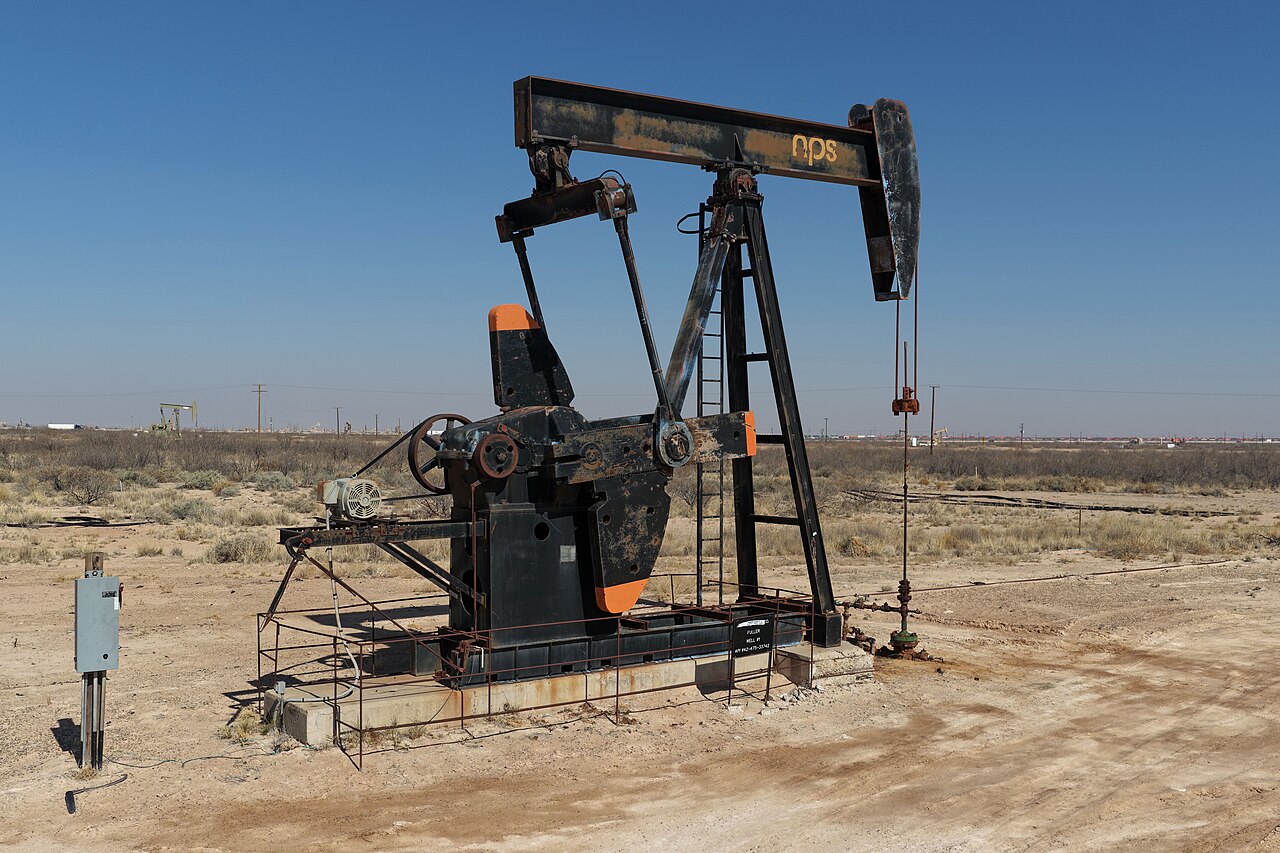
Pumpjack near Monahans, Texas, in the Permian Basin. Photograph by Quintin Soloviev, CC BY 4.0. One well, not a national reserve.
01 · Tight oil
The Permian is a crowd of small decisions.
The United States leads recent oil production because wells like this one can be drilled, completed, and left to decline, then replaced by another. A pumpjack is the visible machine. The resource is a stack of tight rock under west Texas and southeastern New Mexico, opened well by well rather than by one giant field with a single choke.
That flexibility is real, and it is not spare capacity in the Gulf sense. A Permian barrel is light. A refinery built for heavy crude cannot take a flood of it in a week. The well can flow and the buyer can still be the wrong buyer.
Statfjord A, in the North Sea. Photograph by Marcusroos, CC BY-SA 3.0. A concrete platform and a pipeline coast, not an LNG plant.
02 · The North Sea
Norway’s oil is a neighbor’s pipeline.
Statfjord A stands on a concrete base in open water. The oil and gas it helped produce do not wait for a specialized cold ship. Norwegian gas moves by pipe into Britain and the European mainland. The field, the coastal plant, and the landfall are one system.
That is why a North Sea story and a Gulf story should not be folded together. One is a pipeline neighbor. The other is a strait, and then, for Qatar’s methane, a liquefied cargo.
LNG tanker Gulf Energy, near Haugesund, Norway, 2023. Photograph by Gordon Leggett, CC BY-SA 4.0. The ship carries methane that has already been frozen.
03 · Cold gas
The ship is the last step, not the first.
Liquefied natural gas is methane cooled to about −162°C. The hull in the photograph cannot carry crude oil, and a crude tanker cannot carry this cargo. The United States became the largest LNG exporter in 2023 from plants on the Gulf. Qatar and northwest Australia are the other great gates.
A liquefaction train takes years. A floating import terminal can be hired faster than a new export plant can be built. The strategic object is the plant that makes the liquid.
Garzweiler lignite mine, North Rhine-Westphalia. Photograph by Maya, CC BY-SA 3.0. Lignite is too poor to ship across an ocean.
04 · Coal, split in two
This pit feeds the power station next door.
Garzweiler is lignite: low in energy, dug beside the boilers that burn it. It is not the coal that crosses an ocean, and it is not the coal that becomes coke. Thermal coal still makes about a third of world electricity. Metallurgical coal is the carbon inside a blast furnace. Closing one does not close the other.
China burns more than half of the world’s coal. A German pit is a local lesson in what cannot be shipped, not a portrait of the seaborne trade.
Olkiluoto units 1 and 2, Eurajoki, Finland. Public domain. Unit 3 is a later reactor and is not this picture.
05 · The fuel cycle
The building is the part a camera can hold.
Nuclear power is around a tenth of world electricity, and about two-thirds of France’s. The reactors in the photograph burn fuel that was mined, milled to yellowcake, converted, enriched, and fabricated. Kazakhstan leads mine output, mostly by dissolving the ore underground. The enrichment club is much shorter than the list of mines.
A reactor loads fuel in a campaign, not on a daily truck. A week of trouble at a mine is an inventory story. A lasting loss of enrichment is a different story.
Three Gorges Dam, Sandouping, April 2007. Photograph by Dan Kamminga, CC BY-SA 2.0. 22,500 megawatts of installed capacity, which a dry year does not guarantee.
06 · A river, dammed
You cannot reroute a watershed.
Three Gorges is the largest power station yet built, at 22,500 megawatts of nameplate capacity. Itaipu, shared by Brazil and Paraguay, is 14,000. Hydropower is on the order of 15 percent of world electricity, and the share moves when the rains fail.
Aluminium smelters notice first, because they are electricity poured into bauxite. A drought in Sichuan, in Brazil, or on the Zambezi shows up as idle pots. The dam is strategic the way a territory is strategic.
Horns Rev 1, Danish North Sea, commissioned in 2002 at 160 megawatts. Photograph by Thomas Dahlstrøm Nielsen, CC BY-SA 4.0. Later farms are counted in gigawatts.
07 · A flow, and a machine
The wind is free. The queue is not.
Each turbine is steel, concrete, and copper, and many direct-drive machines use a rare-earth magnet. Offshore farms add substations and export cables. The weather decides when the electrons arrive. A factory queue decides when the machine exists at all.
China builds and installs more wind capacity than any other country. Europe’s North Sea is the other concentration. Neither fact replaces the calm week, or the transformer that was ordered too late.
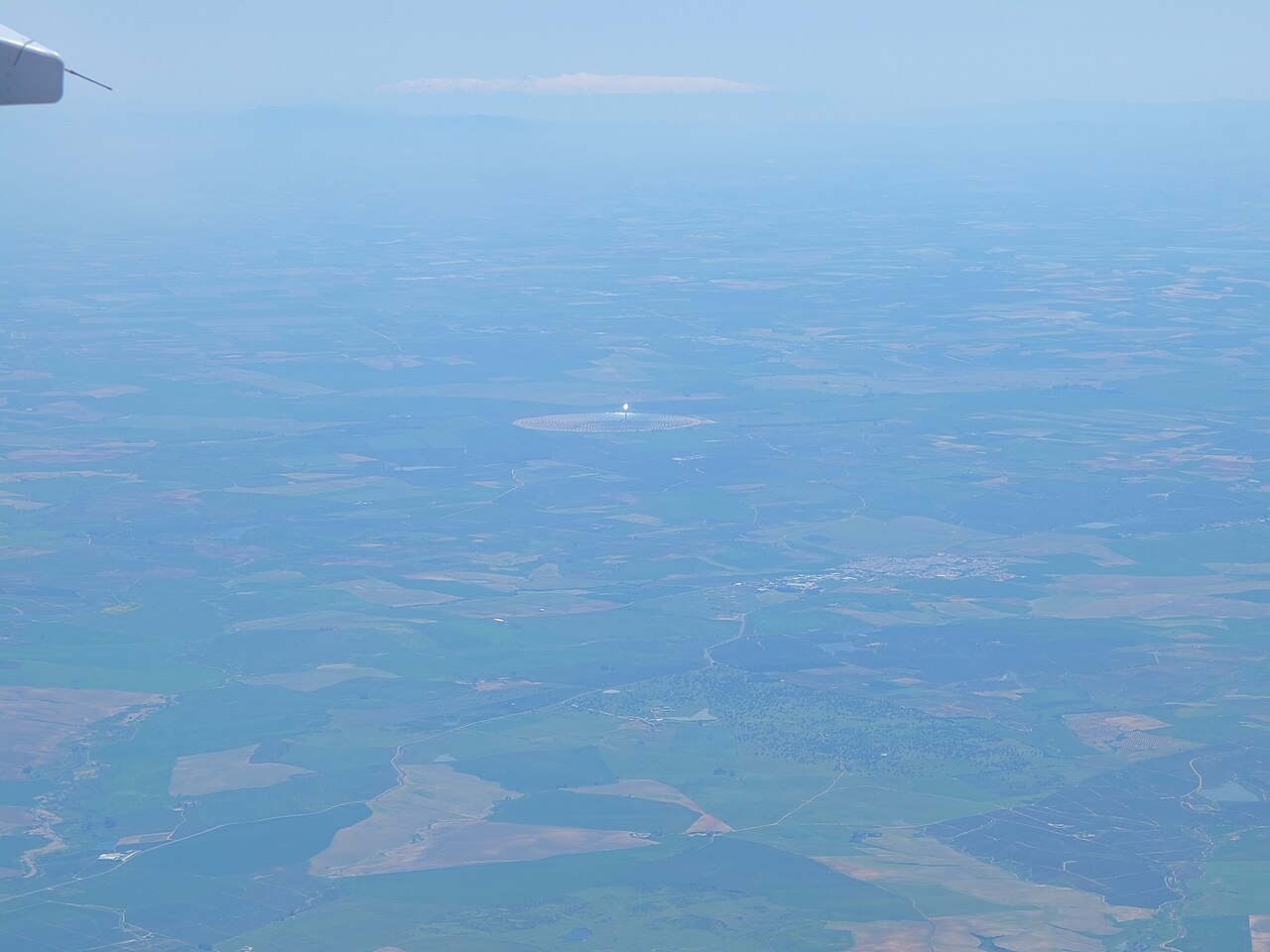
Gemasolar, Andalusia. Photograph by Redfive, CC BY-SA 4.0. Concentrating solar with molten-salt storage. Most new solar capacity is photovoltaic, not this design.
08 · Two suns
The striking plant is the smaller story.
Gemasolar uses mirrors to heat a fluid and can store that heat so a turbine still turns after sunset. Ivanpah, in the Mojave, is another tower. Almost all of the growth in solar since the late 2010s has been photovoltaic panels, not mirrors.
The panels are a manufacturing story. Polysilicon, wafers, cells, and modules have been heavily concentrated in Chinese plants. On the grid, the power arrives in the middle of the day and leaves the evening still to be solved.
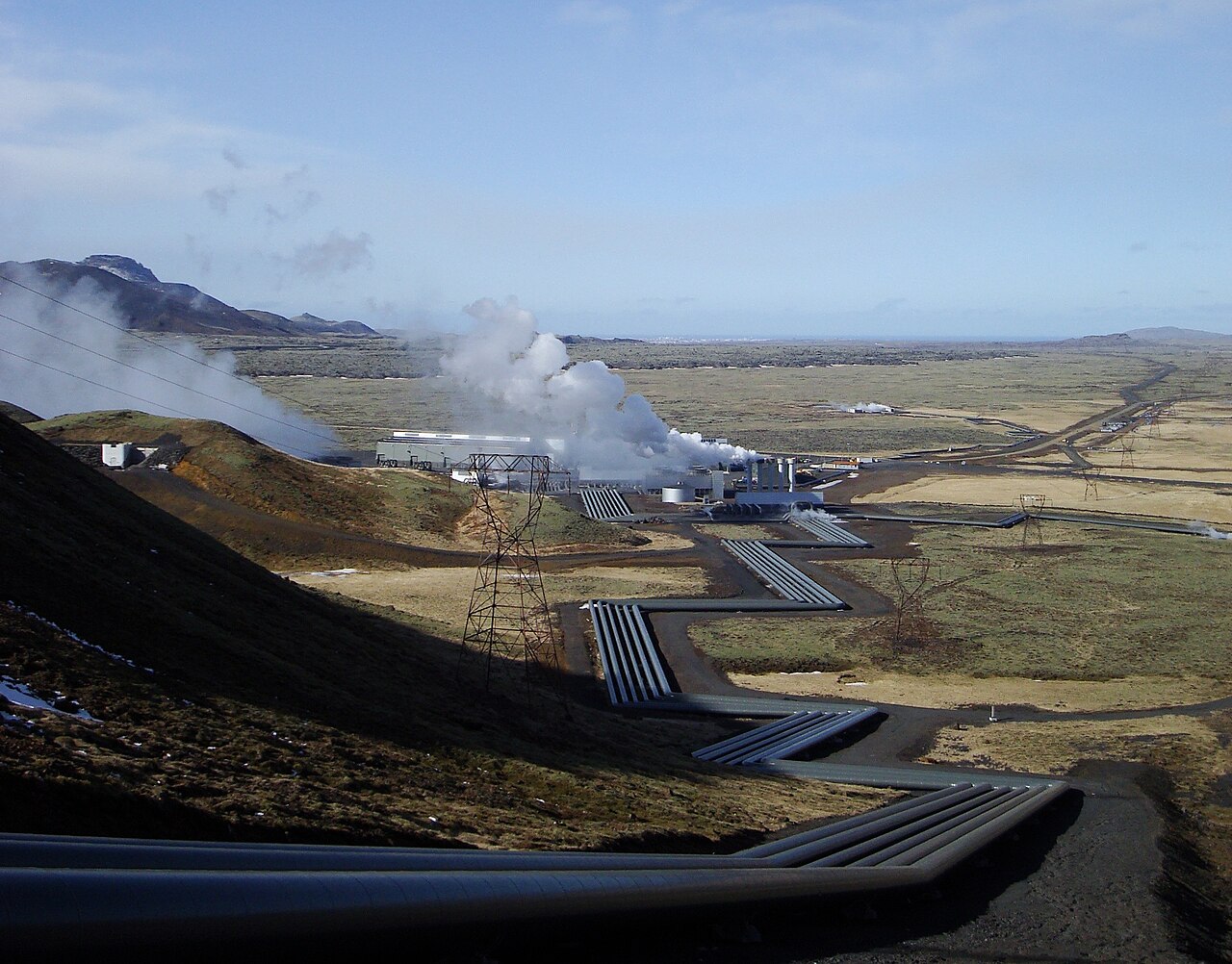
Hellisheiði, Iceland. Photograph by ThinkGeoEnergy, CC BY 2.0. Power and hot water for a city, from a volcanic system that will not travel.
09 · Heat that stays
Geothermal never becomes someone else’s cargo.
Iceland’s electricity is almost entirely hydropower and geothermal. Hellisheiði and Nesjavellir, east of Reykjavik, send both power and district heat. Kenya’s Olkaria field is the other national-scale place to know. The heat belongs to a fracture in the rock.
You cannot put the reservoir on a ship. That makes geothermal a local strategic resource, like a dam, and unlike LNG. It fails only where it stands.
Strait of Hormuz, 4 December 2020, MODIS. NASA, public domain. A doorway. The water produces nothing.
10 · A door
Hormuz decides whether Gulf oil can leave.
In the EIA’s account of 2023, about 20.5 million barrels a day of oil and petroleum products moved through this water, roughly a fifth of world petroleum liquids consumption. A large share of Qatar’s liquefied natural gas uses the same door. Saudi Arabia, Iraq, Kuwait, and the United Arab Emirates can have full tanks onshore and still be unable to reach the buyers.
The East-West pipeline to Yanbu and the line to Fujairah avoid the strait for some barrels. They are not big enough to replace it. Spare capacity that cannot be shipped is only a fuller tank.
Suez Canal, March 2021, Sentinel-1 radar image. European Space Agency, CC BY-SA 3.0 IGO. This is a radar picture, not a photograph in daylight. The queue is the point.
11 · A ditch
Suez is a schedule the world wrote for itself.
The canal does not produce energy. It shortens the road between the Mediterranean and the Red Sea. When a ship blocks it, the alternative is the Cape of Good Hope, measured in extra days and extra fuel, not in a slogan.
Capesize bulk carriers, the usual hull for iron ore, do not fit the canal anyway. They were already going the long way. A container ship and an ore ship do not share a crisis just because both are called shipping.
Miraflores Locks, Panama Canal. Photograph by Crystalcollado, CC BY-SA 3.0. The locks lift ships to a lake filled by rain.
12 · A lake
Panama’s limit is freshwater.
The locks lift a ship up to Gatun Lake and down the other side. The lake is filled by rain in the surrounding forest. A dry year is not a political metaphor. It is less water for the chambers, fewer transits, and a draft limit on the ships that do pass.
Gas from the United States Gulf headed to Asia would rather use this door than the long road. Iron ore does not. The canal is a constraint for some cargoes and a rumor for others.
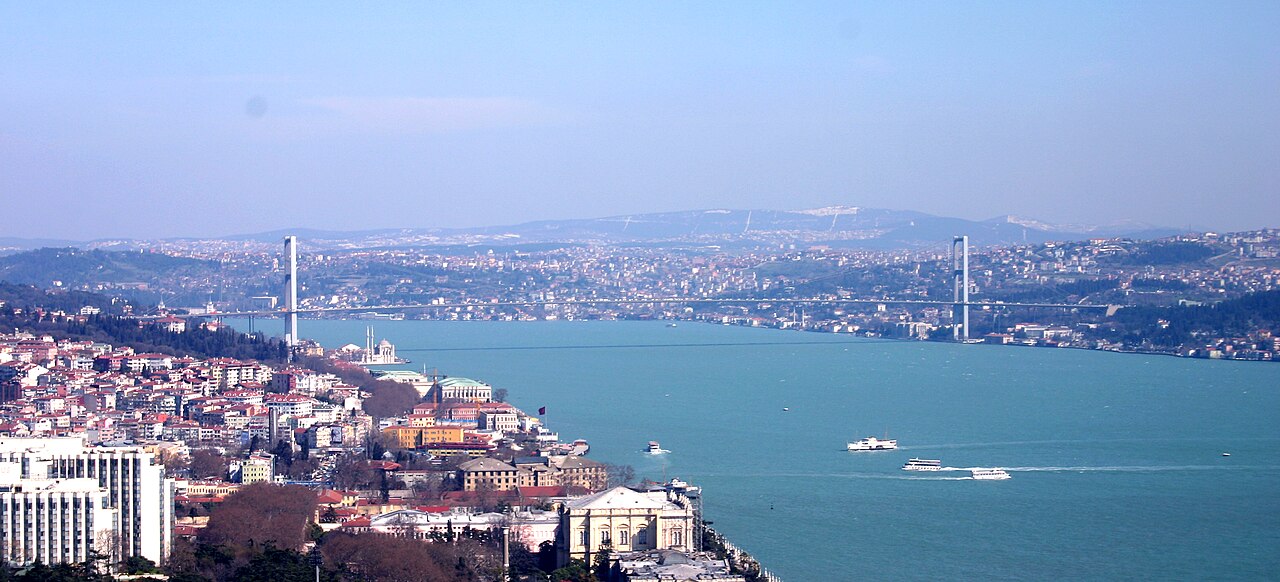
The Bosphorus, Istanbul. Photograph by Bertil Videt, CC BY 2.5. The city is the bank of the strait.
13 · A city
The Turkish Straits pass through a capital.
The Bosphorus and the Dardanelles connect the Black Sea to the Mediterranean. Oil from Black Sea ports and grain use them. There is no way to widen Istanbul. A tanker and a ferry share the water with a city built to the edge.
A passage can stay legally open and still stop being the route a shipowner will choose. The constraint is the bend, the traffic, and the bank, not a missing barrel in the ground.
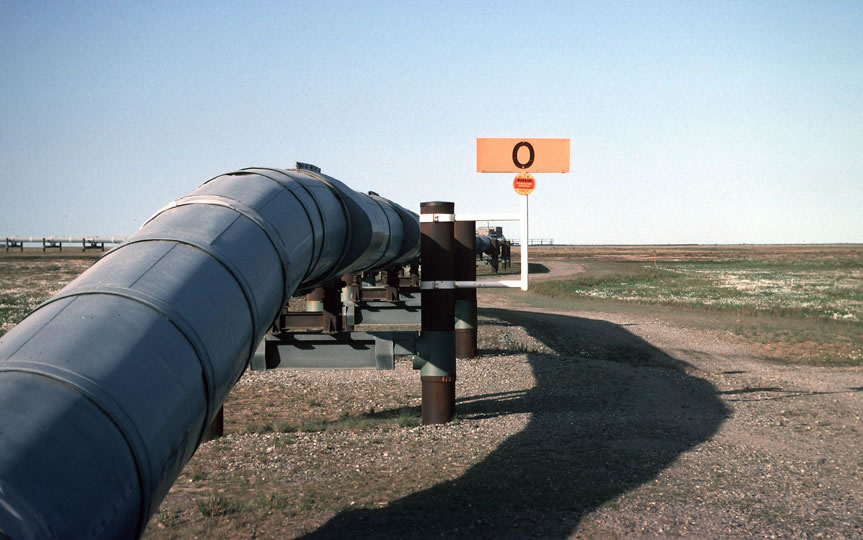
Trans-Alaska Pipeline. Public domain. Shown here as a pipeline, not as a picture of the Cape of Good Hope. The Cape is the detour when the short canals close.
14 · The long road
When the short doors close, the Cape remains.
The photograph is a pipeline in Alaska, because this desk does not pretend a tundra line is the sea road around Africa. The Cape of Good Hope is what ships use when Suez or Bab el-Mandeb will not serve. The cost is days, fuel, and the hulls that can be spared.
Some cargoes were already on that road. Iron ore from the Pilbara to China goes in capesize ships that do not fit Suez or Panama. A closure changes their insurance and their company, not their map.
Iron-ore train leaving Port Hedland, 2012. Photograph by Bahnfrend, CC BY-SA 3.0. The railway is the mine.
15 · A railway of ore
Port Hedland is a port that thinks in kilometres of train.
Australia’s Pilbara and Brazil’s Carajás feed the seaborne iron-ore trade. China buys most of it. Port Hedland can move on the order of half a billion tonnes in a busy year. The trains are measured in kilometres. The ships are capesize.
The crust is full of iron. The system that moves it is full of single points: one railway, one tidal port, one buyer. A pit without those three is a quarry.
Evaporation ponds, Salar de Atacama, Chile, Landsat 8, 2018. NASA Earth Observatory, public domain. Brine after months of sun, not yet a battery salt.
16 · Three maps
The ponds are not the battery.
Australia leads lithium mine output from hard-rock spodumene, much of it in Western Australia. Chile’s Atacama, in the photograph, has evaporated brine for decades. Argentina’s high desert is where new brine capacity has been advancing. Most conversion into battery carbonate and hydroxide has sat in Chinese plants.
Bolivia’s Salar de Uyuni is a famous resource and, so far, a small industry. A white salt flat is not a supply. The chemical plant is the third map, and it is the one a headline most often skips.
Copper cathode sheets. Photograph by Xstrata Technology, CC BY-SA 3.0. This is refined metal, not the ore that left the pit.
17 · After the mill
What ships is often a concentrate. What a factory wants is this.
A large copper pit often runs at under one percent metal. Most of the rock stays in a tailings dam. The thing that leaves the mill is a concentrate. The sheets in the photograph are what a smelter and a refinery made afterward. Chile has led mine output for a generation. China smelts a larger share than it mines.
An electric car uses on the order of eighty kilograms of copper once the motor and the charger are counted, against a little over twenty in a petrol car. The ore can be generous. The smelter queue and the transformer queue are not.
Ranger uranium mine, Kakadu, Australia. Photograph by Alberto Otero García, CC BY 2.0. Mining stopped in 2021. The picture is not a current mine.
18 · A date on a picture
A closed pit is not a supply, even when the photograph is beautiful.
Ranger has stopped mining. Kazakhstan has not. Kazakhstan leads uranium output by in-situ leaching: dissolving the ore underground and pumping the solution up. Canada’s Athabasca ores are far richer per tonne. The fuel cycle still has many gates after whichever mine is running.
Yellowcake, the yellow powder people remember, is an intermediate. It is not a fuel assembly. The photograph and the tonne need the same discipline: a date, and a refusal to let a picture stand in for a different country.
Cruas nuclear plant on the Rhône, 2018. Photograph by Florian Pépellin, CC BY-SA 4.0. The river is part of the plant. Heat has to go somewhere.
19 · A fleet, not a tower
France’s kilowatt-hour was a building program.
Cruas is one station in a fleet that made nuclear the default French unit of electricity. About two-thirds of France’s power comes from reactors. The world share is nearer a tenth. A single cooling tower is the photograph. The system is the repeat: the same kind of plant, on rivers that can take the heat, with a fuel cycle behind them.
The United States still has the largest number of operating reactors. New large projects in Europe and North America have been slow. South Korea, China, and Russia have been the exporters still delivering plants on a repeatable pattern. A picture of one French river does not describe that split.
A dry or a hot river is an operating limit, not a geology story. The fuel can be in the core and the plant can still have to ease back because the water alongside it is already warm.
Fawley oil refinery, Southampton Water. Photograph by Peter Facey, CC BY-SA 2.0. One refinery among hundreds. The diet of crude is the point.
20 · The diet
Crude oil is not yet a fuel anyone burns.
Fawley takes a slate of crudes and turns them into diesel, jet fuel, gasoline, and the naphtha a chemical plant cracks. Light oil from the Permian and heavy bitumen from Alberta do not swap places in that slate in a week. The refinery was built for a diet.
World oil demand in the mid-2020s sits a little above 100 million barrels a day in the International Energy Agency’s market reports. That number is already a basket of products. Counting it at the well hides the plant that makes the basket usable.
When a strait closes, the first question is which refineries lose the grade they were built to run. A full field and an empty product tank can be true on the same day.
Athabasca oil sands, Alberta. NASA Earth Observatory, EO-1, public domain. A satellite image of a factory laid over a forest, not a conventional well.
21 · Bitumen
The oil sands are a mine that calls itself a barrel.
The pits in this satellite image are not pumpjacks. Bitumen is heavy, and getting it out is closer to moving earth than to opening a valve. Upgraders and refineries built for that heaviness are part of the project. A light tight-oil barrel does not replace it in the machines that were tuned for it.
Alberta’s constraint is the plant, the pipeline south or west, and the carbon cost of a barrel that took more energy to produce. The forest in the picture is the other ledger. Both belong in the caption.
This is still oil, in the trade’s broad sense. It is not the spare capacity that can be opened in the Gulf in weeks. Different clocks, different doors.
Strait of Malacca, MODIS. NASA, public domain. The long narrow sea between the Malay Peninsula and Sumatra.
22 · The second door
Malacca is where Gulf oil becomes an Asian fact.
Hormuz is the door out of the Gulf. Malacca is the door into East Asia. Oil, products, and a great share of the manufactured trade the other way share a seaway that is long, shallow at the edges, and crowded. The strait produces nothing. It decides whether a cargo already loaded can arrive on the schedule a refinery wrote down.
A detour through the Lombok or Sunda straits, or the long way south of Australia, is measured in days. Those days are fuel, hulls, and the insurance a shipowner will still pay. They are not a new oil field.
The same water carries iron ore and containers. A reader who treats every ship in the picture as an oil barrel will mis-count the crisis.
Bab el-Mandeb, seen from mid-channel, 2003. Photograph by Richard Weil, CC0. The short door between the Gulf of Aden and the Red Sea.
23 · The short door
Bab el-Mandeb is a few miles with a very long alternative.
Ships that have come from the Gulf or from Asia and want Suez have to pass this strait, then the Red Sea. When the passage becomes hostile, the alternative is the Cape of Good Hope. The extra distance is not a slogan. It is days of fuel and a queue of ships that used to be somewhere else.
The photograph is from the channel in 2003. The coast has not moved. The politics on the banks have. A caption needs both the year of the picture and the fact that the geography is still the constraint.
Oil, containers, and grain do not suffer the closure in the same proportion. The strait is one door. The cargoes keep their own ledgers.
Mount Whaleback, Newman, Western Australia. Photograph by Calistemon, CC BY-SA 3.0. A pit of this scale exists because a railway and a port were financed.
24 · The pit
Whaleback is the rock. The railway is the system.
Mount Whaleback is a deep red pit in the Pilbara. The ore is not rare in the crust. What is rare is the private heavy-haul railway, the trains kilometres long, and Port Hedland at the end of them. Without that chain the pit is a hole in excellent rock.
China buys most of the seaborne iron ore. Australia and Brazil’s Carajás feed it. A blast furnace at the far end also needs metallurgical coal, which is not the coal in a power station. Closing a boiler does not close the furnace.
The photograph shows the mine because the mine is photogenic. The constraint a steel mill feels is the train, the tide, and the ship that is too wide for the canals.
Bingham Canyon, Utah, 2012. Photograph by David Ratledge, CC BY 4.0. A copper pit you can see from space. Not a portrait of the Congo.
25 · A pit you can see from space
Bingham Canyon is one address in a trade with several.
The terraces are what a low-grade copper orebody looks like after a century of trucks. Most of what comes out of a pit like this stays in a tailings dam. The metal share is often under one percent. The thing that ships is a concentrate, then, after a smelter, a cathode.
Chile has led mine output for a generation. Escondida is the largest pit by tonnes. The Congo has risen on high-grade ore. China smelts a larger share than it mines. Utah is in the photograph because the photograph is of Utah. It does not stand in for those other places.
An electric car uses several times more copper than a petrol car. A new transmission line spends the metal again. The rim of this canyon is not the queue for the transformer.
Chuquicamata, above Calama, Chile, 2016. Photograph by Diego Delso, CC BY-SA 4.0. The same pit as the top of this page, read here as a system rather than as a poster.
26 · Calama
The hole is the start of the map, not the map.
Chuquicamata sits in the Atacama at about 22.3° south. The terraces, the haul roads, and the dust are the part a panorama can hold. The cathode that leaves for a wire factory has still to be milled, smelted, and refined, and the power and the water for those steps are not in the picture.
Chile’s copper is a national fact and a plumbing fact. The plumbing is the concentrator, the pipeline or the railway downhill, the port, and the smelter that may be in another country. A reader who stops at the rim has the geology and has missed the month that goes wrong.
The background of this site is this photograph, darkened so the type can sit on it. The essay is the refusal to let the picture be the whole supply.
Grasberg, Papua, Indonesia. Photograph by Alfindra Primaldhi, CC BY 2.0. Copper and gold. Not the nickel parks of Sulawesi, and not Congolese cobalt.
27 · Do not move the mountain
Grasberg is a copper and gold pit on a different island.
The mine sits in steep country in Papua. It is famous, and it is the wrong picture for two stories people attach to Indonesia. Nickel’s new midstream is on Sulawesi, around Morowali and Weda Bay. This desk has no field photograph of those parks, and it will not use Grasberg as a stand-in.
Cobalt is mostly a by-product of copper in the Congolese Copperbelt, about seven in ten mined tonnes in recent USGS totals. Refining is concentrated far from that pit. Grasberg’s mountain is not that by-product either.
A careful caption is the whole point of a picture on a strategic page. The ridge is real. The label has to be as narrow as the ridge.
Norilsk, seen from Talnakh, Russia. Photograph by Ninaras, CC BY 4.0. Sulfide ores of nickel, copper, and palladium. Not Indonesia.
28 · The older nickel
Norilsk is the Arctic map. Indonesia is the new one.
Most nickel still goes into stainless steel. A smaller stream becomes nickel sulphate for some battery cathodes. Those are not the same product. A tonne of nickel pig iron for a Chinese stainless mill does not automatically become a battery chemical.
Indonesia accounted for about half of world nickel mine output in the USGS total for 2023, after rules that kept ore processing onshore. Laterite ore is abundant and awkward. High-pressure acid leach plants can make a battery-suitable intermediate. They are difficult, power-hungry, and hard on tailings. Many of those parks burn captive coal. The metal can be low-carbon in the car and high-carbon on the island.
Norilsk, in the photograph, is the older geography: sulfide ore in the Russian Arctic, also copper and palladium. Canada and New Caledonia belong to that older map. They have not vanished. They have been outgrown. The snow is not Sulawesi.
Salar de Uyuni, Bolivia. Photograph by Iván Loire, CC BY 2.0. A vast lithium resource. Not, so far, a large industry.
29 · A resource in white
Uyuni is the picture people use when they mean a supply.
The salt flat is one of the most photographed lithium resources on earth. Commercial production has stayed small. The brine is rich in magnesium, which complicates the chemistry, and the arrangements around the flat have not become a reliable factory. A resource is a model of the rock or the brine. A reserve is the part a signed study says can be mined. A producing tonne is the only one that reaches a cathode plant.
Australia became the largest mine producer with spodumene, a hard rock, sold into conversion plants that already existed. Chile’s Atacama has evaporated brine for decades. Argentina’s high desert is where new brine projects have actually been advancing. Uyuni is the landscape. It is not the ranking of tonnes.
File a headline that names only the salt flat with the other resource stories, and wait for a commissioning report.
Salinas Grandes, northwest Argentina. Photograph by Jaan-Cornelius K., CC BY-SA 2.0. The famous empty white. Producing projects sit in other salars of the same desert.
30 · Another white flat
The postcard and the project are not the same salar.
Salinas Grandes is the picture of Argentina’s high desert that travels. The brine projects with construction schedules have been farther into Catamarca and Jujuy, on flats with a company, a permit, and a road. An empty white surface is a true photograph and a weak supply statistic.
Even a producing pond is not a battery. Months of sun thicken a solution. A chemical plant, most of them still in China, turns that solution or a spodumene concentrate into carbonate or hydroxide a cathode maker can use. Three maps: rock, brine, chemicals.
Water and the communities who live on the desert are the constraint that does not show up as a tonne. The flat can be full of lithium and still be a fight about the water table.
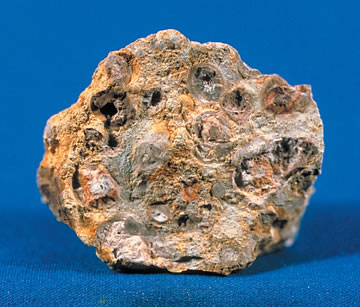
Chalcopyrite, a copper-iron sulfide. Photograph by Chmee2, CC BY-SA 3.0. The mineral in the hand is not the tonne in the trade.
31 · The mineral, then the tonne
A specimen is how the metal looks before the mill.
Chalcopyrite is the brassy sulfide that carries a great deal of the world’s copper. In the rock it is a fleck. In this photograph it is a chosen piece. Neither is a cathode. The mill crushes the ordinary rock, floats the sulfide, and throws the rest away. The trade begins at the concentrate, not at the crystal.
This is why a museum rock and a satellite pit can both be “copper” and still tell different truths. One is chemistry. The other is logistics. The desk uses both, and labels which is which.
Scrap copper from old cities is a third truth: metal that already went through a refinery once. It returns slowly. It does not replace the next decade of wire by itself.
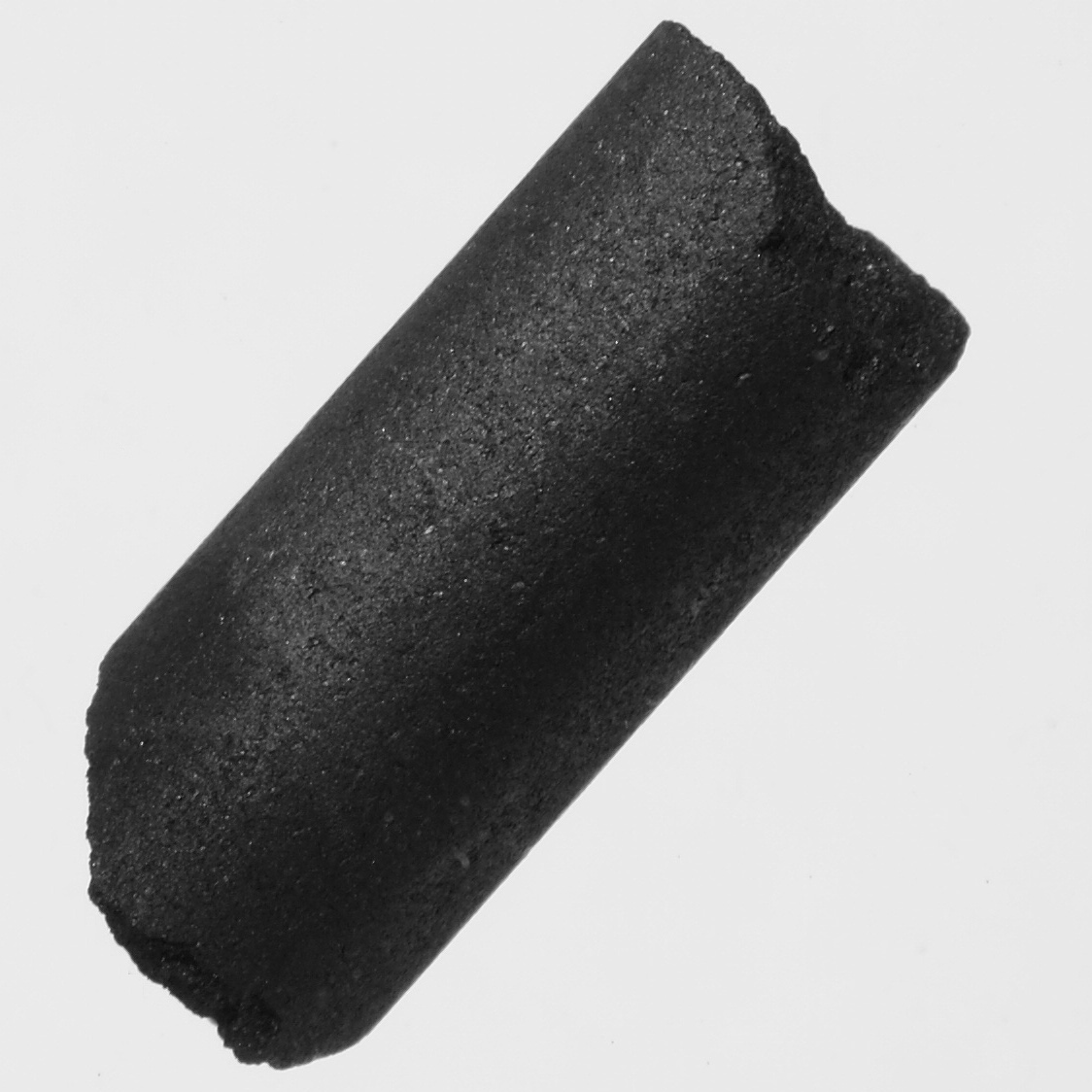
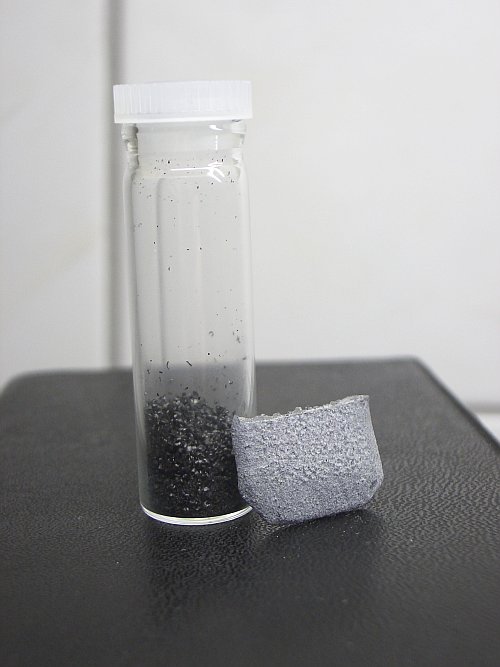
A bar of graphite. Photograph by Jurii, CC BY 3.0. Carbon, after processing. Not yet a coated anode powder.
32 · The anode
Every conventional lithium-ion battery is also a carbon story.
The anode in a conventional lithium-ion cell is graphite. Some of it is mined. Some of it is made from petroleum coke or coal tar, which is synthetic graphite, a different plant. The bar in the photograph is the element. A battery plant wants a coated spherical powder with a specification.
Natural graphite mining and that coating step are both heavily concentrated. A new mine announcement does not move the powder. The plant that rounds and coats the flakes does.
Oil and batteries meet here in a way a chart of metals misses. The coke for synthetic graphite is a refinery product. The flake is a mine. The anode can come from either door, and the doors are not interchangeable in a hurry.
Neodymium metal. Photograph by Wilco Oelen, CC BY-SA 3.0. A separated element, not a rare-earth ore and not yet a magnet.
33 · Separation
The scarce step is splitting the elements apart.
Neodymium and praseodymium make the strong permanent magnets in many motors and in many wind turbines. The ore that contains them also contains the rest of the rare-earth row, and the row is chemically stubborn. Digging the ore is a mining problem. Separating one element from the next is a plant problem, and that plant is the concentrated step.
A magnet factory is a further building. Metal in a dish, as in the photograph, is already far downstream of the mine and still upstream of the motor. Counting “rare earth reserves” as if they were magnets double-counts the geology and skips the work.
Not every turbine uses these magnets. A reader who treats every offshore farm as a rare-earth object will overstate the link. Many direct-drive designs do use them. That is the sentence that survives.
Bauxite. Public-domain photograph, U.S. government. The ore is ordinary. The smelter current is the strategic part.
34 · Solid electricity
Aluminium is bauxite plus a furious amount of power.
Bauxite is the weathered residue of long rains. Guinea has become a leading exporter. Australia remains a major producer. The ore is refined to alumina, and alumina is smelted in pots that run on a continuous current. Interrupt the power and the pots freeze. Restarting them is a repair, not a switch.
Smelters sit beside hydro in Canada, Norway, and Iceland, and beside whatever power is cheap enough elsewhere. China smelts more aluminium than the rest of the world combined. A country with bauxite and no cheap power exports dirt and imports metal. A country with a dam and no bauxite does the reverse.
This is why a dry year on a river shows up in aluminium before it shows up in a speech. The metal is electricity, stored in a shape you can ship.
Yellowcake, a uranium oxide concentrate. Public domain. An intermediate. Not a fuel assembly, and not a weapon.
35 · After the mine, before the core
The yellow powder is the middle of a long corridor.
Miners produce a concentrate. Converters turn it into a gas. Enrichers raise the share of the fissile isotope. Fabricators press pellets and load them into tubes. Kazakhstan leads mine output, often above two-fifths in recent totals, mostly by dissolving sandstone ore underground. Canada’s Athabasca grades are far higher per tonne of rock. Namibia and Australia’s Olympic Dam, a copper mine with a uranium co-product, fill out the list.
The enrichment club is smaller than the list of miners: Russia’s Rosatom, Europe’s Urenco, China’s own plants, and a more limited fleet in the United States. A reactor that loads fuel once a year can ride through a short mine outage. It cannot shrug off a lasting loss of enrichment.
Ranger stopped mining in 2021. The yellowcake photograph is not that closed pit, and it is not the fuel in Olkiluoto or Cruas. Each picture keeps its own step in the corridor.
Super Pit, Kalgoorlie, Western Australia. Photograph by Hemendra Jebaliya, CC BY-SA 4.0. A gold mine. Not potash, not a battery metal.
36 · Gold, named as gold
Not every famous pit is a strategic mineral for the energy transition.
The Super Pit is an open cut in Kalgoorlie worked for gold. It is here so the eye can see what a large Australian pit looks like, and so the label does not drift. Gold is a monetary and a jewelry metal, with an industrial sliver. It is not the copper in the wire, the lithium in the cell, or the potash in the fertilizer.
Potash, which does sit inside food, is a different rock in Saskatchewan, Russia, and Belarus. This photograph is not a potash mine. The desk would rather show a gold pit and say so than borrow a palace or a patrol boat and call it a mineral.
The discipline is the same as Grasberg and Ranger. If the picture is of a place, the sentence has to be about that place.
Ivanpah, Mojave Desert. Photograph by Craig Dietrich, CC BY 2.0. Concentrating solar towers. A small part of new solar capacity.
37 · Mirrors
Ivanpah is the picture. Photovoltaic panels are the industry.
Three towers take focused sunlight and make steam. It is a true plant and a modest share of what has been built since. Almost all new solar capacity is photovoltaic: a semiconductor, a glass sheet, a factory. The factories for polysilicon, wafers, cells, and modules have been heavily concentrated in China.
On the grid the question is the hour. Solar arrives in the middle of the day. Spain, California, parts of Australia, and now much of China spend the afternoon with abundant power and the evening with a gap. Storage, a dam that can wait, and a wider wire decide whether the noon peak becomes useful energy.
The mirrors are worth knowing because they can be confused with the panel story. They should not be. Gemasolar, with molten salt, is the version that stores heat. Ivanpah is the version the camera loves.
Nesjavellir, Iceland. Photograph by Gretar Ívarsson, public domain. Steam and hot water for a city that cannot export the reservoir.
38 · The other Icelandic plant
Nesjavellir is the same lesson as Hellisheiði, from the next valley.
Two plants east of Reykjavik, Nesjavellir and Hellisheiði, turn volcanic heat into electricity and into water hot enough to heat rooms. Iceland’s grid is almost entirely hydro and geothermal. Kenya’s Olkaria field is the other place where geothermal is a serious share of a national system rather than a curiosity.
The heat will not travel. There is no tanker for a fracture in the rock. That makes this the clean exception on a page of straits and smelters: the fuel cannot be captured by someone who holds a door, because there is no door. It can only fail where it stands, if the wells decline or the plant stops.
New Zealand, the western United States, the Philippines, and Indonesia have commercial fields of their own. None of them is a seaborne trade. The steam in the photograph stays in Iceland.
A transmission pylon. Photograph by Yanachka, public domain. Copper, aluminium, and electrical steel, ordered years before the line is switched on.
39 · The last object
The grid is a mineral order with a long lead time.
A high-voltage line is aluminium in the cable, steel in the tower, and copper in the transformers and the substations at each end. Those transformers are wound in factories that have queues. A solar farm can have every module on the ground and still wait on the substation that makes the power usable.
This is where the earlier stops meet. The Permian barrel, the Atacama pond, the Pilbara train, and the Hormuz door are all upstream of a wire that has to exist before any of them changes a city’s evening. An electric car adds another copper order, on the scale of about eighty kilograms against a little over twenty in a petrol car.
Scrap from old cities returns some of that metal. It returns on the day a building comes down, not on the day a plan is announced. The pylon is ordinary. The queue behind it is the strategic fact.
If you have read this far, you have walked the system once: well, plant, door, pit, pond, and wire. The inner pages are the same walk, slower, with the sources named again. Nothing on this desk is a suggestion to buy or sell.
Energy · about 12 minutes if you read it through
Power is a set of places.
The world does not use “energy” in the abstract. It uses diesel in a ship, methane in a turbine, coal in a boiler, falling water, splitting atoms, and electrons from a machine that only works when the wind or the sun is there. This page names the places.
Click a system
The constraint, in one card.
What stops oil is rarely an empty reservoir.
World demand sits a little above 100 million barrels a day.
The United States leads recent production from the Permian. Saudi Arabia holds most spare capacity.
A refinery has a diet. The wrong crude is not a substitute.
Hormuz carried about a fifth of petroleum liquids in the EIA’s 2023 account.
Pipeline gas is captive to its pipe. LNG is a cold liquid on a ship that cannot carry crude. Export plants in the US Gulf, Qatar, and Australia are the gates. Europe learned the difference in 2022, when pipeline gas from Russia fell away and cargoes plus Norwegian pipes filled part of the gap.
Thermal coal still makes about a third of world electricity. Metallurgical coal is the carbon in most blast furnaces. Closing a power station does not retire the second. China burns more than half of world coal. Indonesia and Australia dominate the seaborne thermal trade.
The building is visible. The fuel cycle is the strategy.
About a tenth of world electricity, and about two-thirds of France’s. Kazakhstan mines the largest share of uranium. Enrichment is a much shorter list of countries than the mines. Yellowcake is an intermediate, not a fuel assembly.
Three Gorges is 22,500 megawatts of installed capacity. Itaipu, shared by Brazil and Paraguay, is 14,000. A dry year in Sichuan, Brazil, or on the Zambezi shows up as idle smelters, because aluminium sits beside cheap hydro on purpose.
Horns Rev 1 was 160 megawatts in 2002. New North Sea farms are measured in gigawatts. Each machine is steel, concrete, and copper, and many direct-drive turbines use rare-earth magnets. The scarce pieces are cables, installation vessels, and the line to the city.
Almost all new capacity is photovoltaic, not the mirror towers in the photographs. Polysilicon, wafers, cells, and modules are heavily concentrated in Chinese plants. On the grid, the power arrives at noon and leaves at dusk. The evening ramp is a mineral story: batteries, wires, and flexible plants.
Iceland’s electricity is almost all hydro and geothermal. Hellisheiði and Nesjavellir serve power and district heat. Kenya’s Olkaria is the other national-scale field to know. You cannot put the reservoir on a ship, so geothermal never becomes someone else’s chokepoint. It only fails locally.
Pumpjack near Monahans, Texas, in the Permian Basin. Photograph by Quintin Soloviev, CC BY 4.0.
Liquids · the spare barrel
Oil is a logistics system that happens to start underground.
World oil demand in the mid-2020s sits a little above 100 million barrels a day, in the International Energy Agency’s market reports. That number is gasoline, diesel, jet fuel, petrochemical feedstock, and the thick fuel burned in ships. It is not a single product, and a barrel of crude is not yet any of those products. It has to be refined.
The United States has been the largest producer in recent years, led by tight oil from the Permian Basin of west Texas and southeastern New Mexico. The pumpjack in the photograph is the visible machine. The larger fact is thousands of wells, a web of gathering pipes, and refineries on the Gulf Coast that can take the light crude those wells yield. Saudi Arabia remains the producer that matters most in a crisis, because it holds the bulk of the world’s spare capacity: oil that can be brought on within a short time, rather than oil that would require a new project. Spare capacity is a strategic object. A country that is already pumping flat out cannot answer a sudden loss elsewhere.
OPEC and the wider OPEC+ group try to manage that balance by agreement. They do not own every barrel. Russia, the United States, Canada, Brazil, Guyana, and others produce outside the original OPEC list, or inside the plus. Canada’s long-lived resource is the oil sands of northern Alberta, visible from orbit as geometric mines in the boreal forest. Alaska’s North Slope still sends crude down the Trans-Alaska Pipeline to Valdez, a system built for a much larger flow than it carries now.
The vulnerable part is rarely the reservoir. It is the loading buoy, the strait, and the refinery that can run a particular grade of crude. Fawley, on Southampton Water, is one refinery among hundreds, and a useful picture of what “processing” looks like after dark: stacks, flares, and a shoreline measured in kilometres. Close the Strait of Hormuz and the Gulf fields do not empty. The ships do not sail.
LNG carrier Gulf Energy at anchor near Haugesund, Norway, May 2023. Photograph by Gordon Leggett, CC BY-SA 4.0. The ship is the subject; Norway’s main gas export is by pipeline.
Methane · two different trades
Gas is local until someone freezes it.
Natural gas moves in two incompatible ways. In a pipeline it is a continuous flow, cheap per unit once the pipe exists, and captive to the geography of that pipe. As liquefied natural gas it is cooled to about −162°C, loaded into a specialized ship, and freed from the pipeline map. The ship in the photograph is one of those specialized hulls, at anchor in Norway. Norway itself is mainly a pipeline supplier to Britain and the European mainland, from fields such as Statfjord and Troll. The LNG trade is led by other coastlines: the United States Gulf, Qatar’s Ras Laffan, and the plants of northwest Australia.
The United States became the largest LNG exporter in 2023, as new liquefaction trains at Sabine Pass, Corpus Christi, Cameron, Freeport, and later plants turned shale gas into cargoes. Qatar is expanding the North Field, the huge non-associated gas reservoir it shares, geologically, with Iran’s South Pars. Australia’s Gorgon, Wheatstone, Ichthys, and Prelude projects tied offshore gas to export. Each of those names is a decade of capital before the first cold cargo.
Europe learned the difference between the two trades in 2022, when pipeline gas from Russia collapsed and LNG cargoes, Norwegian pipes, and reduced demand filled the gap. A liquefaction plant cannot be built in a season. A receiving terminal can be improvised faster, with a floating storage and regasification ship, which is why regas capacity grew quicker than export capacity. The strategic object is the plant that makes the liquid, not the methane still in the ground.
Garzweiler lignite mine, North Rhine-Westphalia. Photograph by Maya, CC BY-SA 3.0. Lignite here is a local fuel, burned close to the pit.
Two coals, two jobs
Coal still makes about a third of the world’s electricity.
Share is not the same as disappearance. In the global electricity reviews published by Ember and in the IEA’s coal reports, coal remains the single largest source of electricity, on the order of a third of generation. China burns more than half of the world’s coal. India is the other great consuming system. The exporting trade is a thinner story: Indonesia and Australia ship thermal coal for power, and Australia, the United States, Canada, and Russia ship metallurgical coal for steel.
Those are different rocks. Thermal coal is burned to raise steam. Metallurgical coal is turned into coke, and coke holds up the burden inside a blast furnace while it reduces iron ore. A country can close power stations and still need coking coal, or the newer iron-making routes that try to replace it. Garzweiler, in the photograph, is a third kind of deposit: German lignite, low in energy per tonne, not worth shipping across an ocean, stripped from a landscape that has had villages moved out of the way. It is strategic only to the grid next door.
Seaborne thermal coal can be replaced, at a price, by other cargoes and other fuels. A steel system built on blast furnaces cannot. That is why “coal” on a strategic list should always be split in two before anyone argues about it.
Olkiluoto units 1 and 2, Eurajoki, Finland. Public-domain photograph. Unit 3, an EPR, began commercial operation later and is not this picture.
Heat from a metal
Nuclear power is a fuel cycle, not a building.
Nuclear reactors supply around a tenth of the world’s electricity, and about two-thirds of France’s. The buildings are the part a photograph can show. Olkiluoto 1 and 2 are boiling-water reactors on the Gulf of Bothnia. France’s Cruas plant, on the Rhône, is part of a fleet that made nuclear the default French kilowatt-hour. The United States still has the largest number of operating reactors. New large projects in Europe and North America have been slow and expensive; South Korea, China, and Russia have been the exporters still delivering plants on a repeatable pattern.
The metal is uranium. Kazakhstan produces the largest share of mined uranium, mostly by in-situ leaching: dissolving the ore underground and pumping the solution up, rather than digging a pit. Canada’s Athabasca Basin holds much higher grades, at mines such as Cigar Lake and McArthur River. Namibia and Australia are the other names that recur. After the mine comes conversion, enrichment, and fabrication. Enrichment is a small club of companies and states. A reactor without fabricated fuel is a concrete box.
Spent fuel and waste are a political constraint of their own, measured in decades. They do not change the arithmetic of the next winter’s power, but they decide whether a society will permit the next plant. The desk treats that as a fact about institutions, and leaves the geology of uranium to the minerals page.
Three Gorges Dam, Sandouping, China, April 2007. Photograph by Dan Kamminga, CC BY-SA 2.0. Nameplate capacity 22,500 megawatts.
A river you cannot reroute
Hydropower is geography, poured in concrete.
Hydropower provides on the order of 15 percent of world electricity, with large year-to-year swings when the rains fail. Three Gorges, at 22,500 megawatts of installed capacity, is the largest power station yet built. Itaipu, shared by Brazil and Paraguay on the Paraná, is smaller in nameplate capacity, at 14,000 megawatts, and has in many years produced more energy than stations with a higher rating, because the river is steady. Grand Coulee, on the Columbia, remains the largest station in the United States. Hoover Dam is the photograph people know; it is not the largest.
A dam is strategic in a way a cargo is not. You cannot ship a watershed. Drought in Sichuan, in Brazil, or on the Zambezi shows up as dark factories and idled smelters, because aluminium and other electrochemical industries sit next to cheap hydro on purpose. Paraguay’s half of Itaipu is one of the great energy surpluses in the world relative to a small domestic grid. Canada’s hydro in Quebec and British Columbia is the same kind of fact, and it is why those provinces appear in arguments about green metals.
New large dams are harder to permit than they were in the twentieth century. The remaining resource is real in parts of Africa, the Himalaya, and Southeast Asia, and so are the costs to fisheries, sediment, and people moved from valleys. The briefing does not resolve that argument. It insists that a megawatt of hydro is a specific river, not a technology class.
Horns Rev 1, Danish North Sea, commissioned in 2002 at 160 megawatts. Photograph by Thomas Dahlstrøm Nielsen, CC BY-SA 4.0.
A flow, and a machine
Wind replaced the fuel with a supply chain.
Horns Rev 1 was among the first large offshore wind farms. Its 160 megawatts would now be a modest project. Farms on the Dogger Bank and in the North Sea are measured in gigawatts, and single turbines are offered around 15 megawatts. The change in scale is the story. The other story is what the machine is made of.
A turbine is steel, concrete, copper in the generator and the cables, and, in many direct-drive designs, rare-earth magnets. Offshore farms add substations and export cables that are industrial projects of their own. The wind is free. The queue for cables, vessels that can install a nacelle, and port space is not. On land, the constraint is often the transmission line between a windy plain and the city that wants the power.
China builds and installs more wind capacity than any other country, and manufactures a large share of the components. Europe’s North Sea is the other great concentration, shared by Denmark, Britain, Germany, the Netherlands, and their neighbors. The United States has superb wind on the Great Plains and a slower offshore start. None of these regions can store a windy week inside the turbine. Storage, hydro, gas turbines, and trade across a wide grid are the companions, or the power is curtailed.
Gemasolar, Andalusia. A concentrating solar plant with molten-salt storage. Photograph by Redfive, CC BY-SA 4.0. Most new solar capacity is photovoltaic, not this design.
Glass, polysilicon, and a noon peak
The panels are a manufacturing story. The noon peak is a grid story.
Two technologies share the word solar. Photovoltaic panels turn light into current in a semiconductor. Concentrating solar, like Gemasolar and the earlier PS10 tower near Seville, uses mirrors to heat a fluid, and can store that heat in molten salt so the turbine still turns after sunset. Ivanpah, in the Mojave, is a concentrating plant of the tower kind. It is a striking photograph and a small part of new capacity. Almost all of the growth since the late 2010s has been photovoltaic.
The IEA’s work on solar supply chains has documented a deep concentration of manufacturing: polysilicon, wafers, cells, and modules, each step led by Chinese factories, several of them above four-fifths of global capacity in recent surveys. That concentration is a strategic fact distinct from the sunlight, which is widely shared. A country can have a desert and still import every module.
On the grid, solar arrives in the middle of the day. Places with a lot of it — Spain, California, parts of Australia, now much of China — spend the afternoon with abundant power and the evening with a steep ramp as the sun leaves and people come home. Batteries, transmission to a different time zone, hydro that can wait, and gas turbines that start quickly are the physical answers. The mineral answers sit on the minerals page: lithium, nickel, graphite, copper.
Hellisheiði Power Station, Iceland. Photograph by ThinkGeoEnergy, CC BY 2.0. One of the largest geothermal plants yet built.
Heat that will not travel
Geothermal is wonderful, and it stays home.
Iceland’s electricity is almost entirely hydropower and geothermal. Nesjavellir and Hellisheiði, on the volcanic systems east of Reykjavik, produce power and, just as importantly, hot water for district heating. Kenya’s Olkaria field in the Rift Valley is the other place a world reader should know: geothermal there is a serious share of a national grid, not a curiosity. New Zealand, the western United States, the Philippines, and Indonesia have commercial fields of their own.
You cannot put a reservoir on a ship. The heat belongs to a fracture system and a body of rock. That makes geothermal a local strategic resource, like a dam, and unlike LNG. Enhanced systems that drill into hot dry rock are being tested, including in the United States and Europe, and they are not yet a second Iceland. Where the resource is already flowing, the constraint is usually the grid around it and the chemistry of the brine, which can scale pipes and, in some fields, bring small amounts of metals up with the water.
For this desk, geothermal is the clean exception that proves the rule. Most energy on this page either moves by ship or hides a mine inside the machine. Heat from the ground does neither, and so it never becomes a chokepoint for anyone else. It only ever fails at home.
Minerals · about 14 minutes if you read the entries
The second map is the plant.
Every entry separates the mine from the refinery. They are often in different countries. Policy that names only the orebody is reading half the sentence. Filter if you are following the seven-minute route and want copper first.
Those five buttons filter the long entries underneath. The eight buttons here each open a short, separate note on the bottleneck.
Copper’s tight step is the smelter and the winding shop.
The ore is spread across Chile, Peru, the Congo, and others. Cathode and transformer capacity are not. A new pit is a fifteen-year argument. A city can order a substation and still wait.
The salt flat and the chemical plant are different countries.
Australia leads mine output from spodumene. Chile and Argentina evaporate brine. Most conversion into battery hydroxide and carbonate sits in Chinese plants. Uyuni is a resource, not yet a plan.
Indonesia was about half of world mine output in the USGS total for 2023, after keeping the ore at home. Nickel pig iron for stainless steel is not nickel sulphate for a cathode. The class of the product is the bottleneck.
About seven in ten mined tonnes come from the Congolese Copperbelt, mostly beside copper. Refining of the chemical is concentrated far from the pit. Battery makers have reduced cobalt per cell. They have not made the address irrelevant.
The anode is carbon, and the coating step is narrow.
A lithium-ion cell is named for the cathode. By mass, the anode is graphite. Natural flake and the spherical coating that factories buy are both heavily concentrated. A cell plant can be waiting on powder after every other contract is signed.
Neodymium and praseodymium make the strong magnets in many motors and turbines. Pulling one oxide away from the other sixteen is a long solvent-extraction train. That train, at industrial scale, is the scarce building.
The mine and the centrifuge hall are not the same address.
Kazakhstan leads mine output, often above two-fifths, by in-situ leaching. Canada’s Athabasca ores are far richer per tonne. Enrichment is a smaller club than the miners. Ranger in Australia stopped mining in 2021.
A mineral that never enters a car and still feeds people.
Potash, from Saskatchewan, Russia, and Belarus, is the potassium in fertilizer. Phosphate reserves are dominated by Morocco. Nitrogen fertilizer is made from natural gas. Food security sits on this list beside the battery metals.
Copper cathodes from electrolytic refining. Photograph by Xstrata Technology, CC BY-SA 3.0.
Mine leadersChile, Peru, the Congo, then China, the United States, and others
The bottleneckSmelting and refining capacity, and the time to open a new pit
What it becomesWire, motors, transformers, roofs, plumbing, and the busbars in a battery plant
A figure to keepA battery-electric car uses several times more copper than a comparable petrol car
Copper is the most ordinary strategic metal, which is why it is the most important. It conducts electricity and heat, it can be drawn into wire, and it survives outdoors. Grids, motors, wind turbines, electric vehicles, data centers, and the factories that build all of those things spend it in bulk. Industry estimates used widely in IEA discussions put the copper in a battery-electric car several times above the copper in a petrol car, on the order of eighty kilograms against a little over twenty, once the motor, the inverter, and the charging hardware are counted. The exact kilograms depend on the car. The direction of the difference does not.
Chile has been the largest mine producer for a generation. Escondida, in the Atacama, is the largest copper mine by output. Chuquicamata, the pit on the front page of this desk, is the historic Codelco mine above Calama. It has been worked for more than a century, and a growing share of its future ore is underground, because the open pit has gone as deep as the walls will sensibly allow. Peru is the usual second. The Democratic Republic of the Congo has risen quickly, led by high-grade mines in the former Katanga, including Kamoa-Kakula. The United States still has Bingham Canyon in Utah, Morenci in Arizona, and a set of smaller pits. None of these regions dominates copper the way the Congo dominates cobalt. The ore is geologically generous.
The tighter map is smelting. China refines more copper than it mines, taking concentrates from Chile, Peru, and elsewhere and returning cathode. Treatment charges — the fee a smelter charges a miner to turn concentrate into metal — are a small, watched number in the trade, because they say who needs whom this year. A new mine is a fifteen-year argument about water, communities, and grade. A new smelter is an argument about power prices and permits. Electrification spends copper at both ends, and the spending is arriving faster than the pits.
Scrap is the quiet reserve. Copper is recycled without losing its nature, and a mature city is a stock of wire and pipe. It is not large enough to cover the build-out of new grids. It is large enough that a serious strategy counts it beside the mines, not as an afterthought.
Brine, rock, then a chemical
Lithium
Salar de Atacama evaporation ponds, Landsat 8, 2018. NASA Earth Observatory, public domain.
Mine leaderAustralia, from hard-rock spodumene
BrineChile and Argentina produce; Bolivia’s Uyuni is mostly still a resource
The bottleneckConversion to hydroxide and carbonate
What it becomesCathode salts for lithium-ion cells, and a smaller list of greases and glass
Lithium is a small metal with a large argument attached. There are two commercial rocks, and they are not interchangeable on a short timetable. Spodumene is a hard-rock silicate, mined in open pits, concentrated, and then roasted and leached. The largest of those pits is Greenbushes in Western Australia. Brine is salty water under a salt flat. Producers pump it into ponds and let the desert do the evaporating, which is what the Atacama photograph actually shows: not a mine in the copper sense, but a field of ponds the color of antifreeze. That process wants sun, altitude, and time. It does not want a rainy season.
Australia leads mine production. Chile is the other large producer, from the Atacama, with a long-running industry and a political argument about who should own the next expansion. Argentina’s high desert, including salars near Salinas Grandes and the more southerly projects of Catamarca and Jujuy, is the faster-moving brine frontier. Bolivia’s Salar de Uyuni is often described as the great prize. It is a vast resource with a difficult brine chemistry and, so far, little production. A resource is not a plan. The notes page is blunt about that, and Uyuni is the example to keep.
The third map is chemical. Battery makers do not want rock. They want lithium hydroxide or lithium carbonate at a tight specification. China holds a large majority of that conversion capacity. A spodumene mine in Australia can be fully employed and still depend on a plant in Jiangxi or Sichuan to become a cathode. New conversion plants in Australia, the United States, and Europe are the attempt to redraw that map. They are plants, with commissioning risk, not announcements.
From stainless steel to a sulphate
Nickel
Norilsk, seen from Talnakh, Russia. Photograph by Ninaras, CC BY 4.0. A historic center of nickel, copper, and palladium, not the new Indonesian midstream.
Mine leaderIndonesia, about half of world mine output in the USGS total for 2023
Older centersRussia, the Philippines, Canada, New Caledonia, Australia
The bottleneckClass of nickel: not all metal is battery-grade
What it becomesStainless steel first; high-nickel cathodes where the chemistry asks for it
Most nickel still goes into stainless steel. The strategic excitement sits in a smaller stream: nickel sulphate for lithium-ion cathodes. Those are not the same product, and a tonne of nickel pig iron destined for a Chinese stainless mill does not automatically become a battery chemical. The processing path matters as much as the ore.
Indonesia changed the trade by refusing to export raw ore and insisting that processing happen onshore. The result, visible in the USGS mine totals, is that Indonesia accounted for about half of world nickel mine production in 2023, from a much smaller share a decade earlier. Industrial parks on Sulawesi, around Morowali and Weda Bay, turn laterite ore into nickel pig iron, matte, and mixed hydroxide. Laterite nickel is abundant and chemically awkward. High-pressure acid leach plants can make a battery-suitable intermediate. They are also difficult to run, hungry for acid and power, and hard on tailings.
Norilsk, in the photograph, is the older geography: sulfide ores in the Russian Arctic, worked for nickel, copper, and palladium. Canada’s Sudbury basin and Voisey’s Bay, and New Caledonia’s French-territory mines, belong to that older map. They have not vanished. They have been outgrown. The new risk is a midstream clustered on a handful of Indonesian industrial parks and a handful of Chinese partner firms, powered in many cases by captive coal plants. The metal can be low-carbon in the car and high-carbon at the island. Both sentences are true, and a careful reader keeps both.
A by-product with a primary address
Cobalt
Grasberg, Papua, Indonesia, is a copper and gold mine, shown here as a portrait of the kind of pit the Copperbelt also builds. Photograph by Alfindra Primaldhi, CC BY 2.0. Congolese cobalt is mostly a by-product of copper, not of this mountain.
Mine leaderThe Democratic Republic of the Congo, about seven in ten tonnes
How it occursMostly beside copper, so cobalt supply follows copper decisions
The bottleneckRefining, overwhelmingly outside the Congo
What it becomesStabilizing metal in some lithium-ion cathodes; also superalloys
Cobalt is usually not the reason the mine exists. In the Congolese Copperbelt it comes up with copper, and the decision to mine is a copper decision. That is why cobalt supply can surge when copper is profitable and sag when it is not, even if battery makers are desperate. The USGS totals put the country’s share near seven in ten of world mine output. Artisanal digging, alongside the industrial pits, has been a persistent part of the ore flow and a persistent human-rights problem. Industrial buyers now spend real money trying to show a chain that excludes it. The geological concentration remains either way.
Refining is the second concentration. Most cobalt chemicals are produced in China, from hydroxide shipped out of southern Africa. A mine can be nationalized, flooded, or blocked by a road, and a refinery on another continent feels it months later in a contract. Other producers — Indonesia as a by-product of the new nickel plants, plus smaller streams from the Philippines, Australia, Cuba, and Morocco — are the diversification that exists in the data. They are not yet a second Congo.
Battery chemists have spent a decade reducing cobalt per kilowatt-hour, moving toward high-nickel cathodes and lithium-iron-phosphate cells that use none. Iron-phosphate has taken a large share of the Chinese car market and a growing share elsewhere. Cobalt has not become irrelevant. It has become a choice, and choices can swing back when energy density or a cold climate demands it. The strategic position is that the choice still runs through one country’s pits and another country’s chemical plants.
The anode is carbon
Graphite
A bar of high-purity graphite. Photograph by Jurii, CC BY 3.0. Battery anodes use coated spherical graphite, not a bar like this.
Natural graphiteChina leads mine output; Mozambique and Madagascar are the other large exporters
SyntheticMade from petroleum coke, energy-intensive, also concentrated
The bottleneckPurification and spherical coating
What it becomesThe anode of a conventional lithium-ion cell
A lithium-ion cell is named for the lithium in the cathode. By mass, the anode is the larger mineral story, and the anode is graphite. Natural flake graphite is mined, purified, shaped into spheres, and coated. Synthetic graphite is baked from petroleum coke in furnaces that use a great deal of electricity. China leads both the mining of natural graphite and the coating step that battery plants actually buy. Mozambique’s Balama mine is the main large source outside that system. Madagascar produces as well. New projects in Canada, Australia, Tanzania, and Scandinavia are attempts to add a second map. They face the same problem lithium faces: the mine is the easier sentence to announce, and the purification plant is the harder one to run.
Graphite is also a steel and foundry mineral, and the anode boom sits on top of that older trade rather than replacing it. Export controls, when they appear, matter because so much of the qualified supply already flows through one industrial system. A cell plant in Europe or North America can have every other input contracted and still be waiting on coated anode powder.
Seventeen metals, one separation plant
Rare earths
Neodymium metal. Photograph by Wilco Oelen, CC BY-SA 3.0. The strategic product is usually a magnet, not the pure chunk.
MineChina well over half; Myanmar, the United States, and Australia are the other names
The bottleneckSeparation into individual oxides, then metal and magnets
The ones that matter mostNeodymium, praseodymium, dysprosium, terbium
What they becomePermanent magnets in motors, turbines, and drives
Rare earths are not rare in the crust. They are rare as separated, specified oxides. The seventeen elements occur together, and pulling neodymium away from the others is a chemical sequence of solvent extraction, repeated until the purity is good enough for a magnet maker. That sequence, at industrial scale, is concentrated in China. Mining is somewhat wider: Bayan Obo in Inner Mongolia is the historic giant, Mountain Pass in California has been restarted more than once, and Mt Weld in Western Australia ships concentrate for processing. The IEA’s critical-minerals work has put China’s share of separation far above its already large share of mining, in some steps around nine-tenths.
The magnet is the object that enters a motor. Neodymium-iron-boron magnets, often with a little dysprosium or terbium so they keep their strength when hot, sit in electric-vehicle drives, in many wind-turbine generators, and in a long list of smaller machines. Japan still has serious magnet-making skill. A mine that stops at concentrate has not entered that trade. This is the cleanest example on the desk of a bottleneck you cannot see in a satellite photo of a pit. The building looks like a chemical works. The strategic fact is the lineup of mixer-settlers inside it.
The bulk trade
Iron ore
Mount Whaleback, Newman, Western Australia. Photograph by Calistemon, CC BY-SA 3.0.
Seaborne giantsAustralia’s Pilbara and Brazil’s Carajás
The buyerChina’s steel mills take most seaborne cargoes
The bottleneckRailways and capesize ports, not the chemistry
What it becomesSteel, and therefore every tower, rail, ship, and turbine mast
Iron ore is the opposite of a rare earth. The chemistry is simple, the tonnes are enormous, and the strategic assets are railways and ports. In Western Australia’s Pilbara, BHP, Rio Tinto, and Fortescue run private heavy-haul lines from inland pits to Port Hedland, Dampier, and Cape Lambert. Port Hedland moves on the order of half a billion tonnes of iron ore in a busy year, the largest bulk-export harbor on earth. Trains are kilometres long. Ships are capesize, too big for the canals, and they sail the long way.
Brazil’s Carajás ore is unusually rich, often above 65 percent iron, and Vale’s railway to the coast is the other great machine. China produces a large amount of ore at home and imports a larger amount, because domestic grades are poor and steel demand has been vast. The price the trade watches is a 62 percent iron fines benchmark, delivered to China. When that price moves, it is usually a statement about Chinese construction, or about a railway in the Pilbara, or about weather at a Brazilian port. It is rarely a statement about scarcity in the crust. The crust is full of iron. The system that moves it is full of single points.
Electricity, stored as metal
Bauxite and aluminium
Bauxite specimen. Public-domain photograph, U.S. government. The ore is the start; the smelter is the strategic step.
OreGuinea, Australia, and a widening list of tropical pits
The bottleneckCheap, steady electricity for smelting
What it becomesAluminium metal: light structures, cable, cans, and the skin of aircraft
A figure to keepSmelting is so power-hungry that aluminium is sometimes called solid electricity
Bauxite is an ordinary tropical rock, the weathered residue of long rains. Guinea has become a leading exporter, with a corridor of mines and a port system built for the purpose. Australia remains a major producer. The ore is refined to alumina, a white oxide, and alumina is dissolved and smelted into metal in pots that run on a fierce, continuous current. Interrupt the power and the pots freeze. Restarting them is a repair, not a switch.
That is why smelters sit beside hydro dams in Canada, Norway, and Russia, beside geothermal and hydro in Iceland, and beside coal plants where those are the cheap electrons. China smelts more aluminium than the rest of the world combined, and the location of those pots has chased power prices inland and then back toward the coast. A country with bauxite and no cheap power exports dirt and imports metal. A country with hydro and no bauxite does the reverse. The strategic resource is the pair.
From yellowcake to a fuel bundle
Uranium
Yellowcake, an intermediate uranium concentrate. Public-domain photograph. It is not reactor fuel.
Mine leaderKazakhstan, often above two-fifths of world output
High gradeCanada’s Athabasca Basin
The bottleneckConversion and enrichment, a much smaller club than the miners
What it becomesFabricated fuel assemblies, years after the drum of yellowcake
Yellowcake is the photograph people remember, and it is only an intermediate. Miners produce a uranium oxide concentrate. Converters turn it into a gas. Enrichers raise the share of the fissile isotope. Fabricators press pellets and load them into tubes. A reactor that burns once a year does not care about a mine outage measured in weeks, because fuel is loaded in campaigns and inventories sit at several steps. It cares a great deal about a lasting loss of enrichment, because that club is small: Russia’s Rosatom, Europe’s Urenco, China’s domestic capacity, and the United States’ more limited fleet.
Kazakhstan’s Kazatomprom became the largest miner by perfecting in-situ leaching in sandstone, a method that does not look like Ranger or Chuquicamata. Canada’s mines are the opposite extreme, extraordinarily high grade and therefore small in tonnes of rock for each tonne of metal. Namibia’s Rössing and Husab, and Australia’s Olympic Dam — a copper mine with a uranium co-product — fill out the list. Ranger, in Kakadu, stopped mining in 2021 and is being rehabilitated. The photograph on the atlas page is of that site. It is included so a reader does not treat every famous picture as a current producer.
Secondary supply from old weapons material and from reprocessed fuel has mattered in past decades. It is not a plan for a new fleet. A world that builds more reactors will need more mined uranium, and it will need the unglamorous plants between the yellowcake and the core.
The rest of a serious list
Steel coal, potash, platinum
The Super Pit, Kalgoorlie, Western Australia. Photograph by Hemendra Jebaliya, CC BY-SA 4.0. Gold is a monetary metal; the pit is here as a scale marker for open-cut mining.
Metallurgical coalAustralia, the United States, Canada, Russia — coke for blast furnaces
PotashCanada, Russia, Belarus — the potassium in fertilizer
PhosphateMorocco holds the dominant share of reserves
Platinum groupSouth Africa’s Bushveld, and Russia’s Norilsk
A strategic list that contains only battery metals is a list about cars. Food and steel are older and larger. Metallurgical coal is the carbon that still reduces most of the world’s iron. Potash, mined in great quantity from the prairie evaporites of Saskatchewan and from Russian and Belarusian deposits, is one of the three fertilizer nutrients without which yields fall. Phosphate rock is the second, and Morocco’s reserves are large enough that the trade is a single-country story in a way copper is not. Nitrogen, the third, is made from natural gas in a chemical plant, which ties the food system back to the gas page.
Platinum, palladium, and rhodium come overwhelmingly from South Africa’s Bushveld complex and from Norilsk. They clean the exhaust of petrol and diesel engines and they catalyze parts of the hydrogen and chemical industries. A shift to electric cars reduces the autocatalyst demand and does not erase the rest. Manganese, led by South Africa, Gabon, and Australia, is both a steel alloy and a candidate cathode metal. Gold, in the Kalgoorlie pit above, is a monetary and jewelry metal more than an industrial one. It is included because readers ask, and because the honest answer is that a strategic-resources desk can admire the pit and still refuse to treat bullion as a fuel.
The European Union’s Critical Raw Materials Act, in force from 2024, set 2030 benchmarks for a list of these materials: at least a tenth of annual EU consumption extracted in the Union, two-fifths processed there, a quarter recycled, and no more than 65 percent of any strategic raw material from a single non-EU country. Benchmarks are not supplies. They are a published admission that the second map, the plant, is the one Europe does not control.
Routes · about 11 minutes
A chokepoint is a place that is hard to go around.
The sea is wide. The useful sea is not. Oil, liquefied gas, iron ore, and the manufactured goods that contain them pass through a short list of narrows. This page is that list, with the detour attached to each door.
About 20.5 million barrels a day in 2023, plus a large share of Qatar’s LNG. Pipelines to Yanbu and Fujairah are real and too small to replace the strait. Spare oil capacity sits mostly on the inside of this door.
The default road from the Indian Ocean to East Asia.
The EIA has long ranked Malacca second among oil chokepoints, with transit in the mid-teens of millions of barrels a day depending on the year. Sunda and Lombok are longer. A canal across Thailand has been discussed for decades and not built.
Bab el-Mandeb is the gate into the Red Sea and therefore into Suez. From late 2023, attacks on shipping led many lines to sail around Africa. The water did not have to close completely. It only had to become more expensive than the long way.
Suez is a sea-level canal. In March 2021 the Ever Given stayed across it for six days and stopped both directions. The SUMED pipeline can move some crude around the ditch. It cannot move containers.
Every transit uses freshwater from Gatun Lake. Drought in 2023 and 2024 cut daily slots and draft. US Gulf LNG and grain felt it. Panama is a reminder that infrastructure includes the weather on a watershed.
The Bosphorus and the Dardanelles carry Black Sea oil and grain. There is no way to widen Istanbul. A passage can stay legally open and still stop being the route a shipowner will use.
Capesize ore ships were always going this way. Container ships and tankers use it when Suez or the Red Sea is unavailable. An Asia-to-northern-Europe voyage often picks up on the order of ten days. Those days are ships that cannot take the next cargo.
There is no second mouth of the Gulf at the same scale
The volume itself: about a fifth of petroleum liquids
Malacca
Oil headed to East Asia, and the container trade
The Sunda and Lombok alternatives add distance and draft limits
EIA has long ranked it second among oil chokepoints
Bab el-Mandeb
The door between the Indian Ocean and Suez
The alternative is the Cape, a week or more
Red Sea attacks from late 2023 rerouted a large share of traffic
Suez
Containers, oil, products, between Europe and Asia
One grounded hull stops both directions
Ever Given, March 2021, six days
Panama
US Gulf LNG and grain, containers, dry bulk
The limit is freshwater in Gatun Lake, not only the locks
Drought in 2023–24 cut daily transits
Turkish Straits
Black Sea oil, grain, and general cargo
The city is the shore. You cannot widen Istanbul
War risk and insurance on Black Sea cargoes after 2022
Cape of Good Hope
The long alternative, and the natural road for the biggest ore ships
It is the detour, so the cost is days of fuel and ship time
Used in earnest whenever Suez or the Red Sea closes
Strait of Hormuz, 4 December 2020, MODIS on NASA’s Terra satellite. Public domain, NASA GSFC. Iran lies to the north, the Arabian Peninsula to the south.
The door of the Gulf
Hormuz does not produce oil. It decides whether Gulf oil can leave.
The Strait of Hormuz is about 50 kilometres across at its narrows, and the shipping lanes inside it are narrower than that. The EIA’s account of 2023 put oil and petroleum-product flows at about 20.5 million barrels a day, roughly a fifth of world petroleum liquids consumption. Saudi Arabia, Iraq, Kuwait, the United Arab Emirates, and Iran load the crude. Qatar loads LNG from Ras Laffan, inside the Gulf, so a large share of the world’s liquefied gas is in the same queue.
Pipelines exist that avoid the strait, and they are not large enough to replace it. The East-West pipeline carries Saudi crude to Yanbu on the Red Sea. The Habshan–Fujairah line gives Abu Dhabi a tap on the Gulf of Oman. Both are real, both have finite capacity, and both still leave most Gulf exports looking at the same narrow water. Spare capacity, the strategic barrel discussed on the energy page, sits mostly on the inside of this door. A producer who can pump more and cannot ship more has not added supply to the world. He has added supply to a tank.
The coasts are Iran to the north and Oman and the United Arab Emirates to the south. The political fact and the hydrographic fact are the same fact: there is no second Hormuz. A reader who remembers only one passage from this page should remember this one, and should remember that it is a door.
Strait of Malacca, 22 August 2025, MODIS. Public domain, NASA GSFC. The Malay Peninsula is to the northeast, Sumatra to the southwest.
The road to East Asia
Malacca is where Gulf oil becomes an Asian fact.
Between the Malay Peninsula and the island of Sumatra, the Strait of Malacca is the shortest deep-water road from the Indian Ocean to the South China Sea. The EIA has for years ranked it the second oil chokepoint after Hormuz. Published transit figures have sat in the mid-teens of millions of barrels a day, varying with the year and with what is counted as a petroleum liquid. The direction is mostly eastbound: Middle Eastern and African crude for China, Japan, South Korea, and the rest of industrial Asia. The container ships use the same water, which is why a blockage here would be felt in factories as well as in refineries.
The strait is long, shallow in places, and crowded. The alternatives — the Sunda Strait and the Lombok Strait, further east in Indonesia — are real and regularly used by ships that are too deep for Malacca. They are longer. A planned canal across the Kra isthmus of Thailand has been discussed for decades and not built. Pipelines across peninsular Malaysia exist at a scale that matters to a refinery and does not matter to the whole trade. For East Asia, Malacca is the default, and defaults are strategic.
Bab el-Mandeb from mid-channel, December 2003, looking toward Yemen. Photograph by Richard Weil, CC0. Djibouti lies the other way.
The door of the Red Sea
Bab el-Mandeb is a short strait with a very long alternative.
The name means Gate of Tears. The water between Yemen and the Horn of Africa, with Perim island in the middle, is the entrance to the Red Sea and therefore to the Suez Canal. Several million barrels a day of oil have used it in a normal year, plus the container traffic between Asia and Europe. It is not Hormuz. It is the passage that makes Suez worth using.
From late 2023, attacks on commercial shipping in the Red Sea and the Gulf of Aden led many container lines, and a share of the tanker trade, to stop transiting and to sail around the Cape of Good Hope instead. The ships still arrived. They arrived later, they burned more fuel, and the extra days were a tax on every cargo that had planned on the short road. Insurance and naval escort became part of the cost of the short road for those who stayed. A chokepoint does not have to close completely to change the map. It only has to become expensive enough that the long way is cheaper.
The Ever Given aground in the Suez Canal, March 2021, seen by the Copernicus Sentinel-1 radar satellite. European Space Agency, with attribution. A radar image, not an illustration: the bright returns are ships and the canal banks.
One hull, both directions
Suez is a ditch that the world scheduled itself around.
The canal has no locks. It is a sea-level cut from the Mediterranean to the Red Sea, deepened and doubled in places over a century and a half. In a normal year it carries a meaningful share of world seaborne trade, including oil, refined products, and the container services that set factory calendars. The SUMED pipeline, from the Red Sea to the Mediterranean, can move a few million barrels a day of crude around the canal itself. It cannot move containers, and it cannot move products the pipeline was not built for.
In March 2021 the container ship Ever Given grounded across the channel and stayed there for six days. The radar image above is that week. Queues formed at both ends. The lesson was not that canals are fragile in a poetic sense. The lesson was geometric. A single hull as wide as the water is a plug, and a plug stops traffic in both directions because there is no shoulder to pass on. The Cape absorbed the ships, at a cost of days. When the Red Sea became hostile two years later, the same alternative did the same job for months rather than for a week. Suez is fast. The Cape is available. Availability is the strategic property.
Miraflores Locks, Panama Canal. Photograph by Crystalcollado, CC BY-SA 3.0. The locks lift ships to Gatun Lake, which is filled by rain.
A canal that drinks rain
Panama’s limit is a lake.
The Panama Canal is not a sea-level ditch. Locks lift ships up to Gatun Lake and down the other side. Every transit uses a large volume of freshwater, flushed out to sea. In a wet year the lake can spare it. In 2023 and 2024 a drought cut the lake level, and the canal authority reduced daily transits and the draft of ships that could pass. Slots were auctioned. Some US Gulf LNG cargoes bound for Asia, which had been using the expanded Neopanamax locks since 2016, went the long way around the Cape or delayed. Grain and container services made the same arithmetic.
Panama is not a major oil chokepoint in the Hormuz sense. It is a reminder that “infrastructure” includes the weather on a watershed. The expanded locks were an engineering answer to ship size. They were not an answer to a dry season. A reader on this desk should file the canal next to hydropower: both are strategic, and both fail when the rain does.
The Bosphorus, Istanbul. Photograph by Bertil Videt, CC BY 2.5. The city is the bank of the strait.
A city with a tanker lane
The Turkish Straits are a passage through a capital.
The Bosphorus and the Dardanelles connect the Black Sea to the Mediterranean. Oil from Black Sea ports, including Russian and Kazakh cargoes loaded at Novorossiysk and other terminals, uses them, as does grain. The 1936 Montreux Convention sets the rules for warships. Commercial traffic is a different regime: a narrow, winding, urban channel in which a tanker and a ferry share the water with a city of fifteen million people on the banks.
There is no way to widen Istanbul. Turkey has built an alternative pipeline geography over the years — the Baku–Tbilisi–Ceyhan line brings Caspian oil to the Mediterranean without the straits — precisely because the urban channel is a poor place to put an unlimited number of hulls. After 2022, war risk and insurance repriced Black Sea voyages without closing the water. The strategic lesson is the same as at Bab el-Mandeb. A passage can stay legally open and still stop being the route that a shipowner will actually use.
The Trans-Alaska Pipeline, a land route with the same job as a strait: it exists so a field can reach a buyer. Public-domain photograph, U.S. government. The Cape has no pipe. It has distance.
The long way is a system too
The Cape of Good Hope is what remains when the short roads close.
Capesize bulk carriers, named for this cape, are too large for Suez and Panama and were always going to sail around Africa with iron ore and coal. For container ships and tankers, the Cape is the alternative of last resort. An Asia-to-northern-Europe voyage that abandons Suez picks up on the order of ten days, sometimes more, depending on the ports. Those days are fuel, crew, and a ship that is not free to take the next cargo. Multiply by a whole string of weekly services and the world is suddenly short of ships without having lost a single one.
The photograph on this chapter is not the Cape. It is the Trans-Alaska Pipeline, included because land routes deserve the same reading as wet ones. The line from Prudhoe Bay to Valdez is a chokepoint with supports and a right of way. Sabotage, a spill, or a long outage does what a closed strait does: it traps a field behind a door. The pipeline’s throughput is far below the peak of the late 1980s, and it remains the only road for North Slope crude. Strategic resources are full of objects like this, unglamorous, single, and impossible to replace in a season.
Read the seven passages as one instrument. Hormuz gates the Gulf. Malacca gates Asia. Bab el-Mandeb and Suez are a pair, and the Cape is their understudy. Panama gates the Americas and depends on rain. The Turkish Straits gate the Black Sea through a living city. None of them is a producer. All of them can make a producer irrelevant for as long as the door stays shut.
Atlas · about 12 minutes
Places with a job in the system.
These are not country guides. A country is a flag and a budget. A plate on this page is a rock, a railway or a strait, a port, and a buyer. If one of the four is missing, the place is not yet a supply.
The mouth of the Gulf, MODIS, 4 December 2020. Public domain, NASA. The fields are inland of this water; the loading terminals face it.
Spare barrels live here
The Gulf is a set of fields behind one door.
Ghawar, in eastern Saudi Arabia, was for decades the largest oil field on earth, a carbonate anticline producing light crude at a scale no other field matched. It is no longer young, and the Kingdom’s ability to raise output still rests on a portfolio: Ghawar, the offshore fields, Shaybah in the Empty Quarter, and the rigs that can be staffed when a quota opens. Kuwait, southern Iraq, and the western UAE are the same geological province, the Arabian platform, with different governments on top. Iran’s side of the water has its own giants and, in South Pars, the gas reservoir it shares with Qatar’s North Field.
What makes the region strategic is not a single well. It is the combination of low-cost rock, export terminals at Ras Tanura, Juaymah, Basra, and Ras Laffan, and the spare capacity that can be turned on without drilling a new province. Most of that spare capacity is Saudi. It is only useful to the rest of the world if a tanker can clear Hormuz, or if the East-West pipeline to Yanbu has room. The plate and the strait are one subject. Read them apart and both are incomplete.
Qatar’s North Field expansion is the gas version of the same geography. The molecules are already mapped. The limit is the number of liquefaction trains and the ships that can lift the cold gas. A train is a construction project of several years. A field of this size is a geological fact of several decades. The desk keeps those clocks separate.
Near Monahans, Texas. Photograph by Quintin Soloviev, CC BY 4.0. One well among thousands in the Permian Basin.
Tight oil, one well at a time
The Permian made the United States a producer again.
The basin sits under west Texas and southeastern New Mexico. It produced conventional oil for a century. What changed after the late 2000s was the combination of horizontal drilling and hydraulic fracturing in the Wolfcamp, Bone Spring, and Spraberry layers: many thin zones, stacked, each well declining quickly and replaced by the next. The United States returned to the top of the production table because this factory of wells could be sped up or slowed down within a year, in a way a deepwater project cannot.
That speed is also the constraint. A tight-oil well gives up a large share of its oil in the first eighteen months. Maintaining a plateau means drilling continuously. Capital, crews, sand, pipe, and pipeline space out of the basin are the real governors, not a single reservoir pressure. The crude is light and sweet. Gulf Coast refineries, some of them built to run heavier imported grades, spent a decade adjusting. Gas comes up with the oil, and when the gas pipes are full the basin flares or shuts in — a reminder that “an oil region” is also a gas region whether it meant to be or not.
The Permian is strategic because it is flexible, and because that flexibility belongs to thousands of private decisions rather than to one ministry. It does not replace Saudi spare capacity. A ministry can open a valve. A basin opens a drilling calendar. In a crisis measured in weeks, those are different instruments.
Statfjord A, Norwegian North Sea. Photograph by Marcusroos, CC BY-SA 3.0. The field straddles the Norway–United Kingdom boundary; the platform is Norwegian.
A mature sea that still heats Europe
Norway is a pipeline neighbor, not an LNG story.
Statfjord was one of the great early fields of the North Sea, found in the 1970s, still producing in old age with water injection and a gravity-base concrete platform of the kind the photograph shows. Britain’s side of the sea — Brent, Forties, and a long tail of smaller fields — built a petrochemical coast and then declined. Norway’s side aged more slowly and, more importantly, kept investing in gas. Troll, Ormen Lange, and the pipeline landfalls at Easington, Zeebrugge, Dornum, and Dunkirk made Norway the supplier Europe could still count after Russian pipeline gas fell away in 2022.
The strategic object is the network, not the platform. A field can be maintained. A processing plant at Kollsnes or Kårstø can be maintained. The political choice to stay a reliable seller is a choice, and Norway has wrapped it in a sovereign wealth fund that exists because the state took its share in cash rather than in cheap domestic fuel. Domestic electricity, meanwhile, is hydro. The oil and gas are an export, which is why a cold winter in Germany and a wet year in the Norwegian mountains are only loosely related.
The North Sea is also becoming an electricity province. The wind farms that began at Horns Rev sit on the same shelf as the old platforms. In time the wires may matter more than the pipes. They are not there yet. Gas still sets the winter.
An empty BHP iron-ore train leaving Port Hedland for Newman, 2012. Photograph by Bahnfrend, CC BY-SA 3.0. Loaded trains run the other way, kilometres long.
A private railway to a public ocean
The Pilbara is a logistics province that happens to be made of iron.
The ore is banded iron formation, old and rich enough to ship without the elaborate upgrading poorer ores need. Mount Whaleback at Newman, the Tom Price and Paraburdoo hubs, and the newer mines further out are the pits. The asset that makes them a world supply is the railway. Each of the three large producers runs its own heavy-haul line to the coast. The trains in the photograph are empty, heading inland to be filled. Loaded, they are among the heaviest machines that move on rails anywhere.
Port Hedland is shallow, tidal, and enormous in throughput. On the order of half a billion tonnes of iron ore can leave in a busy year, in capesize ships that will not fit through Suez or Panama and will round the Cape or take the southern Indian Ocean routes toward China. Cyclones stop the port. A derailment stops a producer. The orebody does not notice either event, and the steel mill in China does. Brazil’s Carajás system is the other machine of this kind, higher grade, equally dependent on one railway and one coastal complex.
China’s blast furnaces are the buyer. When Chinese construction slows, the Pilbara feels it within a season, because there is no second market of the same size. That single-buyer exposure is the strategic risk of an otherwise robust physical system. The rock is not scarce. The relationship is concentrated.
Salar de Uyuni, Bolivia. Photograph by Iván Loire, CC BY 2.0. A vast lithium resource with, so far, little commercial production. The working brine industry is in Chile and Argentina.
Salt is not a battery
The lithium triangle is three countries and at least two clocks.
Chile, Argentina, and Bolivia share a high, dry plateau where ancient lakes left salt and, under the salt, brine that carries lithium. The phrase “lithium triangle” is useful and dangerous. Useful, because the geology is real and the three governments talk about it as a region. Dangerous, because it hides the difference between a producing industry and a white photograph.
Chile’s Salar de Atacama has been a commercial brine operation for decades. The ponds are the turquoise rectangles a satellite sees. Producers pump brine, evaporate it in the desert air, and send a concentrated solution to chemical plants that finish lithium carbonate. Water, indigenous communities, and the Chilean state’s wish to capture more of the rent are the constraints, not the existence of the brine. Argentina’s northwest — Salinas Grandes is the famous empty white, while projects in Catamarca and Jujuy are the ones with construction schedules — is the place where new brine capacity has actually been advancing. Bolivia’s Uyuni, in the photograph, holds a very large resource and a brine richer in magnesium, which complicates the chemistry. Pilot plants have operated. A world-scale industry has not.
And the largest mine producer is not in the triangle at all. Australia’s Greenbushes and the other spodumene pits of Western Australia dig hard rock. Their clock is a concentrator and a conversion contract, often with a plant in China. A reader who stops at the salt flat has missed the tonne. The Andes are the romance. The shipping documents are the supply.
Chuquicamata, Chile, not the Congo. Photograph by Diego Delso, CC BY-SA 4.0. Shown because this is what a copper pit of world scale looks like. Kolwezi’s pits are a different country and the same trade.
One metal, two famous provinces
From Calama to Kolwezi, copper is a system of pits and smelters.
Chuquicamata sits at about 2,800 metres in the Atacama, a state mine of Codelco, open for more than a century and now partly a transition to underground. Escondida, further south, is the largest copper mine by tonnes of metal. Bingham Canyon, above Salt Lake City, is the American portrait of the same idea: a terraced hole you can see from a commercial flight, run for copper and for the molybdenum that comes with it. These pits are the visible half of the trade.
The Central African Copperbelt is the half a satellite tourist rarely files correctly. It crosses from Zambia into the Democratic Republic of the Congo’s Katanga, now the provinces of Haut-Katanga and Lualaba. Kolwezi, Tenke, and the Kamoa-Kakula complex are the names. Grades are high. Cobalt comes with the copper, which is why a copper decision in this belt is also a battery decision. The roads and the rail to the ports — Dar es Salaam, Durban, Lobito on the Atlantic — are part of the ore. A washed-out road is a supply event.
Concentrates and blister move to smelters, many of them in China, and return as cathode. The cathode photograph on the minerals page is the object a wire mill actually buys. The pit is where the story starts. It is not where the price is set. The price is set, for the most part, on the London Metal Exchange, against a cathode contract, by people who may never stand on either rim.
Norilsk, from Talnakh. Photograph by Ninaras, CC BY 4.0. Sulfide nickel, copper, and palladium in the Russian Arctic — the old map, not the Indonesian one.
Two nickel geographies
Islands took the tonnes. The Arctic kept the older ores.
This desk does not have a field photograph of Morowali in the set, and it will not pretend the picture above is Indonesia. Norilsk is a closed industrial city above the Arctic Circle, built on sulfide ores that yield nickel, copper, and a large share of the world’s palladium. The smelters have been, for decades, among the most polluting industrial sites on earth. The metal is real, the logistics are ice-class ships and a railway, and the political risk is the risk of any single-company Arctic complex.
Indonesia is the new map, and it looks nothing like this. Laterite ores on Sulawesi and Halmahera, once exported raw to Chinese stainless mills, were kept at home by an export ban. Parks at Morowali and Weda Bay now run nickel pig iron lines, matte, and high-pressure acid leach plants aimed at battery chemicals. Power often comes from captive coal units beside the park. The tonnes in the USGS tables followed the ban: about half of world mine output in the 2023 total. The strategic question is no longer whether Indonesia has the ore. It is whether a battery industry elsewhere can specify a nickel chemical that does not pass through a small number of those parks.
Canada’s Sudbury and Voisey’s Bay, and New Caledonia’s nickel, sit between the two stories: real mines, smaller than the new Indonesian flow, valuable because they are not the same political address. Diversification in this metal is a list of second places, not a fantasy of even distribution.
Ranger, Kakadu, Australia. Photograph by Alberto Otero García, CC BY 2.0. Mining stopped in 2021. This is a former producer, kept here so a famous picture is not mistaken for a current one.
Read the date on the mine
Kazakhstan mines the uranium. The photograph is a caution.
Ranger, in the Northern Territory of Australia, produced uranium for four decades inside the boundaries of Kakadu National Park and stopped in January 2021. Rehabilitation will outlast the mine. The photograph is of that place. It is on this page because uranium writing is full of famous names that have already closed, and a desk that shows only active romance is a desk that misleads.
The leading producer is Kazakhstan. Kazatomprom and its joint ventures leach sandstone deposits in place: a solution goes down a well, uranium comes up another, and the surface looks like a field of wellheads rather than a pit. The method is cheap and it is a large share of world mine output, often above two-fifths. Canada’s Athabasca mines, Cigar Lake and McArthur River, are the high-grade exception, rich enough that a small tonnage of rock is a large tonnage of metal, and operated with radiation controls that a sandstone leach field does not need. Namibia’s Husab and Rössing, and the uranium that comes out of Olympic Dam beside the copper, are the other current names.
None of these mines sells a fuel assembly. Conversion and enrichment sit downstream, in a shorter list of countries, and that list is the one a reactor operator loses sleep over. The steppe can be producing and a utility can still be short of enriched product. File the mine under geology and the centrifuge hall under strategy. They are not the same building.
Athabasca oil sands, Alberta, from NASA’s EO-1 satellite. Public domain, NASA Earth Observatory. The pale geometry is the mines; the dark surround is boreal forest.
A reserve that is mostly a process
The oil sands are a factory laid over a forest.
Northern Alberta holds a huge share of Canada’s oil, and Canada holds one of the larger proved reserves on earth, because the oil sands can be booked in a way a speculative shale play cannot. The satellite image shows why the word “mine” fits part of it. Near Fort McMurray the bitumen is close enough to the surface to dig. Further away it is too deep, and operators melt it in place with steam. Both routes are industrial, both are energy-intensive, and both produce a heavy barrel that needs a coker or a sophisticated refinery.
Pipelines to the United States and to the Pacific are the door. Without them the factory fills its tanks and slows down. The carbon intensity of a barrel is higher than that of a light Permian barrel or a Gulf barrel, which has made the sands a target of policy in importing countries and a defended asset in Alberta. The strategic reading is plainer than the argument. This is long-lived supply, slow to start, slow to stop, and tied to a pipeline map. It does not swing in a month. It is the opposite instrument from a Permian drilling crew, and a world system uses both.
The chain · about 9 minutes
Two atoms, and every gate they pass.
Supply chains are usually drawn as arrows. This essay walks them as places. One path is copper, from a pit in the Atacama to a transformer on the edge of a city. The other is lithium, from either a salt pond or a Western Australian pit to a cell. The gates are the point.
Start in the rock, and do not skip the unglamorous buildings.
Take a tonne of copper inside the ore at Chuquicamata or at Escondida. Almost all of that tonne is not copper. The ore grade at a large Chilean pit is often under one percent. The first job, on the mine site, is to turn a mountain into a concentrate: crush the rock, grind it in water until it is a powder, and float the copper minerals — chalcopyrite and its cousins — on bubbles. The concentrate that leaves the mine might be twenty-five or thirty percent copper. The rest of the mountain stays in a tailings dam, which is its own engineering work and its own political argument. A reader who pictures a truck of pure metal leaving the pit is picturing a different industry.
Chalcopyrite, the common copper ore mineral. Photograph by Chmee2, CC BY-SA 3.0. The metal in the wire started as something that looks like this, diluted in a great deal of waste rock.
The concentrate goes to a smelter. Many Chilean concentrates go to Chinese smelters; some are treated in Chile, Japan, Europe, or elsewhere. In the smelter the sulfur is driven off and the copper is separated from the iron. The product at this stage is blister or anode copper, still not pure enough for electrical uses. Electrolytic refining dissolves it and plates pure copper onto cathodes. The stacked sheets in the photograph below are that product: cathode, the form the London Metal Exchange contract understands, the form a rod mill can melt. Only then is the metal drawn into wire rod, and the rod into the sizes a cable maker uses.
Cathode copper. Photograph by Xstrata Technology, CC BY-SA 3.0. This is the tradable object. The pit is several steps behind it.
The pit is several steps behind the object the world actually trades.
Follow the cathode into a cable and the cable into a transformer. A city substation is a copper and electrical-steel object sitting on a concrete pad, often ordered two or three years before it is needed, because the factories that wind transformers have queues. A data center, a new metro line, a neighborhood of heat pumps, and a solar farm at the edge of the same city are all waiting on cousins of that object. When people say the energy transition is slow, they are often describing this queue and not a lack of sunshine. The sunshine was never the scarce piece. The winding shop was.
Nothing in that path required a miracle. It required water at the concentrator, a smelter with a permit and a power contract, a ship, a refinery, a rod mill, and a transformer plant. Interrupt any one of them and the tonne of copper still in the ore does not arrive as a kilowatt. This is the whole argument of the desk, walked once, slowly, with the buildings named.
The lithium path forks at the first step.
Lithium does not have one chain. It has two, and they meet only at the chemical plant.
On the brine path, a pump in the Salar de Atacama lifts salty water that has sat under the crust for a very long time. The water goes into a pond. The sun removes most of it. Workers move the thickening brine from pond to pond as common salt drops out and the lithium remains. Months pass. A chemical plant, sometimes near the salar and sometimes further away, finishes the job and produces lithium carbonate. Hydroxide, which some cathode recipes prefer, is a further conversion. The ponds are slow on purpose. You cannot make the desert evaporate faster because a carmaker has a quarterly target. You can build more ponds, if the water authority and the neighboring communities agree, and then you wait again.
Atacama ponds, 2018, Landsat 8. NASA Earth Observatory, public domain. The colors are chemistry and algae as much as they are a corporate logo. The process takes months.
On the rock path, a pit in Western Australia drills and blasts spodumene pegmatite. A concentrator makes a sand of the mineral. That sand is the thing that goes on a ship. It is not a battery chemical. In a conversion plant — today, most often in China — the concentrate is roasted with acid or with other reagents, leached, purified, and crystallized as hydroxide or carbonate. The plant is a chemical works with a waste stream and a power bill. Commissioning one is a year of disappointment even when the engineers are good. Announcing one is an afternoon.
The two paths meet when a cathode maker mixes the lithium salt with nickel, manganese, cobalt, iron, or phosphate, depending on the recipe. Lithium-iron-phosphate uses no nickel and no cobalt, and it has taken a large share of the market because it is cheaper and more tolerant. High-nickel recipes use less cobalt than the older formulas and more nickel, which moves the strategic weight from the Congo toward Indonesia and toward whoever can make a clean sulphate. Graphite, natural or synthetic, arrives as the anode. A cell plant winds or stacks the two, fills the cell with electrolyte, and forms it with a first careful charge. A pack plant puts cells in a metal box with a cooling plate and a management system. Only then does an automaker have a part.
A salt and a rock become the same battery only after a chemical works has made them identical.
Where the chain actually breaks
It rarely breaks in the orebody. Orebodies are patient. Chains break in the steps with long memories and short inventories.
A smelter has a feed book. If the concentrates stop, it cannot invent copper. If it stops, the concentrates pile up at a port and the miners discover that a pit without a smelter is a stockpile. The treatment charge is the price of that dependence, renegotiated every year. A conversion plant has a specification. Spodumene that misses it is a discounted industrial mineral, not a battery input. A transformer factory has a slot. Missing the slot moves a substation by a year, and the solar farm behind it waits on the substation, not on the modules.
Shipping is the step people notice because a ship is easy to film. The Ever Given was a lesson in geometry, and the Red Sea rerouting was a lesson in insurance. Both mattered. Neither is the whole chain. A capesize full of iron ore and a container ship full of cathode sheets can be at sea in the same week and be exposed to different doors. Iron ore was never going through Panama. Copper cathode can go through any of them. LNG goes where the specialized ships go, and those ships are not interchangeable with a product tanker. The route page is the menu of doors. This page is the reminder that each cargo has a preferred door and a painful second choice.
Fawley refinery, Southampton Water, at dusk. Photograph by Peter Facey, CC BY-SA 2.0. Crude oil meets the same kind of gate a copper concentrate meets: a plant that knows how to take this particular feed.
Oil makes the pattern obvious, which is why the refinery photograph sits here at the end of a minerals essay. A barrel of Permian light and a barrel of Alberta bitumen are both called crude, and they cannot swap places in a refinery without cost. A refinery is a set of units tuned to a diet. Change the diet and you change the yield of diesel, gasoline, and the heavy residue. The strategic petroleum reserves that governments hold are useful only if a refinery in reach can run that crude and if a port can land it. A stockpile behind the wrong door is a lake.
What to do with the walk
None of this is a reason to despair of the physical world, and none of it is a stock tip. It is a way to read a headline. When a headline says a country “has” lithium, ask whether it has brine, spodumene, carbonate, hydroxide, cathode, or cells. Those are six different sentences. When a headline says a strait is “closed,” ask which cargo, for how many days, and what the second route costs in fuel and in ships. When a headline says a mine will open, ask who will take the concentrate, and in which plant, and whether that plant exists yet.
The seven-minute route ends here. The rest of the desk is for the reader who wants the same discipline applied to coal versus coking coal, to uranium’s enrichment step, and to the glossary of words the trade uses so casually. The field notes are the next hour, if you have it. They were written to be read sitting down.
The briefing gives the map. These three notes give the habits of mind that keep the map honest: the difference between a resource and a reserve, the plant you cannot see from orbit, and the minerals hiding inside a kilowatt-hour.
Note one · about 5 minutes
A reserve is not a plan, and a resource is not a reserve.
Mount Whaleback, Newman, Western Australia. Photograph by Calistemon, CC BY-SA 3.0. A pit of this scale exists because a railway, a port, and a buyer were financed, not because the ore was merely known.
Geological surveys publish resources. Mining companies publish reserves. Governments publish both, often in the same press release, and the words get flattened into “has.” The flattening is where bad strategy starts.
A resource is geology plus a reasonable hope. Drill holes, samples, and a model say that a certain tonnage of rock, at a certain grade, is inside a volume of ground. The resource can be measured, indicated, or inferred, and those words are a statement about how closely the drills were spaced. An inferred resource is a suggestion with a number attached. It is not a quarry.
A reserve is a resource that survives a second test. At a stated price, with a stated method, after a study an engineer will sign, the tonnes can be mined at a profit and sold. The study has to include the waste, the water, the power, the road or the railway, the tailings, the permit, and the royalty. Change the price and the reserve changes. A copper deposit that is a reserve at nine thousand dollars a tonne can shrink at seven thousand, without a single new drill hole. This is why reserve tables move in bear markets even when nobody has dug anything. The rock did not leave. The arithmetic did.
Uyuni is the photograph to keep beside this paragraph. White, vast, and not a supply.
Bolivia’s Salar de Uyuni is widely described as one of the largest lithium resources on earth. Commercial production has remained small. The brine is magnesium-rich, the state has preferred arrangements that outside firms would not finance, and evaporation at that altitude and chemistry has not become a reliable factory. Australia, with a less romantic rock, became the largest mine producer because spodumene pits could be built with ordinary mining contracts and sold into a conversion industry that already existed. Chile produced from the Atacama because the ponds had been running for years and the chemical plants knew the brine. The resource ranking and the production ranking are different lists. Anyone who cites only the first is selling a landscape.
Oil uses a cousin of the same distinction. A proved reserve is oil that existing wells and existing projects can recover under current economics. The oil sands of Alberta enter that category because the mines and the steam plants are built and the method is demonstrated. A shale play enters well by well. A deepwater discovery enters only after a final investment decision, which is a meeting, not a drill bit. “The largest reserves” is therefore a mixed sentence. It mixes rock that will be produced by machines already on site with rock that will be produced if a future meeting goes well.
There is a third category the trade uses and the headlines skip: a resource that is real and still stranded, because the infrastructure is the actual project. Simandou, in Guinea, is the iron-ore example a patient reader should know by name. The grade is excellent. The mountain was famous for two decades while the railway and the port through difficult country were still the mine. A famous orebody without its railway is a speech. The Pilbara is what that speech is trying to become, and the Pilbara works because its railways were finished in another generation.
The habit this note is trying to teach is small and strict. When a number is offered, ask which of the three it is. A geological resource. A reserve at a stated price. A producing tonne, last year, in the USGS or a company report. Only the third heats a furnace. The first two are arguments about the future, and they deserve to be read as arguments, with the price and the railway attached.
Note two · about 5 minutes
The plant you cannot see is the chokepoint you will feel.
Fawley, on Southampton Water, one of the largest refineries in Britain. Photograph by Peter Facey, CC BY-SA 2.0. A skyline like this is a diet of particular crudes, not a generic “oil asset.”
Straits are easy to teach because they are narrow on a map. Plants are harder, because they look like any other industrial waterfront, and because the constraint inside them is a specification, not a width.
A refinery is a sequence. Crude is distilled. Heavy fractions are cracked. Sulfur is stripped. Octane is arranged. The units have a diet. Fawley was built and rebuilt to run a slate of crudes available to a British port. A refinery on the US Gulf Coast may have been built for heavy Maya or for Venezuelan grades and then, over a decade, retuned toward light Permian oil. Ask it to do the opposite in a month and it will make the wrong products, or it will refuse the cargo. This is why a disruption is not “oil short” in the abstract. It is diesel short in one region, or heavy sour crude short at one complex, while another region is long gasoline. The barrels are not interchangeable just because the word barrel is.
The same sentence, translated into minerals, is the one the critical-minerals literature has been trying to get governments to memorize. Mining of lithium, cobalt, nickel, and rare earths is already uneven. Processing is more uneven. The IEA’s special reports have shown Chinese facilities holding a dominant share of lithium chemical conversion, cobalt refining, graphite anode material, and rare-earth separation, shares that in several steps run from around sixty percent to around ninety. The ore can be Australian, Congolese, or Indonesian. The qualified powder can still be Chinese. A mine policy that does not include a plant policy has chosen, silently, to keep importing the step that creates the price.
Diversifying the pit and ignoring the plant is a change of flag on the same ship.
Plants are slow for dull reasons. A solvent-extraction circuit for rare earths is a long train of mixer-settlers that must be tuned on real feed, not on a laboratory sample. A high-pressure acid leach plant for laterite nickel eats its own equipment and has a tailings problem that has to be solved on that coastline, not in a slide. A copper smelter needs a sulfuric acid market or a place to put the acid, because the sulfur in the concentrate has to go somewhere. These are not secrets. They are why announced capacity and operating capacity diverge, and why a strategy document dated this year may be describing a plant that will disappoint in three years without anyone having lied about the orebody.
Europe’s Critical Raw Materials Act put numbers on the admission: by 2030, benchmarks of a tenth of consumption extracted in the Union, two-fifths processed there, a quarter recycled, and no single non-EU country above 65 percent of a strategic raw material. The United States has used tax credits and offtake rules to pull battery materials toward free-trade partners and toward domestic plants. Both are attempts to buy the second map. Neither creates a smelter by statute. A smelter is created by a power contract, a permit, a workforce, and a customer who will take the product at a specification. The statute can make the customer more likely. It cannot pour the concrete.
The practical reading is to treat every new “supply” headline as a pair. Where is the rock, and where is the plant that is allowed to take it? If the second answer is “to be announced,” the headline is a resource story. File it with Uyuni, and wait for the commissioning report.
Note three · about 4 minutes
Electricity is a mineral story before it is a climate story.
Horns Rev 1. Photograph by Thomas Dahlstrøm Nielsen, CC BY-SA 4.0. Each machine is steel, copper, and, in many later designs, a rare-earth magnet, standing in weather.
A kilowatt-hour is weightless in the meter and heavy in the world that had to be built before the meter could turn. The heaviness is mineral.
A combined-cycle gas plant is steel and a fuel contract. A coal plant is steel, a boiler, and a pile of thermal coal that has to keep arriving. A nuclear plant is concrete, a forged pressure vessel, and a fuel assembly that began as yellowcake. A dam is concrete and a river. A solar farm is glass, aluminium frames, silver in the contacts, polysilicon, and copper in the inverters and the cables. A wind farm is a steel tower, a concrete foundation, copper in the generator, and often a neodymium magnet. An offshore farm adds a substation at sea and an export cable that is, metre for metre, one of the more copper-intensive objects the decade is building.
The grid that ties these together is the part the renderings leave out. High-voltage lines are aluminium and steel, with copper in the substations. Transformers are electrical steel and copper, and they have been on long delivery times because everyone ordered them at once: renewables, replacement of old units, and new load. The new load is not only cars. Data centers, drawn by computation, have begun to show up in utility forecasts as a serious increment, particularly in the United States, Ireland, and parts of East Asia. The IEA’s electricity outlooks have been revised toward that load. A data hall does not care whether its electrons were virtuous. It cares that they are there every hour. That demand pulls gas, nuclear, hydro, and renewables all at once, and it pulls the copper for the wires regardless of which machine wins.
The argument about which power source is clean happens after the argument about whether the wire exists.
Storage does not escape the minerals. A lithium-ion battery at grid scale is the same cathode, anode, and copper foil as a car battery, in a different box. Pumped hydro is a dam that runs backward, and it needs a mountain and a permit more than it needs a metal. Hydrogen, where it is made by electrolysis, needs electricity first and catalysts — often platinum-group metals or newer substitutes — second. It is not an alternative to the mineral story. It is a later chapter of it.
The habit, again, is to ask what the machine is made of and what has to keep arriving. A solar module can be stockpiled. A gas turbine cannot be stockpiled against a year of fuel. A dam cannot be moved to a dry province. A rare-earth magnet can be stockpiled and usually is not, because the inventory is expensive and the separation plants are far away. Electricity planning that stops at carbon misses the warehouse, the ship, and the winding shop. Those are strategic resources in the exact sense this desk uses the phrase: things a society needs, which it does not fully control, and which fail in a specific place.
Strata is a public briefing on global energy, minerals, and the routes that move them. It is written in English for a general reader anywhere. It is not a company, not a fund, not a ministry, and not a seller of advice.
How a number is allowed onto the page
Figures are taken from public series and then rounded. The sources used most often are the U.S. Energy Information Administration’s chokepoint and energy accounts, the International Energy Agency’s oil, coal, electricity, and critical-minerals reports, the U.S. Geological Survey’s Mineral Commodity Summaries, and the World Nuclear Association’s country and fuel-cycle notes. When a sentence says “about seven in ten” or “on the order of,” the rounding is deliberate. A false precise number would travel further than a honest rough one, and this desk would rather be quoted approximately.
Dates stay attached. The Hormuz volume is the EIA’s account of 2023. The nickel share is the USGS total for 2023. A mine that has closed, such as Ranger, is labeled closed. A photograph of a place is a photograph of that place, not a stand-in for a different country. Where the set has no field picture — Morowali is the example — the text says so.
Three kinds of claim are refused. The desk does not tell a reader what to buy or sell. It does not offer operational advice about shipping, sanctions, or how to move a cargo around a rule. It does not invent a statistic to fill a gap. If a good public number cannot be stood behind, the sentence stays qualitative.
The seven-minute route on the front page is a suggested sitting: the opening briefing, the copper entry, Hormuz, the lithium triangle, and the supply-chain essay. Reading the whole site is an evening, not a glance. That is the point. These subjects are usually compressed into a headline that names a country and a metal and stops. The compression is the thing this desk is built against.
A short glossary
The trade talks in shorthand. These are the words that change a sentence if you know them, and mislead you if you do not.
Resource
Rock or brine that geology can defend with drills and a model. Not yet a plan.
Reserve
The part of a resource that a signed study says can be produced at a stated price, with a real method.
Mine production
Tonnes of metal, or of concentrate, that left a mine in a year. The USGS table you can check.
Refined production
What left a smelter or a chemical plant. Often a different country from the mine.
Concentrate
Ore that has been crushed and upgraded, still far from pure metal. The thing that usually goes on the ship.
Cathode
In copper, a plate of refined metal. In a battery, the electrode that hosts the lithium on discharge. The word is used for both; the context has to say which.
Spodumene
The hard-rock lithium mineral. Mined, concentrated, then converted. Not itself a battery chemical.
Brine
Saline groundwater under a salt flat, evaporated in ponds. The other lithium path.
Yellowcake
A uranium oxide concentrate. An intermediate, not a fuel assembly and not a weapon.
Enrichment
The step that raises the share of the fissile uranium isotope. A smaller club than the miners.
In-situ leaching
Dissolving a mineral underground and pumping the solution up. How most Kazakh uranium is produced.
HPAL
High-pressure acid leach. The difficult plant that can turn laterite nickel into a battery-suitable intermediate.
Spare capacity
Oil that can be produced quickly, above what is already flowing. Mostly a Saudi fact, and useless if it cannot be shipped.
LNG
Natural gas cooled to a liquid so a ship can carry it. A different trade from pipeline gas.
Nameplate
The rated capacity of a plant, in megawatts. Not the same as the energy it will make in a dry or a windless year.
Capacity factor
Energy actually produced, divided by what nameplate would have produced running flat out. Weather and maintenance live here.
Chokepoint
A passage that is hard to replace. Hormuz, Malacca, Bab el-Mandeb, Suez, Panama, the Turkish Straits.
Midstream
The plants between the well or pit and the finished product: refineries, LNG trains, smelters, conversion circuits.
Offtake
A contract by which a buyer agrees to take a mine’s future output. Often what makes the mine financeable.
Benchmark
The reference price: Brent or WTI for oil, a 62 percent iron-ore index, LME copper. A headline “price” is one of these, not a local invoice.
Metallurgical coal
Coal made into coke for blast furnaces. Not the coal burned in a power station, and not replaced by closing one.
Capesize
A bulk ship too large for the canals, named because it rounds the Cape. The usual hull for iron ore.
Photograph register
Every picture on this site is a real photograph or a real satellite image. None was generated for the page. They are served from Wikimedia Commons under the license named here and again in each caption. Satellite scenes from MODIS, Landsat, EO-1, and Sentinel-1 are included because they are instrumental pictures of real places, and they are labeled as such wherever they appear.
Chuquicamata, Chile — Diego Delso, CC BY-SA 4.0.
Salar de Atacama lithium ponds — Landsat 8, NASA Earth Observatory, public domain.
Salar de Uyuni — Iván Loire, CC BY 2.0.
Salinas Grandes — Jaan-Cornelius K., CC BY-SA 2.0.
Bingham Canyon, Utah — David Ratledge, CC BY 4.0.
Mount Whaleback, Newman — Calistemon, CC BY-SA 3.0.
Iron-ore train, Port Hedland — Bahnfrend, CC BY-SA 3.0.
Statfjord A — Marcusroos, CC BY-SA 3.0.
Permian Basin pumpjack — Quintin Soloviev, CC BY 4.0.
LNG carrier Gulf Energy, Haugesund — Gordon Leggett, CC BY-SA 4.0.
Fawley refinery — Peter Facey, CC BY-SA 2.0.
Trans-Alaska Pipeline — U.S. government, public domain.
Athabasca oil sands — NASA Earth Observatory, EO-1, public domain.
Garzweiler lignite mine — Maya, CC BY-SA 3.0.
Cruas nuclear plant — Florian Pépellin, CC BY-SA 4.0.
Olkiluoto units 1 and 2 — kallerna, public domain.
Three Gorges Dam — Dan Kamminga, CC BY-SA 2.0.
Horns Rev 1 — Thomas Dahlstrøm Nielsen, CC BY-SA 4.0.
Ivanpah solar towers — Craig Dietrich, CC BY 2.0.
Gemasolar — Redfive, CC BY-SA 4.0.
PS10 solar tower — afloresm, CC BY 2.0.
Nesjavellir — Gretar Ívarsson, public domain.
Hellisheiði — ThinkGeoEnergy, CC BY 2.0.
Strait of Hormuz — MODIS, NASA GSFC, public domain.
Strait of Malacca — MODIS, NASA GSFC, public domain.
Bab el-Mandeb — Richard Weil, CC0.
Suez, Ever Given week — Copernicus Sentinel-1, European Space Agency, with attribution. Radar image.
Miraflores Locks — Crystalcollado, CC BY-SA 3.0.
Bosphorus — Bertil Videt, CC BY 2.5.
Norilsk — Ninaras, CC BY 4.0.
Grasberg — Alfindra Primaldhi, CC BY 2.0.
Ranger uranium mine — Alberto Otero García, CC BY 2.0.
Super Pit, Kalgoorlie — Hemendra Jebaliya, CC BY-SA 4.0.
Chalcopyrite — Chmee2, CC BY-SA 3.0.
Copper cathode — Xstrata Technology, CC BY-SA 3.0.
Graphite bar — Jurii, CC BY 3.0.
Neodymium metal — Wilco Oelen, CC BY-SA 3.0.
Bauxite specimen — U.S. government, public domain.
Yellowcake — public domain.
Transmission pylon — user Yanachka, public domain.
Names follow the Wikimedia Commons file pages as retrieved for this edition. If a credit here and a caption ever disagree, the caption on the picture is the one to trust, and this list should be corrected to match it.
What this is for
A reader with an evening, anywhere, who wants the world’s energy and minerals described as places and plants rather than as a mood. Start at the seven-minute route if you want a path. Start at the mineral entries if you already have a metal in mind. Start at Hormuz if the news this week is a strait.